


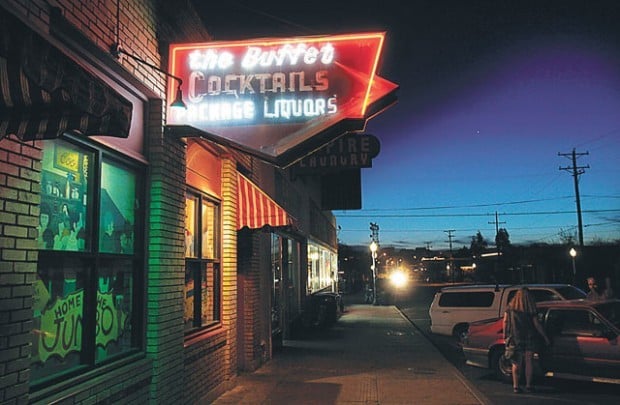
While not all of Tucson's neon signs qualify for historic status, all of them will brighten your day.
Here are several of our favorites, complete with historical nuggets supplied by the Tucson Historic Preservation Foundation.
The Buffet
538 E. Ninth St.
The Buffet, originally called Lantern Buffet, opened more than 75 years ago and claims to have remained at its original location longer than any other bar in Tucson. The neon sign out front is protected by a transparent cover.
Pueblo Hotel and Apartments
145 S. Sixth Ave.
The "diving girl" is mounted atop a vintage sign extolling the former Pueblo Hotel and Apartments' pool. The building has long since been renovated into law offices, and the pool has been filled in. But the neon diving girl still pulls people off the street. Says attorney Michael Piccarreta: "Periodically there's people coming in for rooms, and we have to tell them there's no vacancy."
Rincon Market
2513 E. Sixth St.
Ron Abbott bought Rincon Market nearly three years ago. He says the store's white neon sign has been around "probably since the 1950s." The letters are capitalized, outlined in white and separated by a painted sign that reads, "Since 1926."
The Shelter
4155 E. Grant Road
Kevin Breutzmann has owned The Shelter, Built circa 1963, for more than 10 years. Inside, John F. Kennedy's bust is immortalized on a giant plastic sign with blinking red teeth. Outside, the name of the bar is displayed prominently on top of the building in light-blue neon.
Tucson Inn
143 W. Drachman St.
The Tucson Inn was the largest and first two-story motel in Tucson when it opened in 1953 to fanfare with "bathing beauties," television broadcasts and tours. It featured a covered balcony around the second floor. The massive entrance sign, a Tucson icon, is illuminated at night.
Airport Control Tower
7005 S. Plumer Ave.
The Tucson Airport Authority opened its 11-story, $535,000 tower in October 1958. Then, as now, it sports a neon, vertical "TUCSON" sign that still welcomes passengers as they fly into the Old Pueblo. Recently, the authority announced plans to build a new control tower, but it insisted the old tower will remain intact.
Grill
100 E. Congress St.
In 1950, Minerva Café was remodeled and renamed to The Stag Grill, "Tucson's Newest Downtown Eating Place," serving 24 hours a day. By 1957, the business had been renamed the Rallis Grill. Today it's simply "Grill." Inside, a glowing red turkey in a baking pan illuminates the room. The roof sign reads "Cafe."
Mama Louisa's
2041 S. Craycroft Road
The restaurant was built on a dirt road leading to Davis-Monthan Air Force Base in 1956. Since 1973, it has been owned and operated by the Elefante family. Mama Louisa's neon sign has been around since the 1950s. It is maintained by Fluoresco Lighting and Signs, whose president is married to Tish Cassidy, the granddaughter of Mama Louisa Cassidy.
Rialto Theatre
318 E. Congress St.
In 2001, the Rialto Theatre received $61,000 to improve its facade. The new sign, with letters that blink, one at a time, replaced a 35-foot-tall art deco gold, blue and red neon "Paramount" sign that graced the front of the Rialto until it was condemned and torn down by the city in the mid-'80s.
Riviera Motor Lodge
515 W. Miracle Mile
The streamlined Moderne sign of the hotel, which opened in 1953, originally extended toward the road from a steel post that rose from a brick plinth in a small reflecting pool. The sign is now taller and projects away from the street. The courtyard retains its original palm trees and pool.
Caruso's Restaurant
434 N. Fourth Ave.
Caruso's was started in the 1930s by Nicasio "Caruso" Zagona and remains a family enterprise. Originally located a block away, Caruso's moved about 50 years ago when an August rainstorm washed the place away. The sign was designed to flash on and off, creating fork and pasta movement.
Fox tucson Theatre
17 W. Congress St.
Dimmed in 1974 after the theater closed out its 44-year run, the sign came tumbling down, literally, in February 1986. A replica sign went up in June 2002, and 200 people turned up for the relighting.
Frontier Motel
227 W. Drachman St.
The Frontier was built in 1941 in a 20th-century Revival style, with a 1965 addition at the rear. Ornamentation includes exposed red brick, carved wooden columns and red concrete floors. This property has remained intact and is a fine example of an early highway motor court. The original neon sign lighted up at night.
Ghost Ranch Lodge
801 W. Miracle Mile
Opened in 1941, the lodge was one of the first tourist accommodations along Miracle Mile. Tucson architect Josias Joesler designed the original eight buildings in his signature Spanish Colonial Revival style. Now the lodge and cactus garden are being restored and converted into housing for the elderly. Georgia O'Keeffe had a hand in the design of the sign, which is undergoing repairs.
Tiki Motel
2649 N. Oracle Road
The simplified pueblo deco complex opened in 1940 and featured exposed red brick buildings and attached carports. The original art deco sign was discarded in the mid-20th century when the property was renamed the Tiki Motel. It was replaced with a sign in the shape of a Polynesian war shield and mask outlined with neon.
Owl Lodge
2015 E. Benson Highway
In 1957, the cost of a week at the Owl Lodge was $18. Today it's $135. The sign out front no longer lights up. Owner Chuck Uhlig says he tried to fix the sign, but the birds had other ideas. "I spent $3,500 trying to get that thing up and going," he says, "and within 30 days, the pigeons had wrecked it again."

