

“I am Americana to the core
Rooted here from before before
An indigena’s face with a Spanish tongue,
I learned to say American when I was young.
I am a borderlander, an open wound,
Two flags torn and re-sewn, torn and re-sewn.
I am a fear of the unknown.
A third country marginalized,
Neither from the U.S. or Mexico in their eyes.”
— from “One Journey,” performed in Douglas-Agua Prieta in October 2016
Yadira De La Riva is a fronteriza, from neither here nor there.
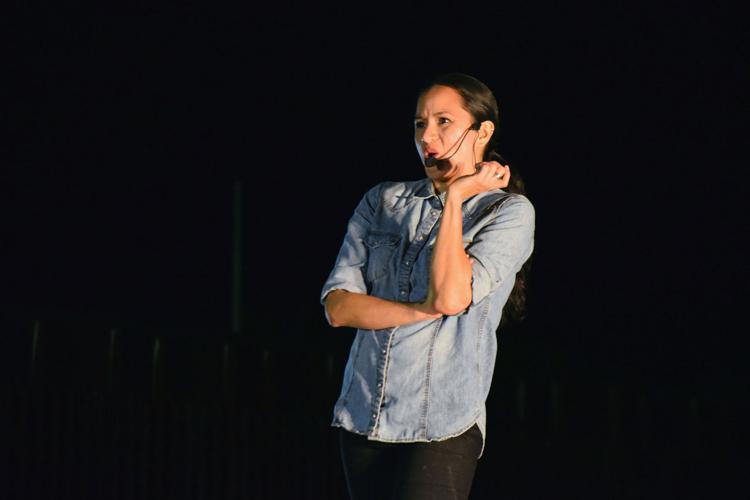
Born and raised in El Paso, Texas and Ciudad Juárez, Chihuahua, she is a proud product of the borderlands. An artist and performer, she wrote a one-woman play about coming of age in la frontera, or the border, weaving together personal experiences, family stories and the social and political history of the United States and Mexico.
Then, she took the show on the road from Brownsville, Texas, to San Diego, performing her story of border life and encouraging other borderlanders to tell their stories, too.
Theater-less
Life on the border is dynamic and culturally rich. It makes for a special type of people who can navigate two governments, two currencies, two languages and “two types of police,” De La Riva says.
But when she started to discover her own voice in theater, the artist and performer was disappointed to find that border stories weren’t being told on stage, and “much less by women.”
She started studying theater at the University of California-Santa Cruz, but despite her passion for theater she quickly bored of the Greek, classical and “very European” subject matter.
So she switched to American studies and acted at the university’s Rainbow Theater, where a diverse cast performed works that addressed social and political issues.
Around the same time, she fell in love with John Leguizamo’s solo show “Freak,” a partially imagined story about his life and the hilarious characters he encounters. Inspired, she decided to tell her own story in a single-voice play.
“I had a mentor who said if something doesn’t exist then you have to create it,” she says.
So she did.
One journey
Wherever she goes in the United States, people ask De La Riza where she’s from.
“I’ll say, ‘Well, I’m from … the desert land, vast and flat the palm of my hand, brown and rough like my hand when it’s dry. Why, I say I’m from long family parties and sun and moon ceremonies, drums beating in the distance.”
But those aren’t the answers people want. They want to know if she’s “American.”
Sharing tales about her family and piecing together the political history of the borderlands, De La Riva’s play uses characteristic elements of her border culture — the music, the Spanglish, the customs and the physical space, including the border wall.
“One Journey: Stitching Stories Across the Mexican ‘American’ Border,” was her master’s thesis at New York University’s Gallatin School of Individualized Study, built on the foundation of oral histories.
She dug up family stories beginning with her beloved grandmother, who migrated to Ciudad Juárez from Chihuahua City to help her family financially when she was just 16 years old. She crossed the border every day to work in El Paso as a maid.
“So she was already living that binational life as a teenager, and she was part of the movement of labor from Mexico to the United States,” De La Riva says.
The show reflects De La Riva’s experience as a border woman.
“You can’t talk about the border without talking about women. You just can’t,” she says.
Women are the workers in the maquiladoras, or cross-border factories. They are the victims of hundreds of killings, or femicides, in Juárez. They are the pillars of families and communities and social movements.
“But in terms of history or who’s telling the stories,” she says,” it’s hardly ever us.”
Women are, in many ways, erased from the common narrative of the border region, says Michelle Téllez, a University of Arizona professor who studies and writes about the border, community and gendered migration. When women are the subject of stories, they are often seen solely as “breeders” — the producers of children who are not wanted in the United States, demonstrated by terms like “anchor baby,” she says.
When De La Riva performed her play in border communities, it resonated. Audiences connected to the stories of family across the border; of not wanting to choose between being American or Mexican; of crossing the line to go to your grandma’s house or the doctor or the grocery store.
“I probably take more pride in saying I’m a fronteriza than I would to say I’m a Mexican-American or a Chicana or Latina. Those are such huge umbrella terms,” she said. “Fronteriza’s just a lot more specific to my experience and how I see the world.”
That identity extends beyond the U.S.-Mexico border. Working on a project in Spain and Morocco, she found that her experiences often mirrored those of the women who transport merchandise across the border each day.
“Spain and Morocco, Palestine and Israel, Haiti and the Dominican Republic, and so on and so on and so on,” she says. “So I’m also trying to expand what that identity means along this 2,000 mile divide for us on the U.S.-Mexico border, but also internationally.”
Sharing the stage
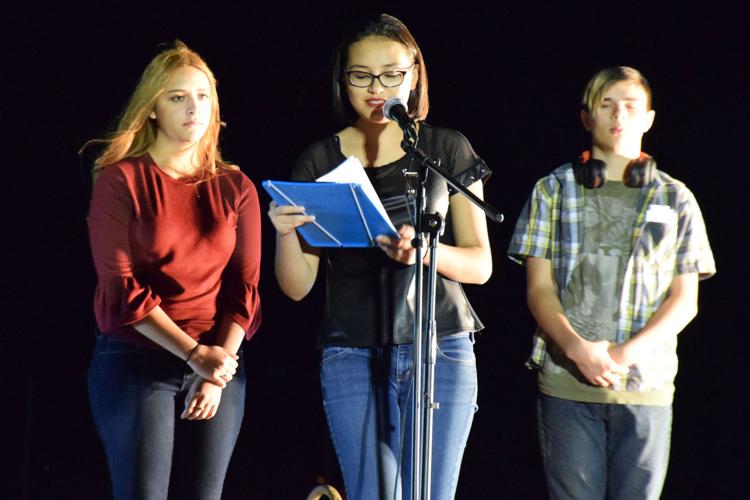
Kiara Morales Diaz steps up to the microphone.
“ La frontera no te divide. The border does not divide you. Nos mantiene juntos. It holds us together. This is my Agua Prieta, and this is my Douglas. My home.”
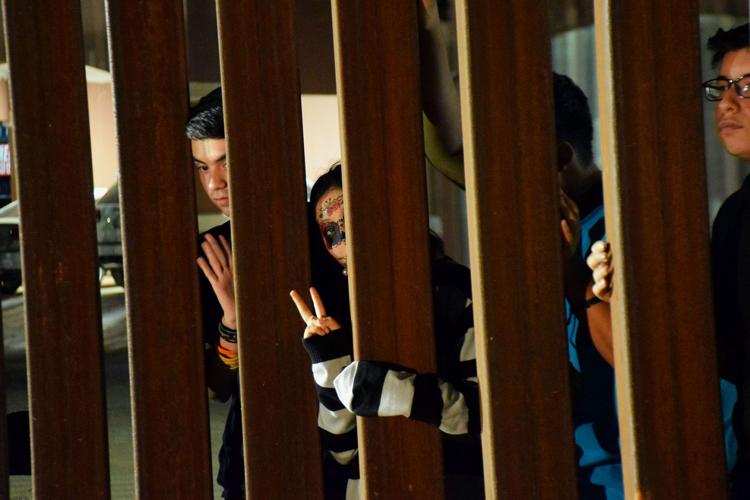
Morales is one of nearly 20 students in Douglas and Agua Prieta who stand on parallel stages divided by the 20-foot fence as they perform original works to an audience on both sides of the border.
The high school drama students performed with De La Riva as part of her two-week Arizona art residency with the Arizona Commission on the Arts AZ ArtWorker program and Arizona State University’s Performance in the Borderlands initiative.
Drawing inspiration from letters they wrote to each other from across the wall, the students wrote monologues, poems and skits about life on the border and their connections and separations from people on the other side.
“Art, the best language we can speak,” says Angel Ramírez, who teaches high school drama in Agua Prieta. “These kids don’t speak English, and many of the kids in Douglas don’t speak Spanish, but they still want to have these conversations and experiences together.”
For his students, just knowing that people in the United States came to hear their stories was the best part.
“We live in a small border town, cut off from opportunities to work with other artists, or to get attention from the outside world,” he says. “It has given them so much more motivation to keep working and performing.”
Social and political theater has a long history on the border and in Mexican-American culture, from El Teatro Campesino — founded by Luis Valdez in the 1960s to draw attention to the plight of migrant farm workers — to Tucson’s Teatro Libertad, which opened 1975 and performed pieces on contemporary social issues from racism and inequality to the economy and drug addiction.
Performing across the border fence added a new, and special, element.
“I’ve done the play in a lot of different spaces, and I divide the stage in half with a piece of tape,” De La Riva says. Being at the place itself was “intense and amazing.”
Theater isn’t the “end all be all” of activism and social change, she says, but it can be a good place to start, opening doors for new connections and a deeper understanding of the world, and of ourselves.
“Theater gave me a platform for my own voice. It allowed me to come together with other people, to learn about other people, learn about other’s histories, to see life through a creative lens,” she says. “So if it’s changed me, then hopefully it can change others too.”

