


The Beach Boys were supposed to be the first act to take the stage at the newly renovated Tucson Arena Saturday night, but in reality they were second.
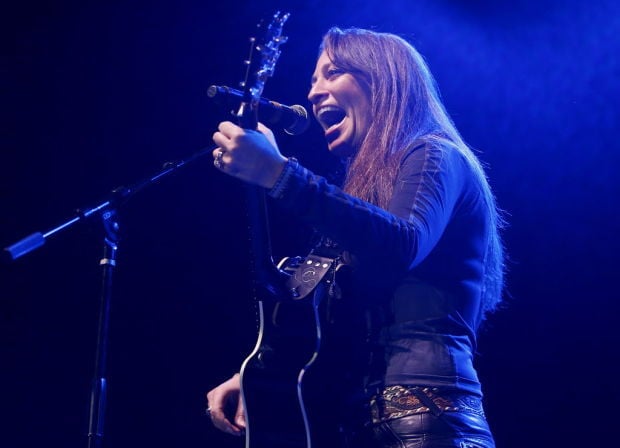
The first was Tucson’s own Grammy-nominated singer-songwriter, Linda Chorney, an artist who despite some pretty remarkable publicity after her improbable 2012 Grammy nomination is still largely unknown in the place she now calls home.
“I’m the first act at the Tucson Arena, and I’m opening for the Beach Boys!” the New Jersey transplant said as she launched into a four-song set that included the ironic ode “The Cantina,” a social statement on Arizona’s laws allowing you to carry a gun outside but not a beer.
Chorney may have started the night as an unknown act, but she ended it in Tucson’s history books — the musician who gave the arena’s new acoustics a test run that showed just what $8 million can buy you.
Those acoustics — crisp and clean without a hint of the annoying feedback and dead spots that plagued the old system — are at the heart of the arena’s new soul. Tucson Mayor Jonathan Rothschild said the renovated arena is now positioned to be on the radar of national touring acts.
“What you see here tonight gets Tucson back on the map to get big shows,” Rothschild said in a short speech sprinkled with Beach Boys puns including “Fun, Fun, Fun,” and “Good Vibrations.”
Bringing in the Beach Boys was the brainchild of Fletcher McCusker, head of the Rio Nuevo Board that spearheaded the arena-renovation project. McCusker, a big fan of the band, had hoped with the low ticket prices — $25 and $35 — they would be able to fill the arena.
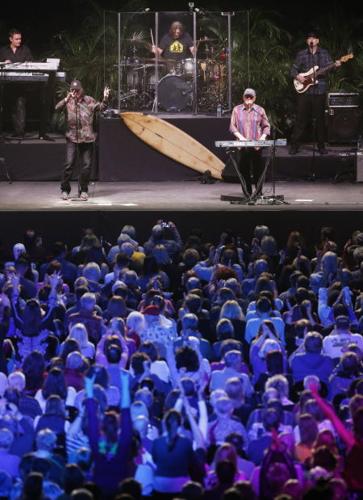
They fell disappointingly short of that goal. No numbers were released Saturday night, but it looked as if at least a third of the arena’s 9,000 or so seats were empty.
For those of us in those occupied seats, it was a comfortable spot to spend the concert’s three hours. The new seats are padded with cup holders, which surely led to far fewer spills than with the old seats.
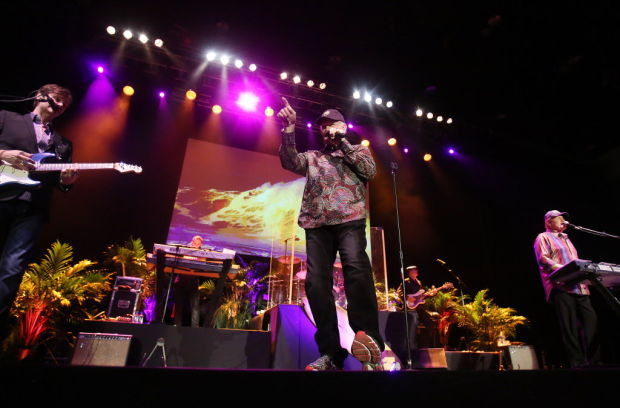
The Beach Boys featuring founding member Mike Love and Bruce Johnston, who has been around since nearly the beginning, performed for more than two hours. They brought out the band’s biggest highlights, hitting on all the 1960s themes that fueled the band through more than five decades: beach romps — “Surfin’,” “Surfin’ Safari,” “Surfer Girl,” “Goin’ to the Beach,” “Surfin’ U.S.A.,” “Catch a Wave”; car tributes — “Little Honda,” “Little Deuce Coup,” “Ballad of Ole Betsy”; and girls — “Help Me, Rhonda,” “California Girls,” “Barbara Ann,” “Then I Kissed Her.”
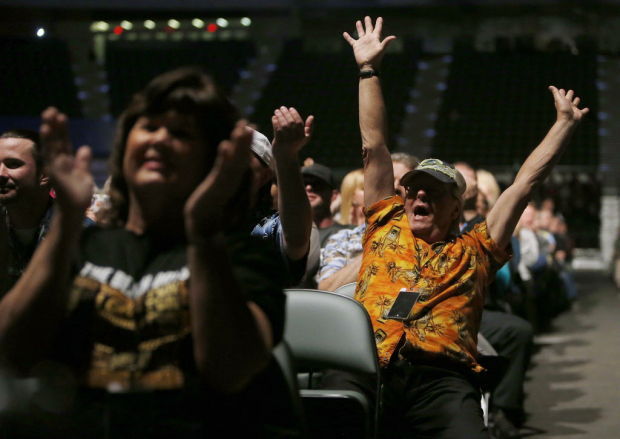
The audience, leaning heavily on the 50-plus demographic, was along for more than just test-driving the comfy new arena seats and checking out the sorely needed upgrades to the once-prisonlike restrooms. They grew up with the Beach Boys; this was their jam. They sang along, danced in their seats and in the aisles and pulled out their cellphone flashlights for the rare slow songs, including “God Only Knows,” featuring a video of the late Carl Wilson on lead vocals.
The improved acoustics highlighted Love’s thinning vocals, but none of that mattered. Saturday night was about reliving the past and looking forward to the future in an arena that holds the potential for many more big nights like this.

