


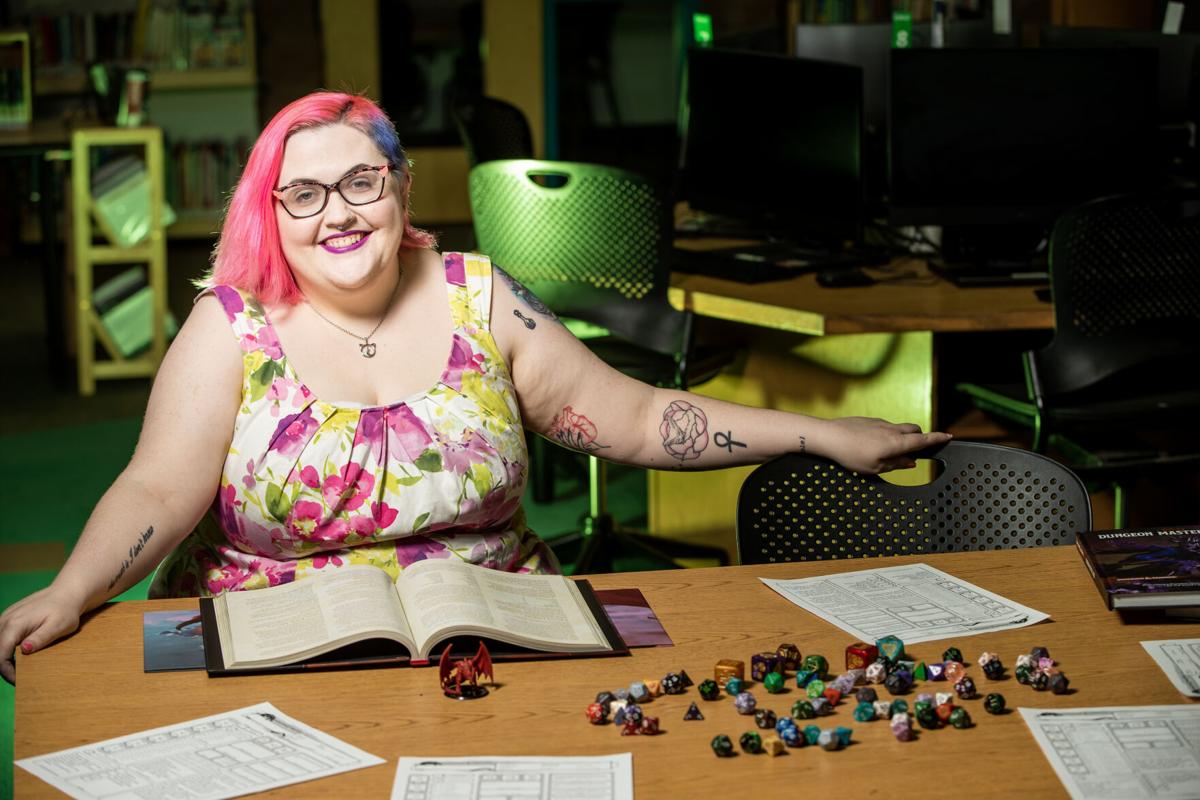
‘OK, so what I want to do is — if the wizard casts fire, right here,” one of my young patrons suggests excitedly, making a rough sketch in the air, “then I have oil in my bag, and I can dip my axe in it. I’ll throw it through the fire, and then it’ll set the bugbear on fire!”
Hearing this, I couldn’t believe my luck. I’d only been hosting Dungeons & Dragons for a few weeks, and already the kids were thinking collaboratively and creatively. As someone passionate about both libraries and tabletop role-playing games (like Dungeons & Dragons), I find that the keys to making each an enjoyable, safe experience are the same: freedom, choice and respect.
I grew up going to the library: Dusenberry-River Library, to be precise. I was a shy, imaginative kid, and that — combined with my mom’s efforts to get myself and my sister reading anything we set our eyes on — made me a voracious reader. I grew up on high fantasy; I loved living in the world of books, where magic and dragons and enchantments and curses were real, and the library is where I found that love.
Of course, it’s my love of fantasy that brings me to tabletop role-playing games like Dungeons & Dragons. I loved my fantasy books, but getting to play in a world I could inhabit with my friends breathed new life into me. Hosting games with my friends taught me a lot about how to be a good librarian. I just didn’t know it yet.
Tabletop role-playing games live and die on two things: imagination and participation. As the host, it was my job to create an environment where these were encouraged and rewarded. One piece of flawed but well-meaning advice given to game hosts is to never say no to their players. The idea is that if a player wants to do something cool but is repeatedly told no, they won’t feel like they can participate. And this is important to keep in mind — the player should be free to act in the way they choose. Especially when it’s something as cool and creative as my young patron’s fire idea.
The reason, however, that “never say no” is flawed advice is the third key: respect. Sometimes, a player wants to do something disrespectful to their peers, and it’s your job as the host to nudge the player in a different direction. No, you can’t hit another player, even in the game. But you can work together.
Really, the advice should be “never give a flat no.” Offering an alternative course of action keeps the player engaged; it allows them to course-correct instead of being rejected entirely while keeping the group cohesive.
Working with kids as a teen and tween librarian at Santa Rosa Library, 1075 S. 10th Ave., is very similar. Working with kids is amazing. As soon as school’s out, we get an influx of kids from the school next door, excited to tell us about their day. We have programs every day to help keep the kids occupied. In my first month working at the library, I decided mine would be Dungeons & Dragons.
It was a perfect fit. Once we got started, I had a core group of kids returning regularly, building on each other’s ideas, excited to come back to their safe place, the library, and their creative world in the game. Every day, one of my kids would ask me when the next D&D session is. I even had one young patron — the same one with the fire idea — tell me he’d started a D&D game at home.
At the end of the day, tabletop games and libraries do the same things: provide a space for kids and adults to safely explore their community and their creativity.
Tucson Landmarks: The Joel D. Valdez Main Library, located at 101 N. Stone Ave., is easily recognized by the red "Sonora" sculpture that stands tall in the front plaza. The Main Library is home to the Cele Peterson Arizona Collection and the Steinheimer Collection along with other resources available to the public. Video by Pascal Albright / Arizona Daily Star.

