

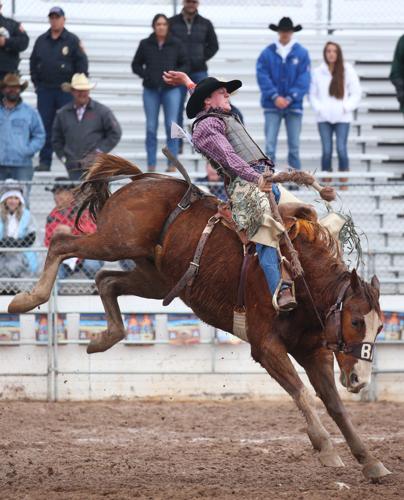

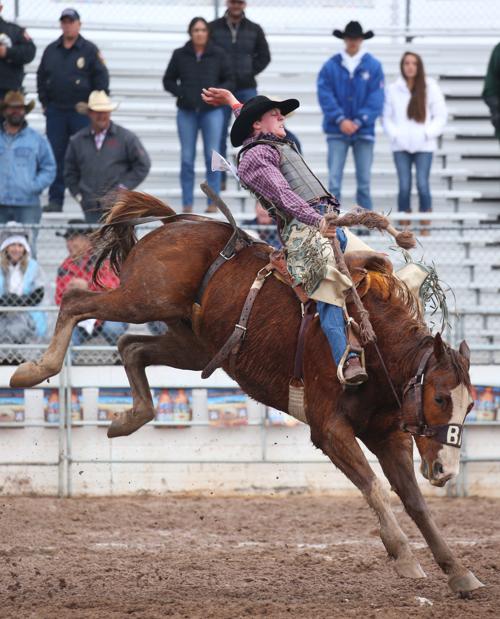
Each February, the corner of South Sixth Avenue and East Irvington Road becomes ground zero for boots, chaps, bulls, broncs and celebrating the spirit of the West.
Tens of thousands are expected to attend this year’s Tucson Rodeo, set to run from Saturday, Feb. 15, to Feb. 23 at the Tucson Rodeo Grounds, 4823 S. Sixth Ave.
Now in its 95th year, many of its attendees have been coming for years.
Here’s what you can expect:
The rodeo
Some of rodeo’s top national talent will be on hand to compete in this year’s Tucson Rodeo, one of the top 25 rodeos in the United States, according to the Professional Rodeo Cowboys Association.
Gates open at 11 a.m. most days, but the official competition runs from 2 to 4:30 p.m. Feb. 15-16 and Feb. 20-23 with a Coors Barn Dance after each session.
Come early and check out kids riding sheep, an activity referred to as “Mutton Bustin,’” buy a cowboy hat or a shiny new belt buckle at the on-site Western Market Place, or just people watch.
Tickets are $16-$29 Saturday, Feb. 15, and Sunday, Feb. 16; $21-$30 Thursday, Feb. 20, and Friday, Feb. 21; $22-$31 Feb. 22; and $24-$33 on Feb. 23, the day of the rodeo finals.
For a full schedule, visit tucsonrodeo.com.
The museum
Located on the grounds, the Tucson Rodeo Parade Museum boasts an impressive collection of more than 100 Old West-themed wagons and other horse-drawn vehicles on display.
Among its offerings, showcased in four separate buildings, are fringe-top surreys used in the filming of “Oklahoma,” Tucson’s first chemical fire wagon, circus vehicles and several wagons made by Frederick Ronstadt Wagon Works.
The museum’s regular hours are 9:30 a.m.-3:30 p.m. Mondays-Saturdays through April 4, but during the rodeo, the museum’s hours are 10 a.m.-1 p.m. Saturday, Feb. 15, through Wednesday, Feb. 19, and Feb. 21-Feb. 23. Admission is $12 with discounts available.

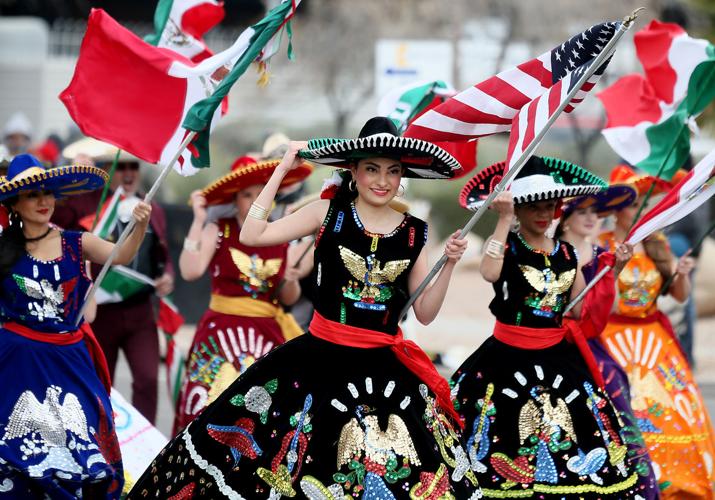
Members of the Miss Latino America float walk down Park Avenue during the annual La Fiesta de los Vaqueros Tucson Rodeo Parade in 2019.
The parade
Described as the longest non-motorized parade in the country, the Tucson Rodeo Parade got its start in 1925, and features an estimated 200 entries, mostly in wagons, rolling their way down south-side Tucson streets to the rodeo grounds.
Organizations, schools and businesses from all over Southern Arizona take part in the parade, which runs from East Ajo Way to South Park Avenue, South Park to East Irvington Road, then East Irvington to North Sixth Avenue.
You can park along the parade route on South Park Avenue for free or spring for grandstand seats along Irvington Road.
Grandstand seating is $10 for adults and $5 for children ages 12 and younger.
If you come to the parade, get there early. It starts at 9 a.m., but street closures generally begin at around 6:30 a.m. Die-hard fans will often camp along the route overnight to get a good spot.
Photos: Tucson Rodeo Parade through the years

1934 La Fiesta de los Vaqueros Tucson Rodeo Parade along Congress Street.

1936 Tucson Rodeo Parade coverage in the Arizona Daily Star

Little Cowpunchers riding in the 1939 Tucson Rodeo Parade. Victor Aros is in the front, left. Pete Aros is standing in the middle, the only one without a cowboy hat.

1940 Tucson Rodeo Parade at 6th Avenue and Alameda Street

The ever-popular Budweiser Clydesdales were in town in the 1940s for the Tucson Rodeo Parade. They made a stop at Jake's Liquor Store, located at the southeast corner of Meyer and Broadway. Jake's (for Jacobs) was owned by the Jacobs family. Edward C. Jacobs is second from left, and his dad, E.A. Jacobs, is third from left.

Tucson Rodeo Parade heading north on Stone Avenue from Pennington Street in 1949. The historic Pioneer Hotel is at upper right.

Photo of the Davis Monthan Air Force Base Wives at the 1950 Tucson Rodeo Parade. Pictured in the front of the parade is Geraldine Casey.

Budd Ramsey, at right, with the bulldogs, won a prize for the most unusual entry in the 1950 Tucson Rodeo Parade. This photo was taken at Scott Avenue and 12th Street.

William Boyd as cowboy Hopalong Cassidy rode in the Tucson Rodeo Parade in 1951.

Crowds at Stone and Alameda in downtown Tucson for the 1951 La Fiesta de los Vaqueros Tucson Rodeo Parade

1953 Rodeo Queen Dianne Moore of the La Fiesta de los Vaqueros Tucson Rodeo and Parade

The 1953 St. Mary's float for La Fiesta de los Vaqueros Tucson Rodeo Parade featured nuns and nuns dressed as Native Americans.

Copy of Historic Tucson Daily Citizen. The headline reads: "Record crowd sees Tucson Rodeo Parade" on Feb. 23, 1956.

The Alice Vail Jr. High School band, which was judged best in the category, heads along West Pennington Street between Stone and Church avenues in 1959 during the Tucson Rodeo Parade.
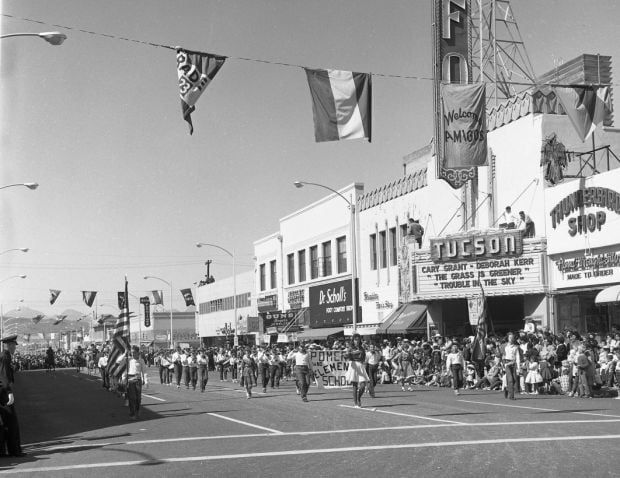
The Pomeroy Elementary School band marches along Congress Street in front of the Fox Theater during the 1961 Tucson Rodeo Parade.

Parade watchers with their 35mm rangefinder cameras and 8mm film movie cameras at the 1961 Tucson Rodeo Parade in downtown Tucson.

Parade watchers hold in the chill morning air during the 1961 Tucson Rodeo Parade in downtown Tucson.

An adult keeps a boy at a safe distance during the 1961 Tucson Rodeo Parade on Stone Avenue in downtown Tucson.
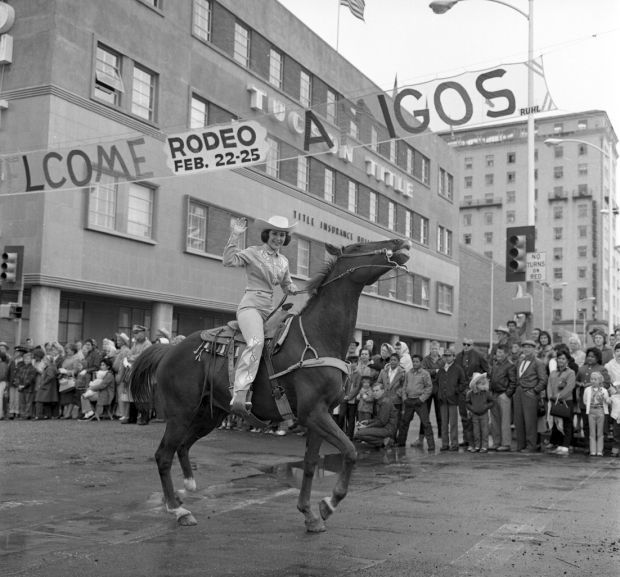
The 1962 Tucson Rodeo Parade.

The aftermath of the 1962 Tucson Rodeo Parade in downtown Tucson.

Mariachis march in the 1962 Tucson Rodeo Parade in downtown Tucson.
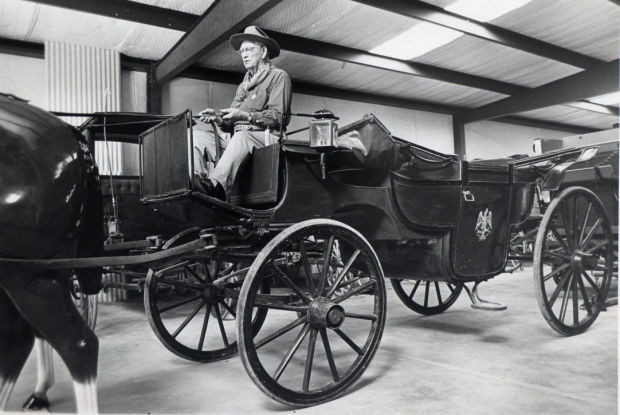
Feb. 26, 1968: Tucson Rodeo Parade equipment custodian Harry Blacklidge, 85 years old and Tucson-born, takes over the reins of the artificial horses hitched to the famous Maximilian coach as its storage site at the Parade Museum.

A young spectator blows a plastic horn as the San Xavier Women's Club entry approaches during the 1971 La Fiesta de los Vaqueros Tucson Rodeo Parade

Feb. 24, 1971: Mr. and Mrs. Otto R. Eicher (in noose) were welcomed to Tucson's Fiesta de los Vaqueros in traditional western style, as the city's Vigilantes and Barbara Bell, a rodeo princess, told them to reach for the sky on Interstate 10 and stick around for five days, courtesy of the City of Tucson and Tucson Jaycees. The Eichers, from Sandusky, Ohio, were selected at random.

Coed Quadrille precedes the University of Arizona Marching Band during the Tucson Rodeo Parade downtown in 1971.

Some things never change: These enthralled young rodeo fans were lined up along the Rodeo Parade route in 1972.

The rodeo parade snakes its way south on Church Avenue, turning east on Cushing Street in 1972. The then-new central fire station is at right. Empty lots in the upper left have been filled with the La Placita office complex and the Superior Court complex.

The Pride of Arizona, University of Arizona Marching Band, during the 1973 La Fiesta de los Vaqueros Tucson Rodeo Parade

A crowd estimated at 200,000 turned out for the 1976 La Fiesta de los Vaqueros Tucson Rodeo Parade.

Members of the U.S. 5th Calvary Troop A ceremonial regiment warms themselves by the fire before the 1976 La Fiesta de los Vaqueros Tucson Rodeo Parade

A Las Vegas Casino stage coach entry passes by the "new" La Placita Village office complex on Church Avenue during the 1977 La Fiesta de los Vaqueros Tucson Rodeo Parade.

Former Gov. Jack Williams, shown in the 1978 Tucson Rodeo Parade, is among the many dignitaries who have ridden in the "Maximilian coach." The century-old vehicle has been the subject of tall tales and controversy since it was acquired by the Tucson Rodeo Parade Committee in 1932.

It was a rainy and windy day in 1983 as the parade made its way along Pennington Street. Because of the tight quarters downtown, the route was moved to South Park Avenue in 1991.

A wagon driver of the Young Explorers School entry struggles to control spooked horses during the 1986 La Fiesta de los Vaqueros Tucson Rodeo Parade. A second wagon veered into the crowd, injuring at least one person.

The La Fiesta de los Vaqueros Tucson Rodeo Parade turns the corner from 5th Avenue to 12th Street, north of Armory Park. Note the old National Guard armory building on the left side of the park. It was demolished to make way for the senior center. Also, 5th Avenue used to pass directly in front of Safford School. It now dead ends there.

