


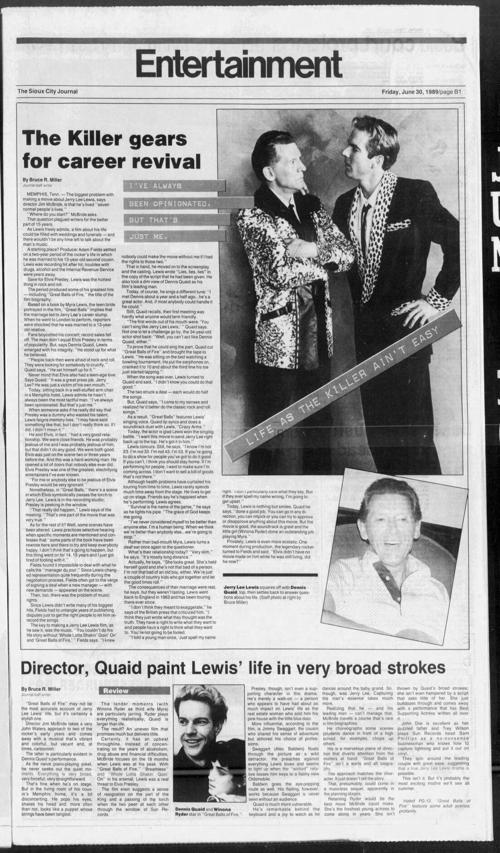
EDITOR'S NOTE: In 1989, the Jerry Lee Lewis film, "Great Balls of Fire" was released. Bruce Miller talked with Lewis, Dennis Quaid and others related to the film. Here's the story that appeared June 30, 1989, in the Sioux City Journal.
MEMPHIS, Tennessee – The biggest problem with making a movie about Jerry Lee Lewis, says director Jim McBride, is that he’s lived “seven normal people’s lives.”
“Where do you start?” McBride asks.
The question plagued writers for the better part of 15 years.
As Lewis freely admits, a film about his life could be filled with weddings and funerals – and there wouldn’t be any time left to talk about the man’s music.
A starting place? Producer Adam Fields settled on a two-year period of the rocker’s life in which he was married to his 13-year-old second cousin. Lewis was recording hit after hit; troubles with drugs, alcohol and the Internal Revenue Service were years away.
Save for Elvis Presley, Lewis was the hottest thing in rock and roll.
The period produced some of his greatest hits – including “Great Balls of Fire,” the title of the film biography.
Based on a book by Myra Lewis, the teen bride portrayed in the film, “Great Balls” implies that the marriage led to Jerry Lee’s career slump. When he went to London to perform, reporters were shocked that he was married to a 13-year-old relative.
Fans boycotted his concert; record sales fell off. The man didn’t equal Elvis Presley in terms of popularity. But, says Dennis Quaid, who plays him in the film, Lewis emerged with his integrity. “He stood up for what he believed.
“People back then were afraid of rock and roll. They were looking for somebody to crucify,” Quaid says. “He set himself up for it.”
Never mind that Elvis also had a teenage love. Says Quaid: “It was a great press job. Jerry Lee? He was just a victim of his own mouth.”
Today, sitting back in a well-stuffed armchair in a Memphis hotel, Lewis admits he hasn’t always been the most tactful man. “I’ve always been opinionated. But that’s just me.”
When someone asks if he really did say that Presley was a dummy who wasted his talent, Lewis feigns memory loss. “I may have said something like that, but I don’t really think so. If I did, I didn’t mean it.”
He and Elvis, in fact, “had a very good relationship. We were close friends. He was probably jealous of me and I was probably jealous of him, but that didn’t do any good. We were both good. Elvis was just on the scene two or three years before me. And this was a hard-working man. He opened a lot of doors that nobody else ever did. Elvis Presley was one of the greatest, most electrifying entertainers I’ve ever known.
“For me or anybody else to be jealous of Elvis Presley would be very ignorant.”
Nonetheless, in “Great Balls,” there’s a scene in which Elvis symbolically passes the torch to Jerry Lee. Lewis is in the recording studio; Presley is peeking in the window.
“That really did happen,” Lewis says of the meeting. “That’s one part of the movie that was very true.”
As for the rest of it? Well, some scenes have been altered. Lewis practices selective hearing when specific moments are mentioned and confesses that “some parts of the book have been rewrote here and there to try and keep everybody happy. I don’t think that’s going to happen, but this thing went on for 14, 15 years and I just got tired of fooling with it.”
Fields found it impossible to deal with what he calls the “manager du jour.” Since Lewis changed representation quite frequently during the negotiation process, Fields often got to the verge of signing a deal when a new manager – with new demands – appeared on the scene.
Then, too, there was the problem of music rights.
Since Lewis didn’t write many of his biggest hits, Fields had to untangle years of publishing disputes just to get the right people to let him re-record the songs.
The key to making a Jerry Lee Lewis film, as he saw it, was he music. “You couldn’t do his life story without ‘Whole Lotta Shakin’ Goin’ On’ and ‘Great Balls of Fire,’” Fields says. “I knew nobody could make the movie if I had the rights to those two.”
That in hand, he moved on to the screenplay and the casting. Lewis wrote, “Lies, lies, lies,” in the copy of the script that he had been given. He also took a dim view of Dennis Quaid as his film’s leading man.
Today, of course, he sings a different tune: “I met Dennis about a year and a half ago…he’s a great actor. And if most anybody could handle it, he could.”
Still, Quaid recalls, their first meeting was hardly what anyone would term friendly.
“The first words out of his mouth were, ‘You can’t sing like Jerry Lee Lewis,’” Quaid says. Not one to let a challenge go by, the 34-year-old actor shot back: “Well, you can’t act like Dennis Quaid, either.”
To prove that he could sing the part, Quaid cut “Great Balls of Fire” and brought the tape to Lewis. “He was sitting on the bed watching a bowling tournament. He put the earphones on, cranked it to 10 and about the third line his toe just started tapping.”
When the song was over, Lewis turned to Quaid and said, "I didn’t know you could do that good.”
The two struck a deal – each would do half the songs.
But, Quaid says, “I came to my senses and realized he’d better do the classic rock and roll songs.”
As a result, “Great Balls” features Lewis’ singing voice. Quaid lip syncs and does a soundtrack duet with Lewis, “Crazy Arms.”
Today, the actor is glad Lewis won the singing battle. “I want this movie to send Jerry Lee right back up to the top. He’s got it in him.”
Lewis concurs. Still, he says, “I know I’m not 23. I’m not 33. I’m not 43. I’m 53. If you’re going to do a show for people, you’ve got to do it good. If you can’t, I think you should stay home. If I’m performing for people, I want to make sure I’m coming across. I don’t want to sell a bill of goods that’s not there.”
Although health problems have curtailed his touring from time to time, Lewis rarely spends much time away from the stage. He lives to get up on stage. Friends say he’s happiest when he’s performing. Lewis agrees.
“Survival is the name of the game,” he says as he lights his pipe. “The grace of God keeps me going.
“I’ve never considered myself to be better than anyone else. I’m a human being. When we think we’re better than anybody else…we’re going to stop.”
Rather than badmouth Myra, Lewis turns a deaf ear once again to the question.
What’s their relationship today? “Very slim,” he says. “It’s mostly long distance.”
Actually, he says, “she looks great. She’s held herself good and she’s not that bad of a person. I’m not that bad of an old boy, either. We’re just a couple of country kids who got together and let the good times roll.”
The consequences of their marriage were real, he says, but they weren’t lasting. Lewis went back to England in 1963 and has been touring there ever since.
“I don’t think they meant to exaggerate,” he says of the British press that criticized him. “I think they just wrote what they thought was the truth. They have a right to write what they want to. You’re not going to be fooled.
“I told a young man once, ‘Just spell my name right.’ I don’t particularly care what they say. But if they ever spell my name wrong, I’m going to get upset.”
Today, Lewis is nothing but smiles. Quaid, he says, “done a good job. You can go in any direction, you can nitpick or you can try to approve or disapprove anything about this movie. But the movie is good, the soundtrack is great and the little girl (Winona Ryder) done an outstanding job playing Myra.”
Privately, Lewis is even more ecstatic. One moment during production, the legendary rocker turned to Fields and said, “Elvis didn’t have no movie made on him while he was still living, did he now?”

