


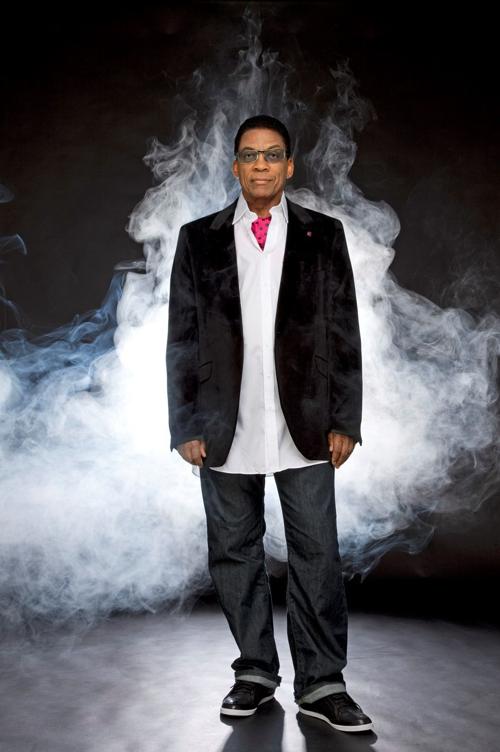
The restless creativity of jazz keyboardist Herbie Hancock has never been still, has never been about what everybody else wanted. During his six decades of barrier-breaking jazz recordings, performances and awards — including 2016’s Grammy Lifetime Achievement honor — the eclectic musician has always been whatever he wants to be.
So it is no surprise that Hancock brings his quintet to Centennial Hall at the University of Arizona on Tuesday, March 6, promising a concert experience much different from the usual Greatest Hits stroll down Memory Lane.
“For about six months I’ve been touring some, while also working on my new album,” said Hancock in his Los Angeles recording studio. “It seems like both have been affecting each other. It feels like my concert was being shaped the way a song should be shaped.”
Hancock starts sounding a little abstract, describing how parts of songs in his show are blended in different ways to create unexpected conjunctions he calls “episodes,” with twists and interruptions woven into longer forms more like a movie soundtrack, where specific moments are always part of something larger.
“A familiar song might play for a short time, then be interrupted by another song. Sometimes it’s like I’m interrupting myself,” he explained, chuckling.
“Everything about the business has changed so much,” the affable artist continued. “Times are so different now. Nobody buys CDs anymore — and recordings aren’t collections of songs meant to sell albums.”
Hancock’s signature hit, “Watermelon Man,” was first recorded in 1962 on his debut album “Takin’ Off.” Several months later the song was covered by Mongo Santamaria as a pop single on his own album “Watermelon Man.” Santamaria’s simplified version became a Top Ten radio hit in 1963.
However, Hancock became a certified pure jazz fixture throughout the 1960s, working as a member of the Miles Davis Quintet from 1963-1969. At the same time, his solo albums recorded on the side included the milepost “Maiden Voyage” (1964) and acquired the label “post-bop.”
By the early 1970s Hancock became discouraged with the lack of interest in avant-garde jazz. Waves of new electronic instruments were being invented quicker than you could say Nikola Tesla. Hancock wanted in.
In 1973 he introduced a new electronic band, the Head Hunters, filled with outer-space sounds, deep whumps and odd time signatures, but also a propulsive sound critics called “earthy” and “funky.” Hancock never looked back. Neither did his new generation of fans.
Several rambunctious albums followed. Was it dance music? Was it jazz? All that rich creativity in a time of very tense pop culture agitation struck gold in 1983 when the release of “Future Shock” and the single “Rockit” with its mind-bending automaton video, became an MTV instant classic.
Hancock was also composing scores for several movies in the 1990s, including the award-winning “Round Midnight.” More explorations swept his music into the new millennium as Hancock’s studio work edged closer to pop.
In 2008 he devoted an album to the songs of Joni Mitchell in “River: the Joni Letters” recorded with a more traditional sound and several vocalists, including Mitchell. It won Grammys for best album and best jazz album.
“The ages in my audience vary widely, which is a good thing, but I can’t begin to cover everything in one night,” said the ageless Hancock. “So I put together these episodes instead of songs. The way the merge makes the show a little more like life — both have lots of surprises.”

