



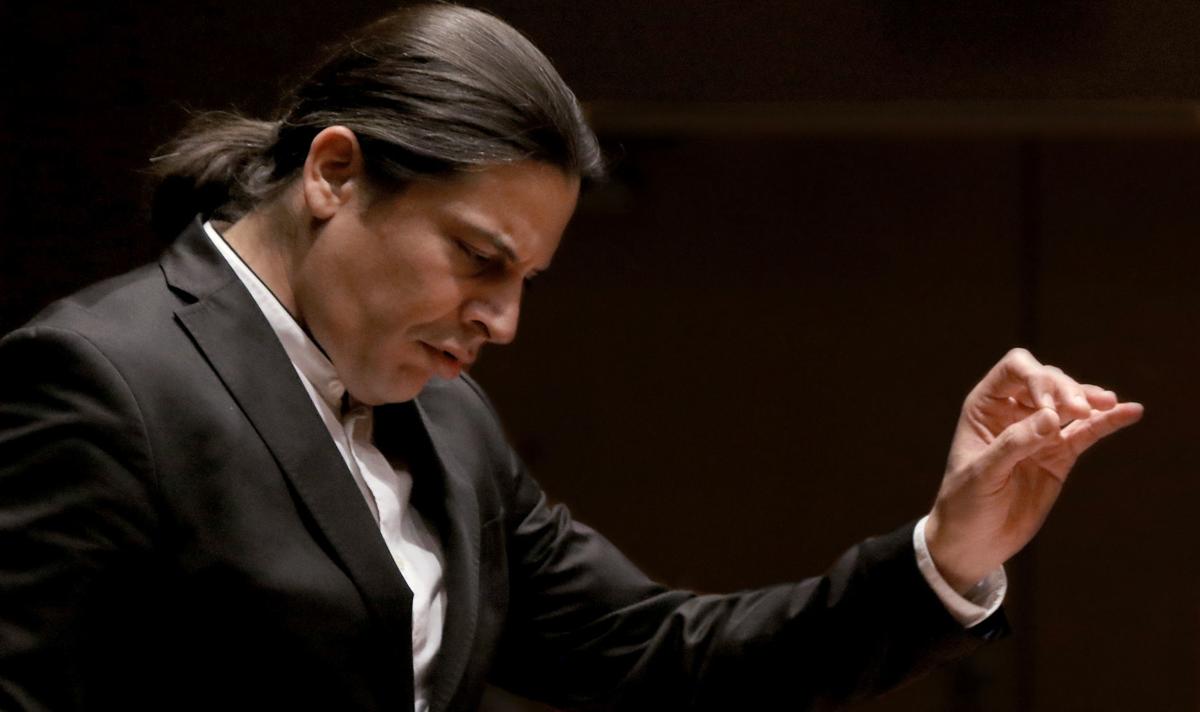
The Tucson Symphony Orchestra continues its season of Beethoven this weekend with a symphonic two-fer: Beethoven’s Symphonies No. 8 and No. 2.
“Beethoven x 2” brings the orchestra, under the baton of Music Director José Luis Gomez, closer to its goal of performing all but one of Beethoven’s nine symphonies in honor of the 250th anniversary of his birth. Gomez left off No. 9, the choral symphony, because the orchestra performed it in spring 2018.
Gomez will complete the cycle in February with Nos. 1 and 6 on Feb. 14 and No. 3 on Feb. 28.
Here’s a little tutorial on Beethoven’s 8 and 2 to give you a leg up on the concert, part of the TSO’s MasterWorks series on Saturday, Jan. 11, and Sunday, Jan. 12, at Catalina Foothills High School.
Symphony No. 8: Composed in 1812, premiered in 1814
Beethoven liked to call this “my little Symphony in F,” largely because he wanted to distinguish it from Symphony No. 6, also composed in the F key.
But it also is among his most light-hearted symphonic writing. There’s a float-on-air brightness to the piece, especially in the first movement, which has some rumble and rock beneath its joy-filled surface. But that is not to regard this as sugary symphonic fluff; there’s heft in the final movement that ends with a rare and wonderful Beethoven wink-wink: a prolonged passage that Tchaikovsky famously dubbed one of Beethoven’s “greatest symphonic masterpieces.”
The four-movement No. 8 clocks in at 26 minutes.
Symphony No. 2: Composed in 1801-02, premiered in 1803
Picture it: Beethoven was coming to terms with the notion that his deteriorating hearing was likely going for good when he penned the Second Symphony. He also flirted with the idea of suicide, expressed in an unsent letter to his brothers titled the “Heiligenstadt Testament.” So you would expect his composing would reflect utter despair bordering on desperation, possibly futility.
And yet, French composer Hector Berlioz saw beyond the angst to the playful core of the Second. He wrote decades later that “everything is noble, energetic, proud.”
NPR, in a 2006 interview with conductor Christoph Eschenbach (Philadelphia Orchestra, National Symphony Orchestra), quoted Berlioz’s effusive review of the symphony, with Berlioz calling the opening Adagio molto “a masterpiece;” the Larghetto “a ravishing picture of innocent pleasure which is scarcely shadowed by a few melancholy accents;” the Scherzo a glimpse into Beethoven’s optimism — “The composer still believes in immortal glory, in love, in devotion. What abandon in his gaiety! What wit! What sallies!” — and the Allegro molto finale, calling it “of like genius.”

