

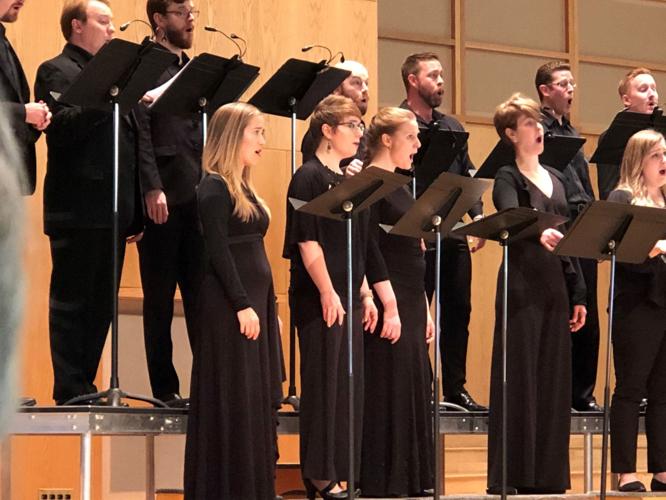

Eric Holtan peered over the heads of the audience Sunday afternoon looking for the woman of the hour.
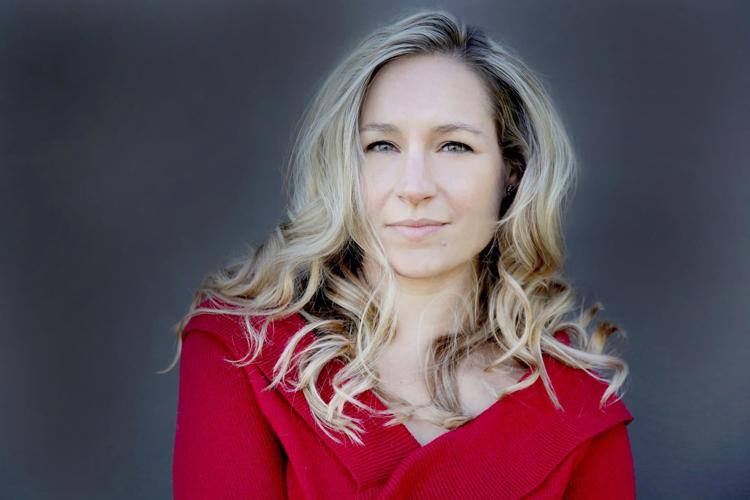
When he spotted Jocelyn Hagen, he motioned for her to join him and his True Concord Voices & Orchestra on the St. Andrew’s Episcopal Church stage.
Hagen shimmied through the throng, which was standing and applauding, and moments later was on stage taking a well-deserved bow as the audience showered her and the musicians with applause for their performance of her choral symphony “The Notebooks of Leonardo da Vinci.”
To simply call “Notebooks” a choral symphony, however, would do it serious injustice. “Notebooks,” a multimedia work that uses the new and sophisticated digital video sync software Musèik, is one of those works that will stick with you long after you leave the concert hall.
The piece opens with a solitary flute — performed Sunday by the very fine flutist Alexander Lipay — playing as a hand projected on two large screens on stage writes. When Lipay paused, the writing stopped. When Lipay upped the tempo, the hand sloppily scribbled out a line as if the writer was rethinking his thoughts.
When the strings and harp joined in, the handwriting became more fluid. Lines filled the page, then hand-sketched images of da Vinci’s inventions mixed in with his writings, page after miraculous page in his hand. It’s as if Hagen, using actual pages from the Renaissance inventor, writer, scholar and genius’s diary, invited us into his head as all this incredible creating was unfolding.
Hagen crafted “Notebooks” in nine movements with a libretto that borrows heavily from da Vinci’s writings, exploring the duality of spiritual and nature. The music goes from western classical in “Painting and Drawing,” which describes a painting as “a poem seen but not heard,” to thunderous contemporary bordering on a rock opera in “The Vitruvian Man,” a long recitation defining the human form that was powerfully performed by the choir.
“Nature” had cinematic flashes while “Perception,” with its singular thought — “All our knowledge has its origin in our perceptions” — showcased the choir’s muscular harmonies.
“Notebooks” closes with perhaps its most powerful exclamation “Look at the Stars,” a heart-stopping romp of crashing percussion and cinematic flourish, with the chorus prolonging the high note in the final line “Wisdom is the daughter of experience” before returning to the opening salvo “Oh Time! Oh Time! Oh Time!” with a sense of urgency and pleading. It was heart-stopping.
True Concord was among at least 20 ensembles to co-commission “The Notebooks of Leonardo da Vinci” to mark the 500th anniversary of his death. True Concord is one of the first to perform the piece, which had its premiere in Hagen’s native Minneapolis, Minnesota, last March.
True Concord Music Director Eric Holtan paired Hagen’s symphony with Mozart’s “Solemn Vespers,” featuring a quartet of superb soloists: baritone Matthew Goinz, tenor Patrick Muehleise, mezzo-soprano Kimberly Leeds and soprano Erika Burkhart.
Leave it to Mozart to add a little zing in what traditionally is a more sobering subject, all-night prayers. The choir sang the amens with the gusto of alleluias and performed the 25-minute piece with a mix of solemn intensity and infectious energy. And while all four soloists were wonderful — baritone Goinz had this lovely burnished tone, Muehleise’s tenor was soft and inviting and Leeds showcased richly shaded overtones to her range — Burkhart stole the afternoon.
Her range is spectacular, from dusky lower notes to soaring impossibly high notes that lingered until she pulled them back to the midrange of her soprano with such glorious nuances. In the closing “Magnificat” movement, which put the spotlight back on the choir, Burkhart sang the final amen and someone — not sure if it was from the audience or someone on stage — let out a audible “whoa.”
“Whoa” indeed.

