

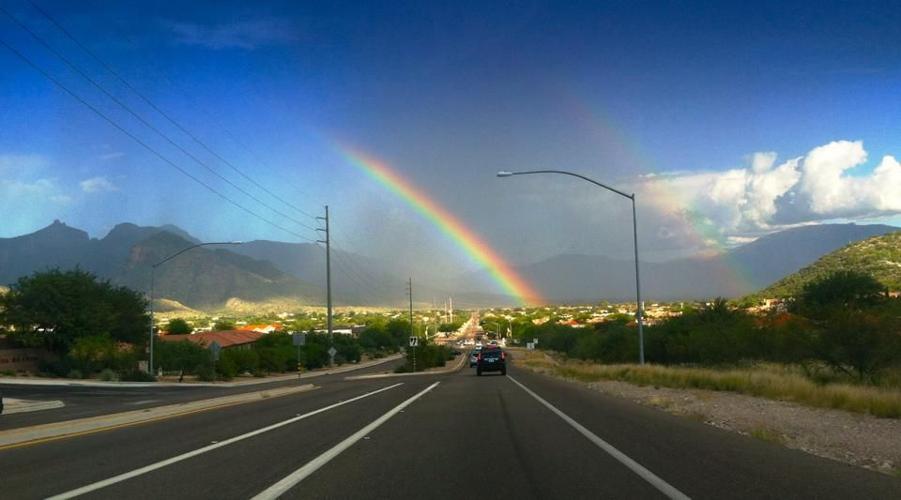
Along with the beloved moisture in the desert when it rains, we sometimes have beautiful rainbows.
As we enjoy the monsoon this summer we'll likely have many opportunities to see them, usually by looking to the east. Why the east? Because we can only view rainbows with the sun at our backs, since the phenomenon is essentially a retro-reflective one.
And, because our summer rains frequently happen late in the afternoon, when the sun will be in the western sky.
Rainbows also occur even when it doesn't rain, in dews and mists, fogs and clouds. It happens when sunlight interacts with water droplets – of any kind.
By investigating the almost magical rainbow you'll have a better appreciation of this spectra-cular phenomenon.
What are some related phenomena?
There are many, but three closely related ones are:
• Dewbows are rainbow forms sometimes seen on golf courses or lawns by early risers. The droplets of dew perform the refraction and reflection, but these are rare. Dew drops are usually hemispheric because of the attraction of the grass blades on the back of the droplet. But sometimes they cooperate. Other bows are formed in the mists of falls, notably Niagara and Victoria.
• Glories, like rainbows, appear opposite from the sun. The light is refracted and divided into colors and returned exactly from where it came. That is why it appears around the head of a person or surrounding the silhouette of a plane. Glories are not easy to describe and are not completely understood. Glories are so named since they mimic the halos one sees in the pictures of saints.
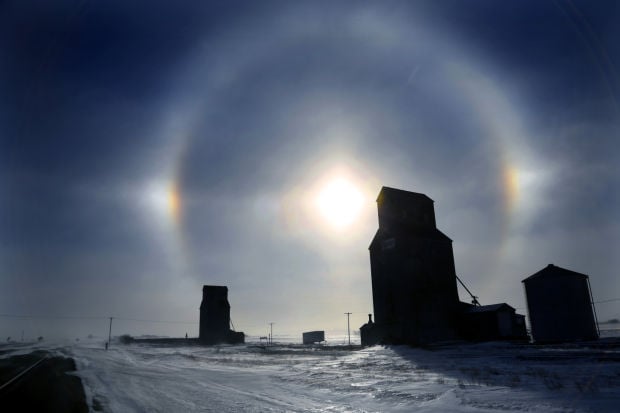
• Sun dogs are created by the refraction of sunlight by hexagonal crystal plates of ice in the atmosphere. They are typically about 22 degrees on each side of the sun at the same altitude, usually when the sun is low in the sky. The photo shows a sun dog over Erie, Colorado. The sun is behind the clouds to the left. The origin of the name is not clear; the scientific name is parhelia, or beside the sun. They are part of many halos formed by different interactions between sunlight and atmospheric ice crystals.
Other less closely related atmospheric effects of light in the Southwest include our blue skies — much bluer than in the East, and our red sunsets — much better than in the East. Additionally, there are the green flash, mirages, atmospheric refraction, the apparent very large harvest moon and others.
Is there a pot of gold at the end of the rainbow?
Of course not. You cannot get to the end of the rainbow; it will just keep moving. There is also no can of oil or a heart or a brain 'Somewhere Over the Rainbow.' There are many legends about this beautiful arc in the sky. It is written in Genesis that God promised Noah there would be no more floods and this was the sign.
The Greeks thought Iris used it as a bridge from heaven to Earth. It was a marvel and a sign of the gods to the ancient Mayans, the Australians, the Danes and others.
How does a rainbow form?
The rainbow is formed when (almost) white light from the sun enters water droplets, which are essentially spherical. Sunlight enters, shown to the right as the white ray. It is then refracted by the surface of the droplet and divided into colors - the way a prism does. Then the rays reflect off the back of the droplet, go to the front and are further refracted as they exit to return to the viewer's eye.
How are different colors created?
The light of the sun is divided into its component colors by the rain droplets because each color is refracted by the water in a slightly different amount.
There is a continuous change in this bending and a continuous distribution of colors in the incoming light. That means a virtual infinity of different colors, although we cannot discern them.
Many of us learned ROYGBIV (red, orange, yellow, green, blue, indigo and violet) for the colors, but that is only a mnemonic, probably coined by Isaac Newton, who first demonstrated this kind of spectrum. It is more like deep red, middle red, not quite so red, a little less than not quite so red, orangish red….
Is the color order always the same?
The colors are always in the same order with red at the top of the rainbow, although they may be reversed if there are reflections involved creating a secondary rainbow. The blue colors are bent (refracted) more than the other colors because they are higher frequency waves. Thus, the colors change from blue to red because the frequency of the waves continuously decreases along with the amount of interaction and refraction.
Sometimes we see a second rainbow. Why?
The secondary rainbow is formed in much the same way as the common, primary rainbow. It arises from a ray meeting the droplet even lower, refracting and then reflecting twice. This rainbow has the opposite arrangement of colors with the blues on top because there are two reflections in the back of the droplets. It is also dimmer as a result of the two reflections.
Very rarely do we see the tertiary (third) rainbow.
When we do the colors will be reversed again – back in the same order as the primary.
William L. Wolfe, professor emeritus at the University of Arizona College of Optical Sciences, has contributed to space programs, military defense and commercial applications during his career in infrared optics. This piece was written in conjunction with the United Nation's International Year of Light. Contact him at foxiewolfe@comcast.net

