


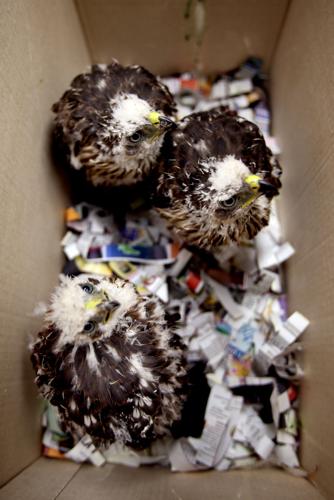
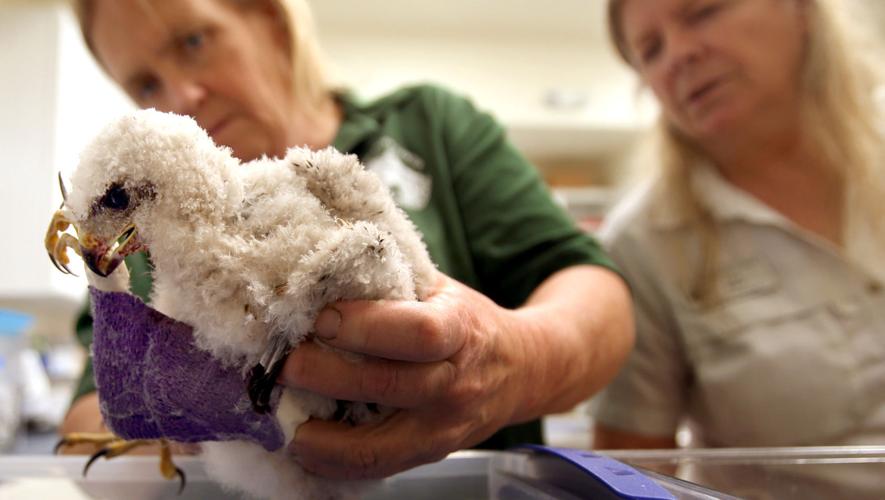

Hundreds of fledgling Cooper’s hawks have abandoned their nests, apparently because of recent extreme heat in the Tucson area, and a few of the young birds have died, says the executive director of the Tucson Wildlife Center.
“We’ve had more than 2,000 calls over the past four days from people who have found young hawks out of their nests and on the ground,” said Lisa Bates, a founder and executive director of the nonprofit center. “We’ve examined more than 200 young Cooper’s hawks at the center’s hospital. Some have been released, but many are being treated for injuries associated with jumping out of their nests or heat-related ailments.”
Bates said some of the young birds have died, but she didn’t have an estimate as to how many.
“A man brought one in yesterday, and it died coming through the door,” she said. “A couple more have died of heatstroke and fractures from falling.”
State wildlife officials say they also have received many calls about fledgling Cooper’s hawks that have left their nests.
“I personally checked on one yesterday, but by the time I got there it had died,” said Mark Hart, a spokesman for the Arizona Game and Fish Department. “We suspect that jumping the nest is related to the high temperatures we’ve been having.”
HAWK BEHAVIOR
“June is naturally the month young Cooper’s hawks begin leaving their nests,” said a news release from the wildlife center. “They are developing their ability to fly and typically spend a week on the ground learning. During this time, the parent hawks are perched nearby, prepared to attack potential threats to their young — whether they be humans or other animals. However, the extreme heat in recent days has caused many young Cooper’s hawks to abandon the nest early.”
WHAT TO DO
Many people who come across fledgling hawks that have left their nests wonder how to determine if they should leave the birds alone or take action to help. Bates and Hart offered some guidance.
If the fledglings have mostly brown feathers, are walking well and appear healthy with no crusting around the beak or eyes, and if they have found shade, Bates advises people to leave them alone.
“The parent hawks likely are monitoring them from a nearby perch. If a bird appears to be heat-stressed, a shallow bowl of water could help, she said. “They should not be fed, and pets should be kept indoors away from the fledglings.”
Hart said that “young hawks that are flapping their wings and seem about to fly might be OK.” But other young birds — especially those that are mostly white with downy feathers — usually aren’t yet ready to leave the nest and might need special assistance such as a makeshift nest, he said.
“Any small plastic container, from shoebox to milk crate size, can be used to make a makeshift nest,” Hart said. “It could be lined with something — leaves for example.”
He said the nest should be attached to a tree with a wire or bungee cord to keep it out of reach of predators.
“Minimize handling of the bird, but carefully put it in the nest, Hart said.
Bates said people who find birds on the ground are welcome to call the center at 290-9453 for advice on what to do. In some cases, people will be given the center’s address and advised to bring the birds in for examination.
“If people bring them to us, we’ll examine them for fractures and disease,” Bates said. “If we find no disease or fractures, we can send them home” for release in the area where they were found.

