

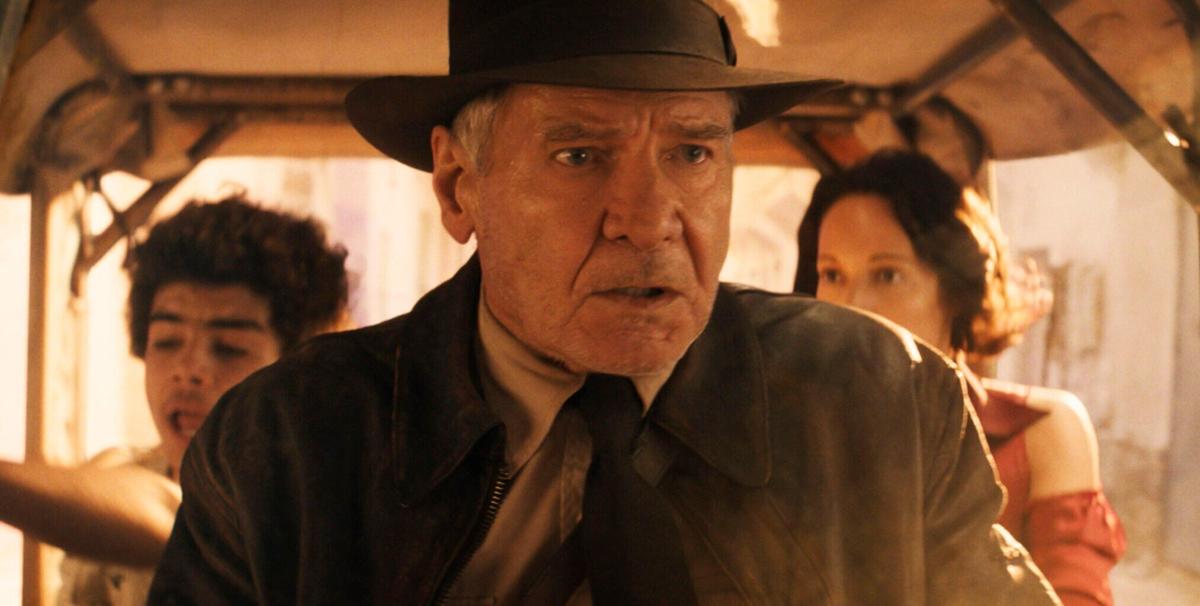
You can tell Steven Spielberg didn’t direct “Indiana Jones and the Dial of Destiny.” It has all the adventure of the previous outings, but lacks the humor and sheen Spielberg lavished on his rough-and-tumble hero.
To make sure you remember just how Tom Cruise-like he was, director James Mangold goes back in time and show a younger Indy (thanks to a special effects process that de-ages Harrison Ford) that puts him in touch with, what else? Nazis.
Then, when it settles down for a more contemporary story, we see an aged Indiana Jones in the 1960s. He’s lecturing and, presumably, past his prime to crawl around caves and tombs. A goddaughter, however, slips into one of his classes and sparks a journey – a search for half of Archimedes’ Dial, a device the mathematician created.
The goddaughter, Helena Shaw (Phoebe Waller-Bridge), has an idea where the other half might be. Indy seems game, but there are others who want the secrets that it holds.
Business, it seems, is back to normal.
De-aging Ford, however, is the real game-changer. Surprisingly, the effect doesn’t look creepy and it allows him to play out a wild adventure in 1944 when he and Shaw’s father are trying to wrest artifacts from the Nazis. That means a harrowing train trip, a jaunt around the map and a peek at his own destiny.
In the ‘60s, he’s still able to don the fedora and crack the whip. When he and Shaw start bumping around (meeting a jaunty sailor played by Antonio Banderas), they use just about every form of transportation and get help from another kid (played with great gusto by Ethann Isidore). The three encounter another form of snakes (Jones’ fear) and slate stops in Greece and Sicily. In a cavern, they find the tomb of Archimedes and a clue as to what he was concocting.
“Dial of Destiny” never seems to sit still (even though it runs more than two-and-a-half hours) and isn’t afraid to visit old haunts. It’s like a reunion tour of a rock group. The highlights are here; only the range is limited.
Ford still has what it takes to make the character work. Waller-Bridge looks (and acts) like many of his female partners from the past. John Rhys-Davies and Karen Allen are here, as well. But the one who makes this work is Mads Mikkelsen as the antagonist determined to get his hands on the dial.
There’s a slight hint of Nazis among us in some of the storytelling but Mangold doesn’t overtly connect the dots. He lets audiences come to their own conclusion and gives Indy a fitting exit strategy.
While much of “Dial” seems dark (could it just be the projector lights?) it reminds us when films were fun and bold new worlds were just a movie ticket away.

