

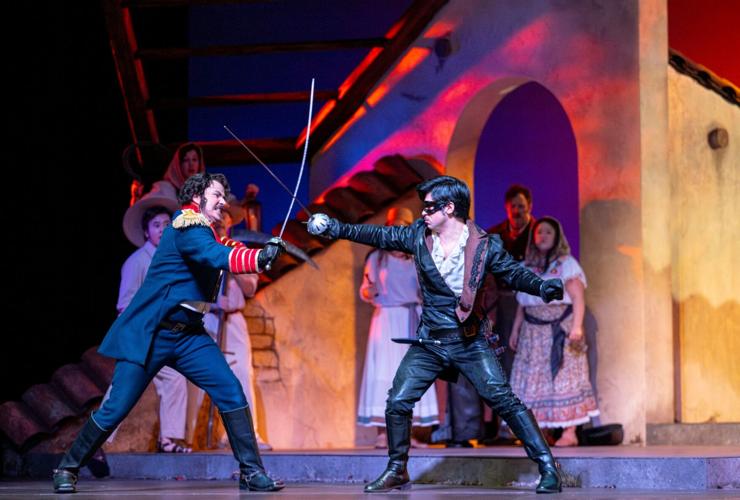

There are at least a dozen movies, TV shows, musicals and stage productions centered around Zorro, the masked vigilante at the center of Johnston McCulley’s 1919 pulp novel “The Curse of Capistrano.”
Now he’s the hero in an opera.
And while composer Héctor Armienta follows the template of Diego de la Vega, a nobleman from 19th-century Spanish California who wields a sword and dons a black cape and mask to fight on the side of the politically oppressed, Armienta places more emphasis on Diego’s human evolution than his body count.
In his opera “Zorro,” which Arizona Opera brings to Linda Ronstadt Music Hall on Saturday, Oct. 4, Armienta takes a deeper dive into Diego’s journey to manhood.
“Zorro is such a big character and it’s just an epic story that in some extent is a story about good versus evil,” the composer explained. “But it’s (also) about a young man in search of his destiny. He finds it in the lives of the poor and the destitute, and inspires them.”

Héctor Armienta’s opera “Zorro” comes to Linda Ronstadt Music Hall on Oct. 4.
That’s not to say that Armienta’s Zorro doesn’t wield a mean sword with a sometimes comical sense of mischief.
“The show starts right off with a sword fight,” said stage director David Radamés Toro. “Act two starts off with this huge fighting montage so there’s swords galore, fights everywhere.”
Armienta, who had composed seven operas before “Zorro,” spent nearly a decade reimagining the swashbuckling hero made famous on TV and films and in comic books.
“I wanted to write an opera that would be really accessible and fun to watch and write as many beautiful melodies as I could,” he explained during a conference call with Toro days before the opera opened in Phoenix last weekend. “There’s a love triangle, which is very dramatic. One of the people is tragically killed. There’s comedy. There’s the Sergeant Gomez character, which many people will be familiar with from the old Disney version of Zorro.”
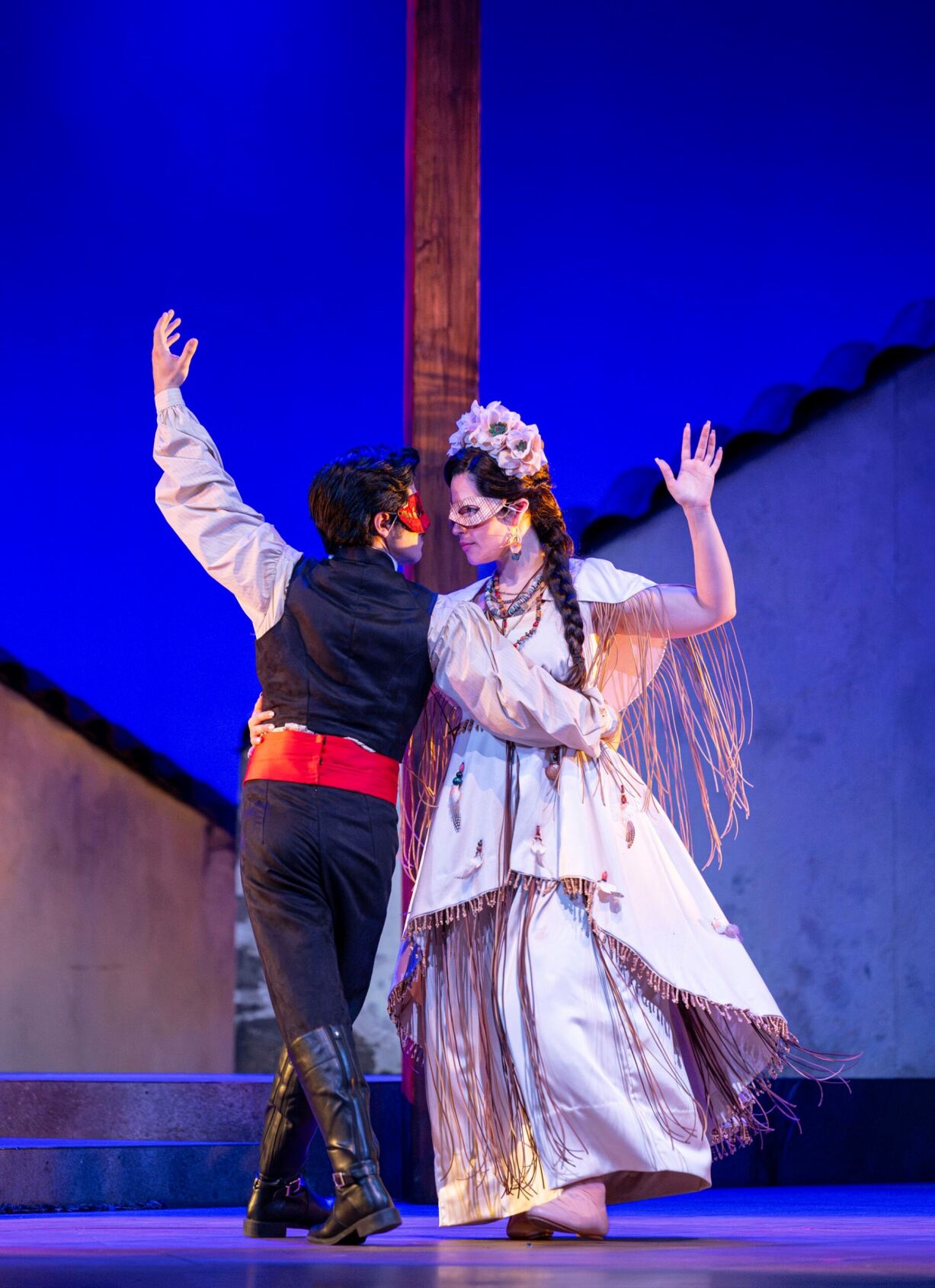
Arizona Opera opens its 2025-26 season with Héctor Armienta’s “Zorro” for one performance only at Linda Ronstadt Music Hall on Oct. 4.
But there’s also an arc of history in the opera.
A history buff, Armienta sets the opera in 1812 as Spain was starting to lose control of its empire, including the coastal territory of Alta California, aka New Spain.
“The Empire was falling apart and that allowed for little embers of revolution to take place in different places,” Armienta said.
Diego comes home from Spain, where his father had sent him to put distance between him and his childhood sweetheart and to learn to fight, and learns about the unrest from his ex-girlfriend.
She tells him about the plight of the poor and the destitute in his Pueblo Los Angeles home that is ruled by his former best friend, the corrupt Mayor Moncada.
“When he comes back to Pueblo, there’s political turmoil happening and he realizes what his true destiny is, and it’s to empower the people,” said Armienta, who wrote the music and libretto. “Those kinds of things absolutely resonate. They’re universal themes.”
Armienta sets the action against the backdrop of music that borrows influences from Spain, Mexico and Western classical’s neoromanticism.
“I’m a great fan of the great, great composers such as Britain and Puccini and Verdi,” Armienta said, describing the score to “Zorro” as a vase with neoromantic influences at the core — “the music is real romantic” — and “these beautiful, different kinds of musical idioms that draw from Mexico and Southern borders; in particular, a lot of Spanish influences.”
“There’s a flamenco piece in the opera. There’s mariachi,” he explained. “There’s corridos, which are like the Mexican country folk songs, but at its core, it’s neoromantic. It’s tonal, very much like in the Bel Canto style.”
The opera is also sung in both English and Spanish, a rarity even among operas written by Mexican and Latin composers.
As a Mexican-American from California, Armienta said he draws on his own experiences and history, which is one of the reasons the opera is bilingual.
“My goal has always been that my words be a bridge to some of the great repertoire in opera,” he said. “You get audiences that often have never seen classical music or opera, and when they see and hear their culture represented, it means ‘I have a place here’,” he said. “Hopefully that leads to building audiences.”
Arizona Opera’s production is a collaboration between Opera San Jose, which mounted the work last spring, and Kentucky Opera, which Toro said is doing it in a future season.
Toro designed the movable sets that can “transform before our eyes” into Pueblo Los Angeles, an office, a hacienda or a ballroom without video enhancement.
Arizona Opera is the fifth company to produce the work, which had its stripped-down post-pandemic world premiere at Fort Worth Opera in January 2022 before the first fully-staged production with Opera Southwest in New Mexico that October. Anthony Barrese, Opera Southwest artistic director, conducted that performance.
Barrese is back at the podium for Saturday’s Arizona Opera production at 2 p.m. at the Music Hall, 260 S. Church Ave. Tickets are $30-$170 through azopera.org.
“Zorro,” part of the McDougall Arizona Opera RED Series, will have English and Spanish supertitles. The opera runs 2 hours, 30 minutes with one intermission.
Arizona Opera's new President and General Director Brian DeMaris talks about "Zorro" and the season ahead.

