


When the Civic Orchestra of Tucson opens its 50th anniversary season on Saturday, Oct. 18, Daphne Madson will take her seat among the violists just as she has since 1977.
Across the aisle, violinist Denise Barnes will be sitting among the second violins, where she’s been for more than 30 years off and on since the mid-1980s.
“There’s a 90-year-old that sits behind me — she’s almost 90 — and she says she’s going to do it till she can’t,” Barnes said. “I think everyone in there loves playing music. I look forward to the rehearsals all week.”
“Once you get into the music, the beauty of it, the complexity of it, everyone working together, it really just changes everything,” added principal flutist Fran Moskovitz, another 30-plus-year veteran.
With the exception of the conductor, Keun Oh, and the concertmaster, no one in the 70-member community orchestra is paid.
Even the audience doesn’t pay; admission has always been free.
But the Civic Orchestra of Tucson, since the day George Schwartz and a few of his friends started playing together in the early 1970s, has never been about getting paid.

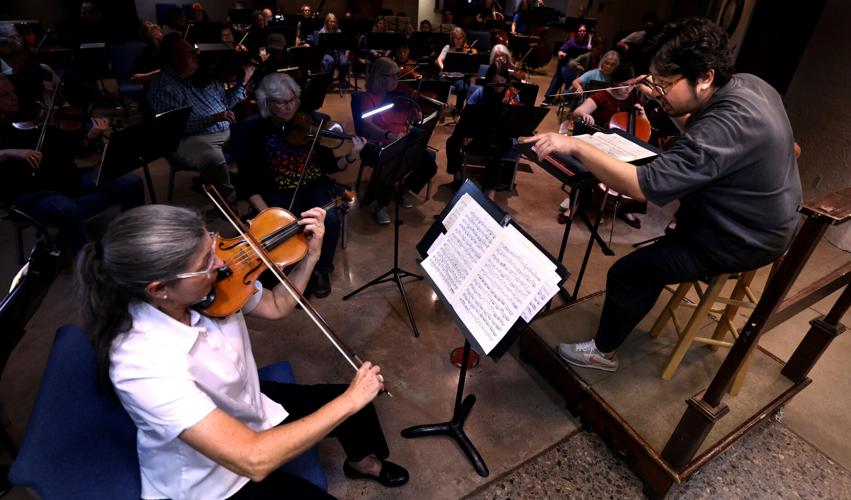
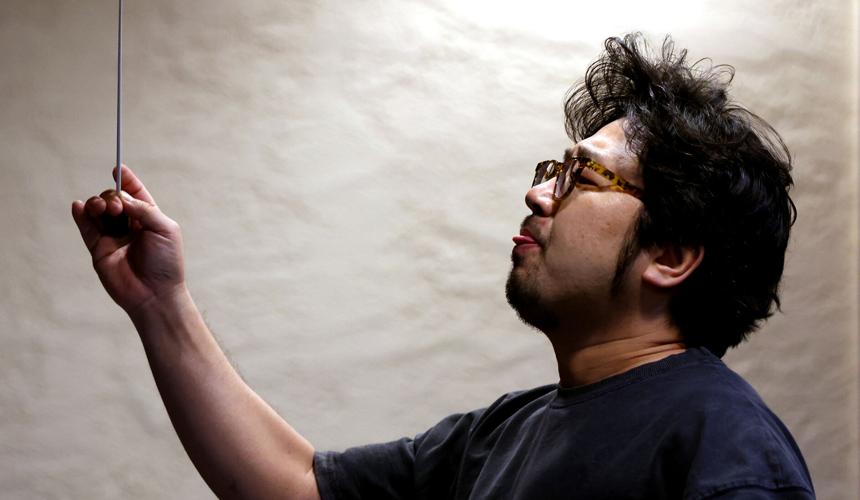
Conductor Keun Oh leads a rehearsal of the Civic Orchestra of Tucson. The orchestra is gearing up for its 50th season.
It’s about playing.
“It gives us all an opportunity to make music together to the best of our ability, and we’re not professionals,” said Madson. “Sometimes you talk to somebody in a professional group and they ... kind of look down at you. But my feeling is, if you got music inside you, you need a place to express it.”

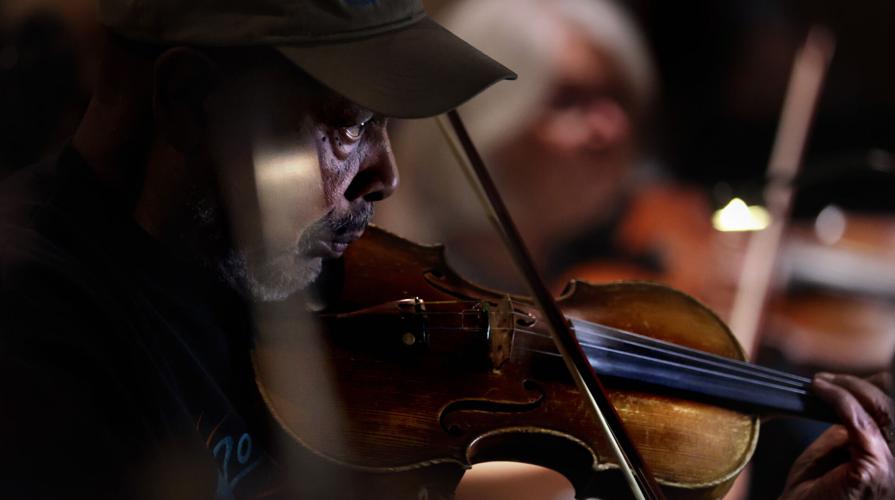
Violinist Wallace Burney and the Civic Orchestra of Tucson rehearse for their first performance of the orchestra’s 50th anniversary season.
Oh, music director since 2022 and only the fourth to lead the community orchestra in its five decades, will open the anniversary season with “Beginnings,” a concert that peers back in time to that first concert on Feb. 2, 1976, with Schwartz.
The program includes two works that Schwartz performed at the inaugural concert: Johann Strauss’s Emperor Waltz and Offenbach’s “La Vie Parisienne”; Oh will lead the orchestra in Antal Dorati’s orchestral arrangement version.
“Beginnings” also showcases where the orchestra has gone since Schwartz.
Each successive conductor, starting with Schwartz’s successor Hershel Kreloff, has pushed the ensemble to take on more challenging repertoire, including the Mendelssohn “Reformation” Symphony that Oh programmed to open Saturday’s concert.
“For the musicians, it becomes an opportunity to grow artistically — stretching beyond familiar boundaries, developing new skills and building confidence along the way,” Oh said in an email interview. “Challenging repertoire also deepens the concert experience for everyone involved. ... For audiences, hearing beloved masterworks or ambitious programs enriches the concert’s impact and reflects the orchestra’s vitality and dedication to artistic excellence.”

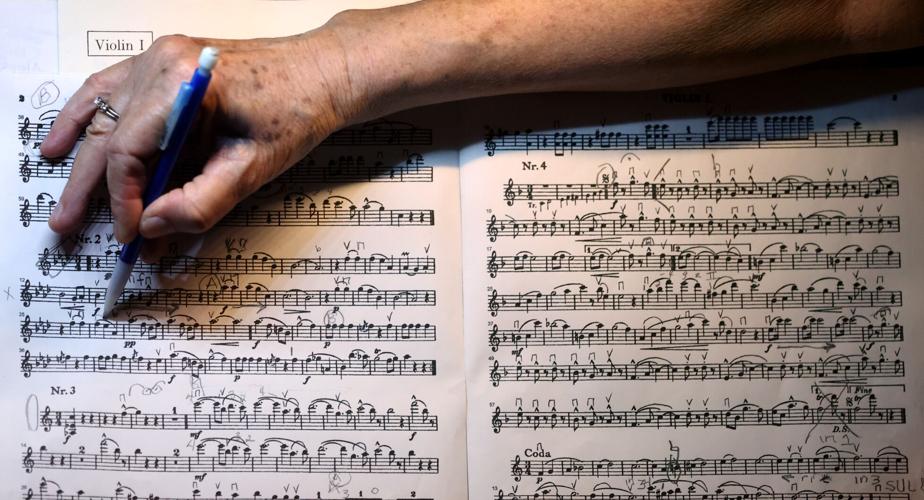
First violinist Emily Evans adds some bowing indicators to the sheet music of one of the other violin players at a rehearsal for the Civic Orchestra of Tucson.
Kreloff, who led the orchestra for 38 years, started programming more demanding repertoire and before long, musicians had to audition before they could join. With each season, Kreloff upped the ante and the audiences came to expect a higher level of performance.
“When Herschel took over from Mr. Schwartz, the quality improved,” said Moskovitz, one of the few musicians in the group who has a musical degree. “He was, you know, a stricter conductor, and he was a wonderful man.”
Kreloff also spearheaded the orchestra’s educational programs, including the introduction in 1984 of the Young Artists’ Competition and the Musical Instrument Petting Zoo that launched in 1995 to give people of all ages a chance to touch and play orchestra instruments.

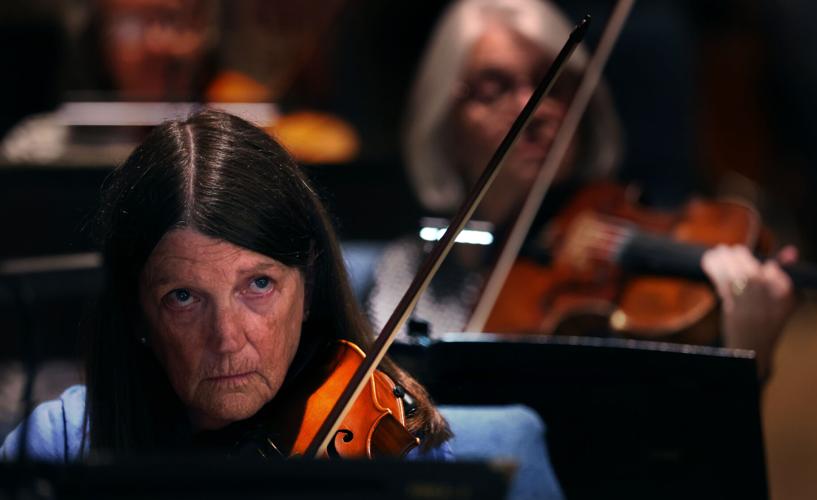
Viola player Daphne Madson watches conductor Keun Oh for her cue.
The ensemble under Kreloff was still a mixed bag of music teachers, students and hobbyists who enjoyed playing but didn’t have the experience or training to go professional.
“I know a couple of the people that were in our section, some were real, real good and some weren’t, but by the time I joined, it seemed to be a real orchestra,” recalled Madson, a Phoenix native who studied violin and viola as a child and played in the ASU Symphony throughout her four years at Arizona State.
It was also during Kreloff’s tenure that the orchestra earned its first national footnote. Civic Orchestra of Tucson was one of 60 community orchestras nationwide to co-commission national composer Joan Tower’s post-9-11 anthem “Made In America.”
Tower was at the podium when the orchestra performed the Arizona premiere in October 2005.

Conductor Keun Oh leads the Civic Orchestra of Tucson through a rehearsal session.
“A contemporary piece with the composer there conducting, that was a fun challenge, but it really was a challenge,” Moskovitz recalled. “I think our group does well with some of the standard literature, and I think we’re trying to have at least one piece each concert that is on the more difficult range to keep everybody on their toes and it makes it more fun.”

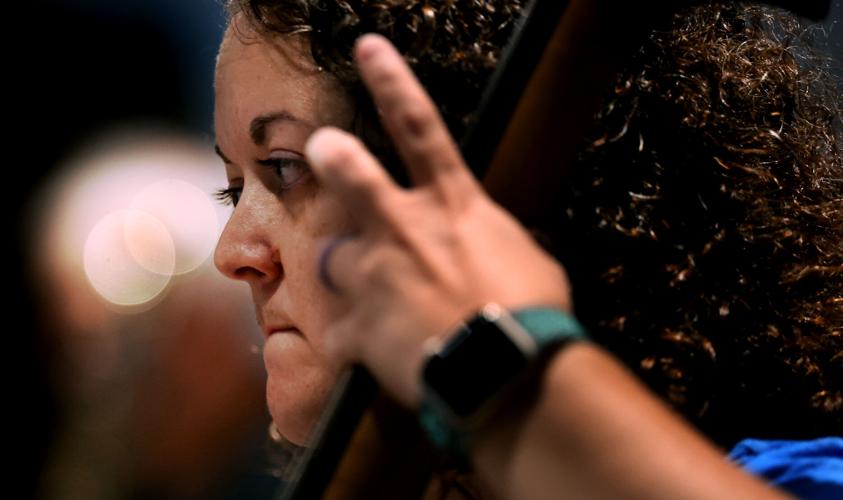
Bass player Jamie Matthews, of the Civic Orchestra of Tucson, works on a piece during a rehearsal.
Madson said one of the perks of being in the orchestra was finding a community of people who loved to play.
“We’d always have a break and somebody would bring cookies and had the stuff to make coffee or tea or whatever you wanted and people would socialize and get to know each other,” she recalled of rehearsals under Kreloff. “We always had a party at the end of the year. Sometimes it was at Herschel’s house, and we’d always celebrate his birthday. It was tightknit, and a lot of friendships were made.”
Kreloff led the orchestra until 2017, when he turned the baton over to Charles Bontrager. Kreloff died in spring 2018, days before his 87th birthday.

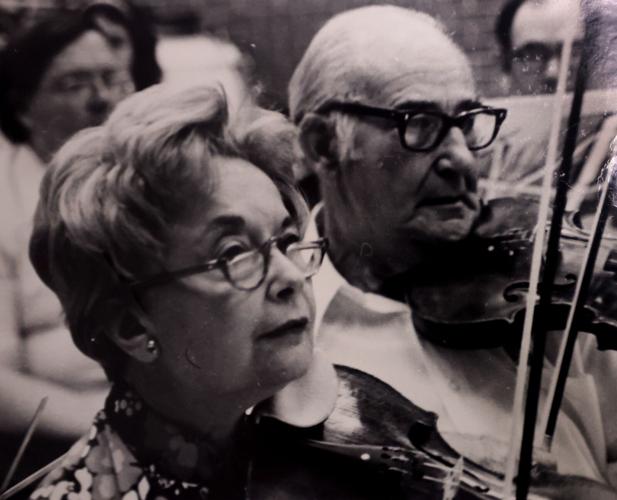
Frieda Schwartz, first violin and wife of original director George Schwartz, and Pedro Valles at a rehearsal for the Civic Orchestra of Tucson, circa 1976.
Bontrager had 35 years of conducting on his résumé when he took over Kreloff’s podium. The former University of Arizona School of Music faculty member had played trombone and euphonium in the Civic Orchestra for several years and reluctantly agreed to step in when Kreloff became ill.
Four years later, Oh, who earned a doctoral degree in orchestral and opera conducting from the University of Arizona, became the ensemble’s fourth music director.
He is also the youngest, Moskovitz said.
“He’s chosen some challenging pieces, and he expects a lot of the orchestra,” said Moskovitz, who is also part of Tucson’s Skyline Flutes ensemble. “It’s very exciting having someone younger at the podium who is at the beginning of his career and is trying to forge us in a certain way.”
“I think that he’s really wanting to challenge us,” said Barnes. “He’s delightful in rehearsal. When we don’t quite get something, he’ll just try a few times, and he’ll say, ‘Homework’.”
For Oh, pushing his musicians is a win-win for the orchestra and the audience.
“When our audiences hear us performing repertoire that is also presented by larger, professional groups, it offers an encouraging and inspiring message,” Oh said. “It reflects the dedication and ambition of our musicians, showing that a community orchestra can also embrace music of great depth and artistry.”
That push toward bigger and better is a big reason why Madson says she can’t imagine life without performing.
“That’s the reason I’m still playing,” she said. “I think more and more as I’ve gotten older, music has just become a part of my soul and it, it speaks to me. I need to create it.”
“It just sweeps you up and takes you away from the daily realities, which are so tough right now,” Barnes said, explaining that in what she called “heartbreaking times,” she is thankful for the chance to continue “to come together and make music (with) a really good group of people ... of a similar heartbeat.”
“Beginnings” will also include Mozart’s overture from “Don Giovanni” and Richard Strauss’s “Thus Spake Zarathustra.”
The Oct. 18 concert begins at 3 p.m. at Mountain View High School, 3901 E. Linda Vista Blvd. in Marana. Admission is free. The concert repeats Oct. 26 at Catalina Foothills High School, 4300 E. Sunrise Drive.

