



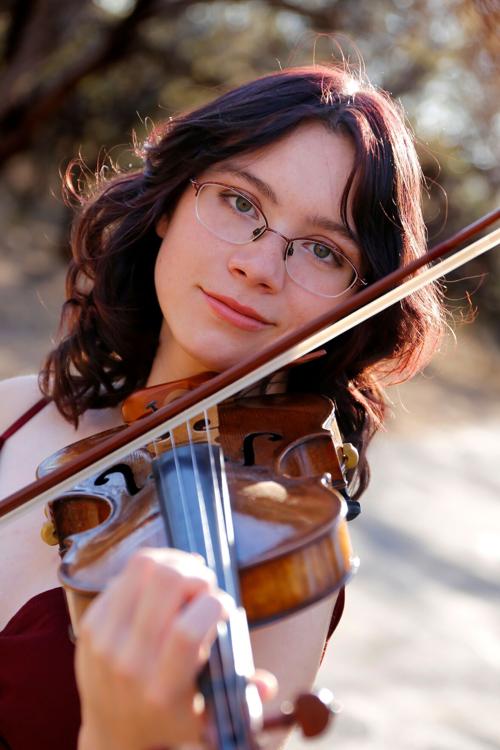
Jacqueline Rodenbeck let her fingers fly over the fingerboard of her violin, up and down, high notes, low, then impossibly high with controlled bowing that summoned the wonderfully lush and romantic melodies of Mendelssohn’s Violin Concerto in E minor.
In the final concert of St Andrew’s Bach Society’s summer series on Sunday, Aug. 17, the 17-year-old virtuoso matched the composer’s flurry of note changes with unflappable concentration and impressive technical prowess. When she played the challenging cadenza, a highlight of the first movement, the audience filling Grace St. Paul’s Episcopal Church held its collective breath.
The cadenza is the showpiece of the concerto that requires impeccable technical chops and stamina. Mendelssohn includes rapid-fire double stops and interwoven arpeggios and open chords that demand a level of dexterity that you don’t often see from a violinist at the beginning of their career.
Which made Jacqueline’s performance with pianist Kathyrn Lieppman on Sunday so thrilling. Jacqueline met every technical challenge the Mendelssohn threw at her with confidence and clarity, summoning the composer’s wonderfully lush and lyrical nuances while balancing the work’s drama and passion.
The majority of Sunday’s audience had come to the concert having only a passing familiarity with Jacqueline, who started her violin journey at age 5 and three years later became the youngest participant in the prestigious Hiefetz Institute Program for the Exceptionally Gifted. Her trajectory since has been straight up, including checking boxes this summer for her Carnegie Hall debut and first-ever international tour as part of the National Youth Orchestra.
Her Bach Society debut Sunday was arguably her biggest local performance to date, 90 minutes of performing a program of works she curated, from her impressive turn with the Mendelssohn to her strikingly beautiful rendition of Spanish composer Sarasate’s sometimes frenetically-paced Introduction and Tarantella. She will play that piece again in a matter of weeks when she joins the Tucson Symphony Orchestra for the Sept. 15 Mexican Independence Day concert, presented by the Mexican Consulate of Tucson.
She opened the second half with a pair of works by William Grant Still, the first African-American composer to have his works performed by a major orchestra. Jacqueline brought out the subtle nods to African-American spirituals and not-so-subtle references to blues and jazz in his Suite for Violin and brought a gentle touch to his moving and cinematically sweeping “Summerland,” before turning her attention to Paganini’s Caprice No. 24 for solo violin.
Her performance of the Paganini was inspiring for her fearlessness. She maintained an unnerving focus as she kept pace with Paganini’s rapid-fire note changes and equally fiery scales, combined with spicatto bowing — a type of off-the-strings bowing that is timed to lift off every note.
The work ran no more than five minutes, but from the audience, it was five minutes of uninterrupted movement that had many of us exhaling when Jacqueline finished. But the young musician looked no worse for the workout, leaving the stage for a few moments before returning with Lieppman for the finale, William Bolcom’s hauntingly jazzy “Grateful Ghost Rag.”
Tickets for the Sept. 15 Mexican Independence Day concert at Linda Ronstadt Music Hall are available for free from the Consulate, but you have to reserve early; the concert always sells out. Reserve tickets by calling 520-882-5595.

