



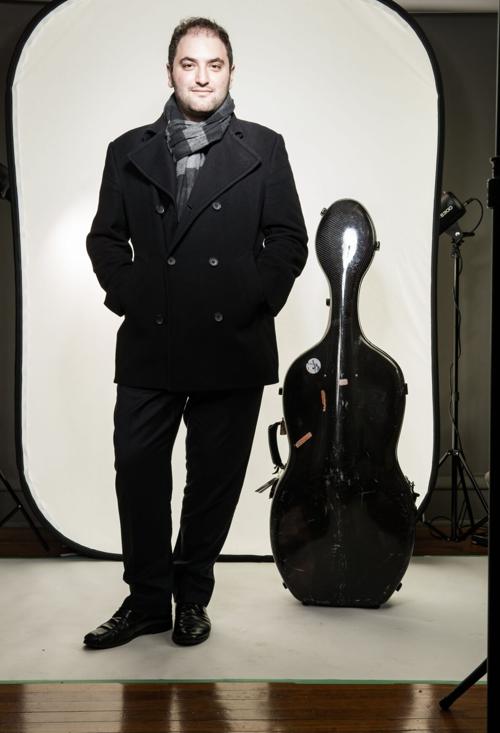
Cellist Julian Schwarz‘s upcoming appearance with the Tucson Symphony Orchestra is starting to look like a residency.
He’s here for three performances of the TSO’s “Beethoven’s Pastoral” Masterworks concert this weekend at Catalina Foothills High School and will stick around through Monday to record a pair of works by retired University of Arizona composer Daniel Asia.
He’s also doing a masterclass with former TSO cellist Theodore Buchholz, who now teaches cello at the UA School of Music, where he also is founding director of the UA String Project.
“It’s turning into this kind of residency,” Schwarz said last week during a phone call from his Virginia home. “It’s really cool.”
Schwarz returns to the TSO for the first time since performing the Shostakovich Cello Concerto No. 1 in his 2018 debut.
This weekend, he’s soloing on two works: Bruch’s Kol Nidrei and Tchaikovsky’s Variations on a Rococo Theme. Schwarz has a long relationship with both works, but the Bruch is perhaps his calling card.
He was just 8 or 9 when he made his public debut with the work in a Jewish synagogue in his native Seattle, where his father, Gerard Schwarz, was the longtime music director of the Seattle Symphony Orchestra.
“That was the first piece I performed and I have performed the Koi Nidrei every single year since,” he said, including his annual performance in early October at New York City’s Central Synagogue on the eve of Yom Kippur. That concert is live-streamed to more than a million viewers.
Bruch, a Protestant, composed his Koi Nidrei for cello and orchestra inspired by the melody he heard from a cantor reciting the traditional Aramaic Yom Kippur prayer. The piece, completed in 1881, is intrinsically linked to the holiest day of the year for Jews.
In the 1930s, the song was banned by the Nazis who mistook Bruch as Jewish.
Schwarz was first introduced to Variations on a Rococo Theme when he toured with the Moscow Radio Symphony in 2010; it was his first major U.S. tour.
“That’s really when I first ... started to get reviews in major cities, and that became a piece that I’ve performed a lot because orchestras have asked me to play it,” he said.
By his count, he’s performed the Tchaikovsky more than 50 times.
“It’s fun because it has the classical theme that is developed into very romantic variations,” he said. “So you get this classical elegance while maintaining the real passion of Tchaikovsky’s language.”
Schwarz said he envisions the Tchaikovsky Variations like one of the Russian composer’s famous ballets, with “all of the twirls and leaps and jumps” that are “very balletic.”
“And I’m on pointe for about 60% of it,” he joked.
“These are pieces that are very dear to my heart,” added Schwarz, who teaches at the Shenandoah Conservatory in Virginia, where he lives with his pianist wife Marika Bournaki and their 5-month-old son Ludwig.
“Beethoven’s Pastoral,” with guest conductor Connor Gray Covington, is bookended by William Grant Still’s “Mother and Child” and Beethoven’s Symphony No. 6 “Pastoral.” The orchestra will perform the concert at 2 and 7:30 p.m. Saturday, Nov. 8, and 2 p.m. Sunday, Nov. 9, at Catalina Foothills High School, 4300 E. Sunrise Drive.
Tickets are $51.85-$94.65 through tucsonsymphony.org.
Schwarz’s Tucson visit comes two years after he was last here in October 2023 as part of the UA’s annual “Music + Festival.”
The event was the finale of a series created and curated by now-retired UA professor and composer Asia.
Asia had tapped Schwarz to perform his 1997 Cello Concerto with the Arizona Symphony; it was the first time the work had been performed since it was premiered in 1998.
Schwarz will record Asia’s Solo Cello Suite, which Schwarz performed at a conference two years ago, and the composer’s 2001 work “A Lament.” The one-movement elegy, originally transcribed from Asia’s Cello Concerto, was written for victims of the Holocaust.
Schwarz will also record Joshua Nichols’ Suite for Solo Cello. Nichols was a student of Asia.

