

If you are a mom and you are reading this, you might be in line at Target. Or sitting in a doctor’s office. You may be picking up NyQuil, or double-checking that it isn't an ear infection.
That's because it's after Thanksgiving and before Christmas, a time rivaled only by the last month of school for the busiest time of the year for most moms. So if you are going to read something, it's probably while you are doing something else — and we'll try to keep it short so you can finish.
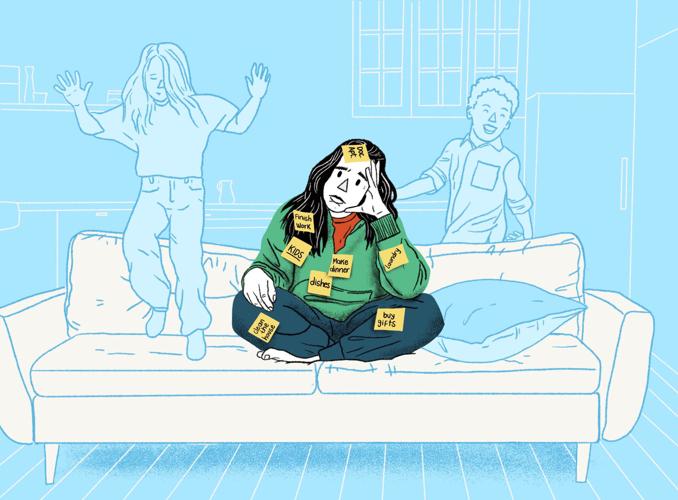
We say moms and not parents because, let's be honest, who is picking the sweater for your mother-in-law in the gift exchange? Who is the one creating the Christmas magic — moving the elf, baking the sugar cookies, scheduling a family photo, making sure there is an equal amount of candy in each child’s stocking — even if one of them is now 19? It's the "mental load" of parenting − the invisible, unpaid work of planning, managing and organizing all the things women take on to keep a family and household running.
And it's pushing women to the breaking point, according to a new USA TODAY/Peacock survey of 1,600 U.S. parents about the mental load parents face. In fact, 43% of women say they are burned out or emotionally exhausted. And more than a third feel that way every single day.

Whose fault is it, anyway?
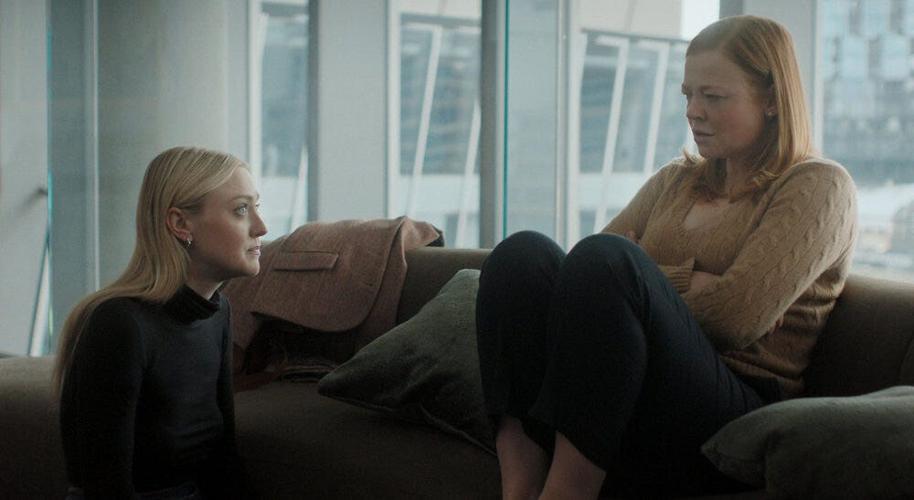
USA TODAY launched the survey with Peacock after the debut of the thriller "All Her Fault." At first the series appears to be a mystery about the kidnapping of a little boy from a wealthy family and who is to blame, but the show sparked conversations on social media, with mom viewers obsessed with a plot they could relate to: the mental load of being a mom.
"All Her Fault" reflects an important moment in motherhood, says Madeline di Nonno, president and CEO of the Geena Davis Institute, which works to increase representation and reduce stereotypes across gender in entertainment and media.
"It's not all about the perfect mom, which is what we see so much on TV," she says. "Women need to see themselves portrayed on the screen. There is a lot of shame and guilt for not being the perfect mom. Showing this idyllic world just isn’t realistic."
Dakota Fanning's character is in one of the most important meetings of her career when her deadbeat husband texts her to ask, "Where is Jacob’s water bottle?"
"I'm the default parent and you're the substitute," Fanning tells him. "It's not equal. It's never equal."

Dakota Fanning and Sarah Snook portray moms in 'All Her Fault' who grapple with the pressure to do it all – and get blamed when there's a mistake.
Women are more likely than men to say the pressure of doing it all and meeting expectations is a challenge, according to the USA TODAY/Peacock survey. They also are more likely to say they don’t turn to anyone for advice or help.
"Women don't want to ask for help. They want someone to know what to do. It's not OK for men to say 'Just tell me what to do,'" says Ivorie Mayes, a therapist and mother of three in Cleveland, Tennessee. "It isn't that men don't care. They weren't raised to scan a home the way moms were. Women are taught to anticipate the needs."
That's how moms become the default parent, the one who holds the medical and dental appointments in their heads, who makes sure the basketball uniform is clean, who not only makes the lunches but does the grocery shopping to make sure the right grapes and Goldfish crackers are purchased.
The survey found that 64% of women say they manage the day-to-day responsibilities of parenting, compared with 43% of men, and 44% of moms also report feeling pressured to "do it all" compared with 37% of men.
The result of all of that decision-making? A full 34% of women feel overwhelmed every single day; another 32% feel that way several times a week.
Mayes started helping moms navigate the mental load a few years ago when she was juggling a full-time job and graduate school while raising her three children with her husband. She noticed at her monthly moms' self-care nights that many women were interrupted by their husbands texting them to ask: How should I calm the baby? Where are the pajamas? What do the kids want for dinner?
"I talk a lot about reminding men: 'You live here. You should know what needs to be done.' I don't say that to put men down; that's not what that's about at all," she says. "It's equal ownership."

Parenting overload
Though moms have long felt the pressure, more dads are starting to feel it, too. Men are more likely than women to say balancing work and family responsibilities is a challenge, according to our survey.
"Our collective expectations of fathers have shifted. We expect dads to be more involved with their kids," says Allison Daminger, author of "What's on Her Mind: The Mental Workload of Family Life" and a professor at the University of Wisconsin, Madison.
"At the same time, the expectations on breadwinning and dads hasn't changed. We've added to their job description. I think younger dads are starting to feel that strain."
Jonathan Gilmor's wife wanted him to do more as a parent to their two children. At first, he admits, he got defensive.
He thought he was doing his part by saying, "How can I help?"
"She had told me she was overwhelmed and at her breaking point," says Gilmor, 31. "I thought mental load was just like a BS thing."
It wasn't until he was laid off earlier this year for a few months and he became the main caretaker of a newborn and 3-year-old that he really understood it.
Now he and his wife both work full time, and he has started taking ownership of chores, not just "helping."
"She's always had higher expectations for me. I've pushed myself to grow," says Gilmor, who started social media accounts called Do Better Jonathan to show what he is learning and to try to inspire other fathers. "Among my friends, there is more of a goal to be more involved with the family. And guys want to learn. It makes me want to do more."
Though men are feeling more stress, most feel confident delegating tasks to their partners. Women, however, wrestle with letting go of some caretaking tasks because they believe they will be judged or blamed if it isn't perfect. Four in 10 women surveyed said they felt pressure to be the "perfect" parent.
"I struggle with relinquishing ownership: 'Why did you do it that way? This way is easier?'" Mayes says of her husband taking on the hair care for their three daughters, a 9-year-old and 6-year-old twins.
"He needed to remind me that if I wanted him to own this task, I needed to step back. It was getting done, even if not the way I would do it," she says. "Now the girls prefer Dad to do their hair."
And while some partners find a way to navigate the load, society still has certain expectations of moms, Daminger says. (Our survey underscored this: 50% of women reported that, when something goes wrong, it's their job to fix the issue.)
"The school will still call the mom if there is a problem," she says. "So it can be challenging for many women to give up these things."
Learning to divide the load
Kaitlyn Nilles has seen firsthand how difficult it is to change from one generation to the next. She grew up in a traditional home where her father worked and her mother cared for the children.
When Nilles got married, she assumed the cooking and cleaning, and later, caring for their children, now 5 and 8.
"We never had a conversation of who is doing what, it was very natural," she says. "But then I was working and taking care of the kids, working full time and it was the pandemic and it was just too much."
Nilles and her husband divorced.
For almost two years, they shared custody of the children. "He was a single father and he literally had to do everything, make the lunches, do the pickups, all of it," says Nilles, 35.
The couple reconciled more than a year ago, in part because he learned to become a better partner.
Now they spend Sunday mornings planning the week, deciding who owns which tasks.
"I've learned done is better than perfect. And there's always something else to be done," she says. "I've had to let go of expectations. We've had conversations. It was not an overnight fix. We really struggled in this area for years and years."
One thing about the mental load is clear: It's hitting all of us. Roughly three-quarters of all parents say their family responsibilities affect their mental health at least somewhat, and 40% say it affects it a great deal, according to the survey.
"The next frontier is getting men talking to each other about it," Daminger says. "The message is still coming through women. I'm hopeful that as time passes, this will not be seen as such a women's issue but couple’s or family issue."



