

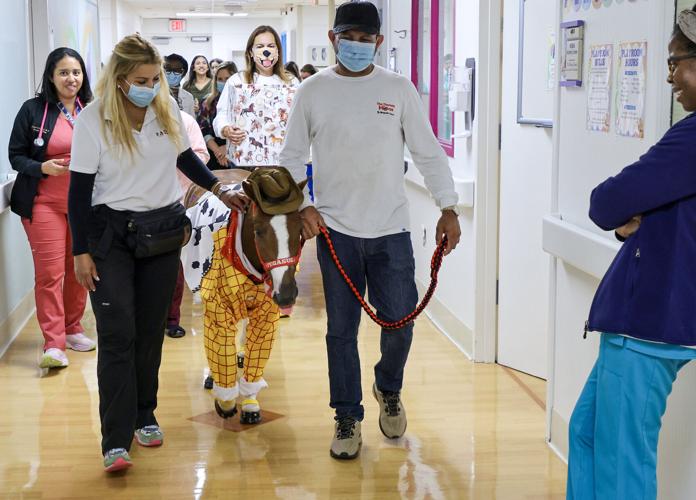
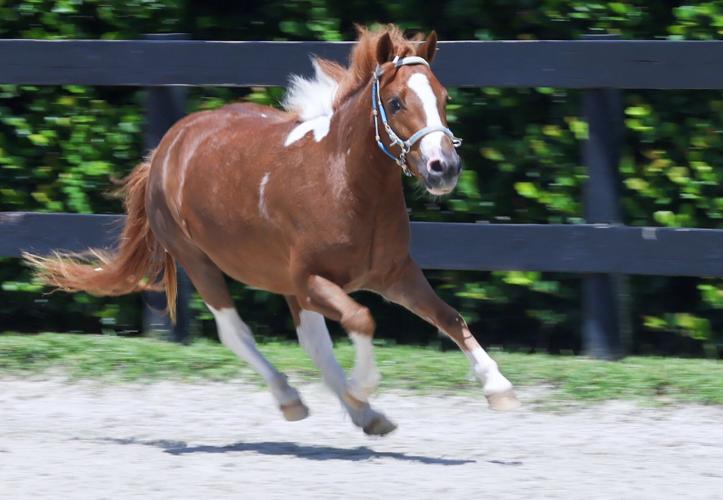
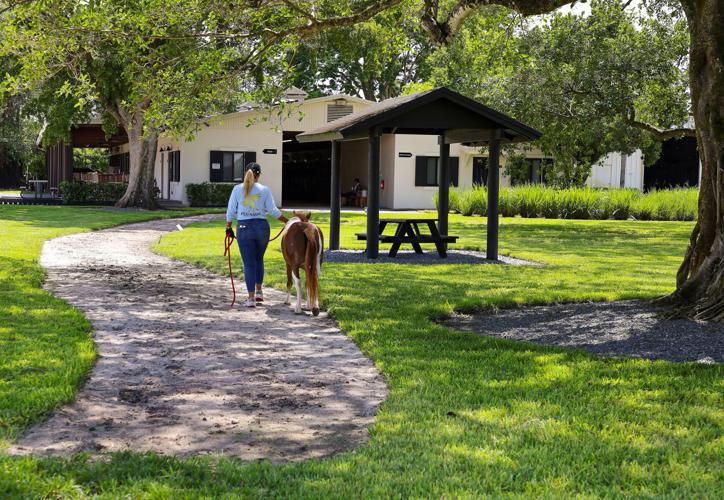
On a recent Friday morning, Pegasus slowly trots out of an elevator, surrounded by doctors and nurses. He’s ready to make his rounds and see the many sick children at Holtz Children’s Hospital in Miami.
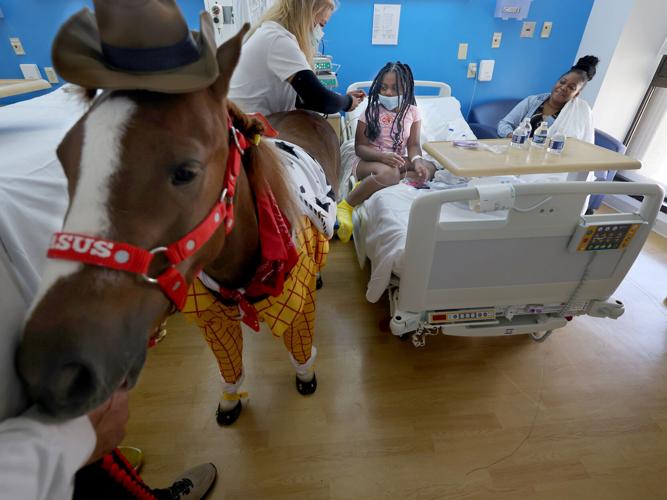
His owner, Alexandra Ramos, doesn’t need to say much to introduce the miniature horse to his first patient. The boy’s eyes light up the moment Pegasus walks into the room.
“He’s never seen a horse in person before, so I’m glad to see him smile, honestly,” Nigeria Harris said as she watched her 9-year-old son, Kumari, pet Pegasus. He was waiting to be discharged after an asthma attack on his first day of fourth grade led him to stay overnight at the children’s hospital.
Holtz and other South Florida hospitals have long used therapy dogs to provide patients with emotional support, either by hiring handlers to bring in the furry companions or by having their own in-house therapy dogs to make more frequent rounds.
Now, hospitals have begun to explore the same philosophy, but with horses. In South Florida, Pegasus has already made rounds at Mount Sinai Medical Center in Miami Beach, HCA Mercy Hospital in Miami and Nicklaus Children’s Hospital near South Miami.
“No one wants to be in a hospital. No one wants to be sick, and anything that could take their mind away from what they’re doing here, I think it’s a really positive thing,” said Gino Santorio, president and CEO of Mount Sinai Medical Center in Miami Beach.
Pegasus first visited Mount Sinai’s hospital in 2024 for Valentine’s Day as part of Mount Sinai’s pet therapy program.
Providing emotional support
“You could tell that people’s attention were immediately drawn to (Pegasus), and for the 10 to 15 minutes that the mini horse was there, that’s all anybody was really thinking about,” Santorio said. “Sometimes that 15 minutes of just mindfulness gives people a mental reset.”
Pegasus, like his six adopted therapy dog siblings, is trained to give emotional support to kids and adult patients undergoing challenging treatments.
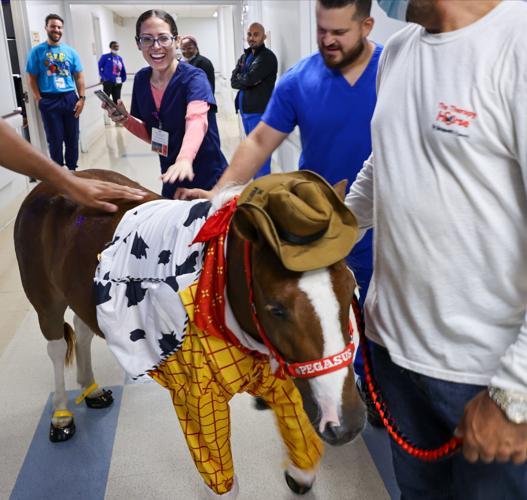
And Pegasus comes dressed to impress. For his first visit to Holtz Children’s Hospital, he arrived in character as Woody the cowboy to match the hospital’s “Toy Story” theme — little cowboy hat and slip-resistant mini boots included.
The horse’s magic repeats itself in every room — bright eyes, smiles, awe and shock. Some kids put stickers on his body.
It’s not easy to plan a visit. Hospitals have to follow strict guidelines to ensure cleanliness and reduce risk of infections and illness for patients, staff and visitors. An employee that stayed close to Ramos and Pegasus during his recent Holtz visit, for example, closely monitored the interactions, making sure the kids cleaned their hands properly and, at times, changed gowns following their interactions with the horse.
Those are just some of the steps the hospital took to make sure Pegasus could visit all of its patients, including those in outpatient, oncology, the transplant institute and the pediatric ICU as part of Holtz’s “Feel Good Friday” initiative, where staff find fun activities for patients, staff and families to do to give kids a mental break.
“The opportunity to pet, the opportunity to cuddle with a horse, is another level … and gives them that opportunity to take a break if they’re going through pain,” said Kim Juanico, Holtz’s nurse coordinator for the pediatric palliative care team. Her team focuses on finding ways to improve quality of life for kids with serious or life-limiting illnesses. “It may not be the medication that helps them, but Pegasus can come in here and give a gentle hug to a kid and let them cuddle and pet, and their pain level goes down.”
“It’s a distraction technique,” she added. “Days are long and hard here. We’re constantly waiting for the next hour to come. This passes a little bit of that time.”
Benefits of equine therapy
Horses are also being used to help reduce anxiety, promote calmness and develop better emotional regulation in children outside of the doctor’s office, too. At Equine Music Therapy Resources, horses and music are used in therapy to help children with anxiety, depression, autism and other behavioral and neurological disorders learn life skills and gain confidence while helping them navigate their emotions, according to Dayne Leon, the company’s president and founder.
Leon said equine therapy works because of how intuitive, almost empath-like, horses are to people’s emotions. Some research indicates horses can not only hear the heartbeat of those around them but can also synchronize the beat of their hearts with their riders, she said. Leon says that connection can often help promote calmness.
“Kids feel in control of that huge animal, but at the same time, it’s building a bond between the animal and the person that is extremely magical,” said Leon, tearing up as she talked about the changes she has seen in the children her organization helps.
“When you see a child that is isolated in their own world and they open up to a new one, they open up to the best version of themselves,” she said.
It’s similar to what therapy dogs do.
The furry companions “help bridge the gap that we, even as clinicians or specialists, can’t get through to the child,” said Talia Mor, a child life specialist at Holtz and the handler of Mahi, the hospital’s facility dog. “You see them start to really talk to you and engage with you when they wouldn’t have been as open to do that before.”
For Ramos, who has worked for over a decade with therapy dogs, equine therapy is a new way to bring that comfort to patients and other children.
From therapy dogs to a therapy horse
Ramos, who grew up with horses and other farm animals in Colombia, worked years ago with Amigos Near, a Miami-based nonprofit foundation that helps underserved children across the world, including kids in orphanages across Haiti, Colombia, Spain and the Dominican Republic. Ramos said she was on the ground shortly after the 2010 Haiti earthquake, helping to deliver food and other essential items to families in need.
As part of her foundation work, Ramos would sometimes go to Nicklaus Children’s, then known as Miami Children’s. One day, she went with her dog Bruno. Someone at the hospital recommended she bring her pup back to interact with patients. Ramos recalls feeling confused by the ask, but nonetheless did so.
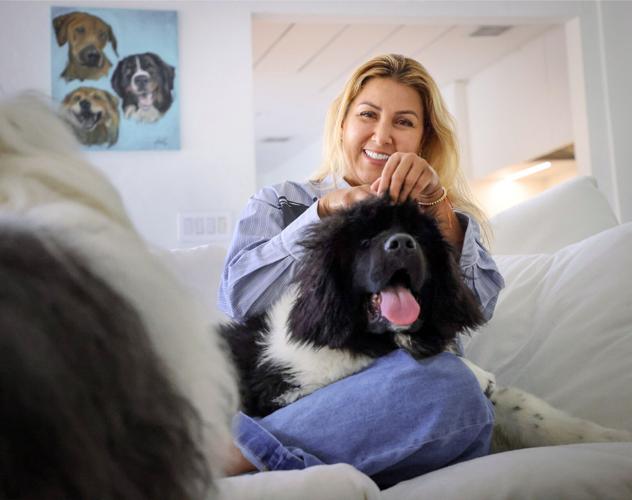
That moment changed Ramos’ life. She now handles six therapy dogs — Ares, Thor, Odin, Apollo, Zeus and Bruno — in addition to Pegasus. He will soon have another brother: Arion, another horse she’s in the process of bringing into the fold. All are rescues named after characters from Greek mythology.
“I don’t have children, but I believe there’s a need to make many kids feel better who lack many things at home,” Ramos said.
Pegasus, to her, is like a big dog. At the farm where he lives in Kendall’s horse country, he’s playful and even a bit mischievous, not always listening to Ramos, pulling on his reigns, impatient to be set loose to go run in his paddock. He loves to roll on his back, a technique horses use to scratch and groom themselves.
But at the hospital, Pegasus is poised. Calm. A steady presence for anyone who needs him.
“He transforms when he’s with patients,” Ramos said.

