

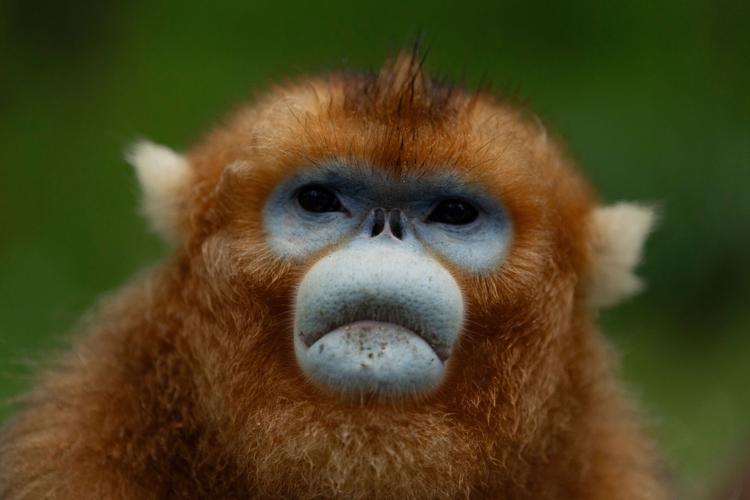
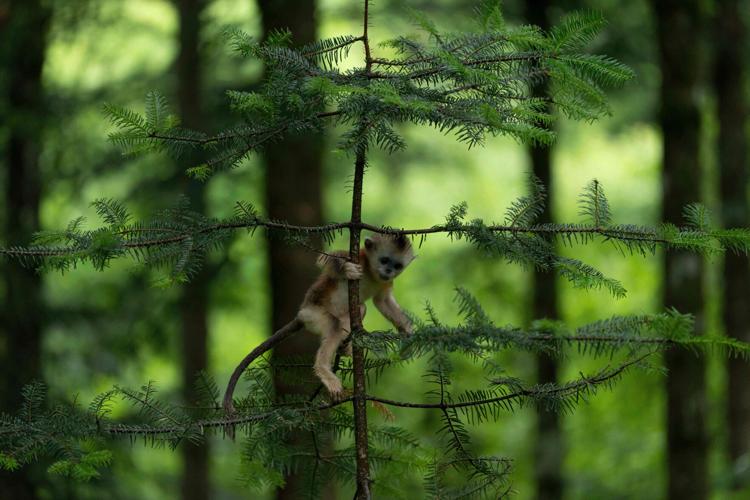
With their distinctive shaggy orange manes, pale blue faces and dense fur covering their hands and feet, it's hard to mistake China's endangered golden snub-nosed monkeys for any other animal.
These rare and charismatic monkeys, unique to the frigid mountains of central China, recently joined the country's famous pandas as furry envoys to zoos in Europe for the first time — on loan for 10 years from the same government-overseen group that coordinates official panda exchanges.
As with "panda diplomacy," some observers cheer new opportunities for scientific and conservation collaboration, while others raise concerns about the welfare of animals transported around the world.

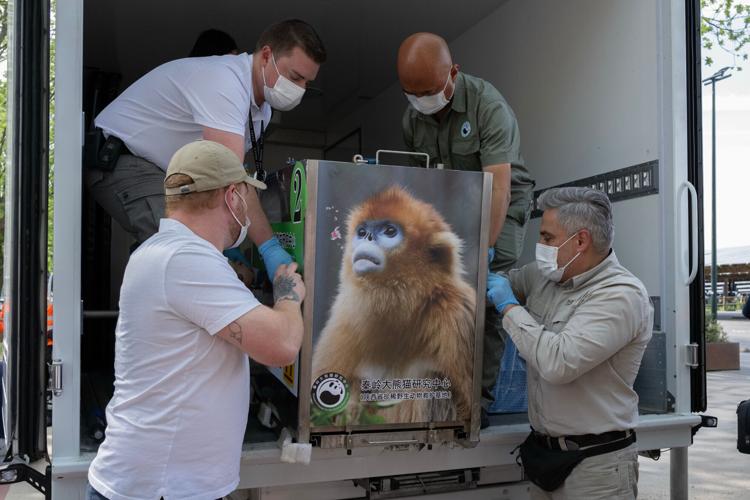
A golden snub-nosed monkey from China is transported in May in Brugelette, Belgium.
Arrival in Europe
Three golden monkeys arrived at France's Beauval Zoo in the city of Saint-Aignan this April, following an agreement to mark the 60th anniversary of the establishment of diplomatic relations between the People's Republic of China and France.
Another trio arrived at the Pairi Daiza zoo in Hainaut, Belgium, in May. The zoo distributed Belgian and Chinese hand flags to visitors on the day the monkeys arrived.
After a monthlong quarantine, the two sets of monkeys made their public debuts. So far, they appear to be in good health, according to the two zoos, adapting to new climates outside Asia for the first time.

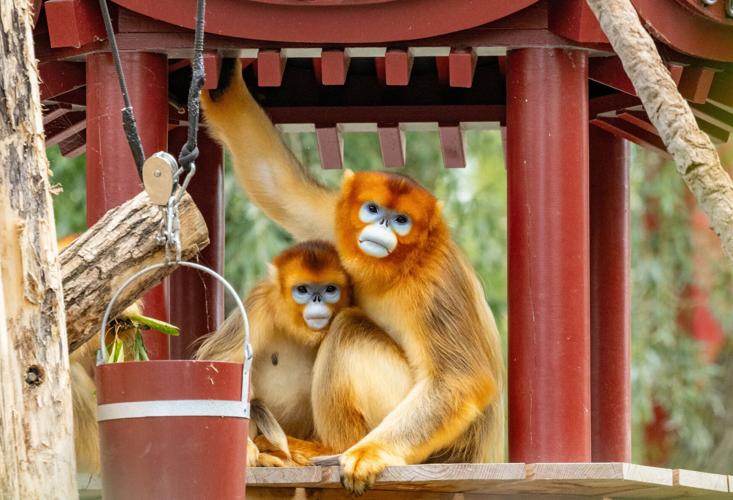
Golden snub-nosed monkeys from China are seen in July at the zoo in Brugelette, Belgium.
At Pairi Daiza, the habitat enclosure for Liu Yun, Lu Lu and Juan Juan includes traditional Chinese gazebos with red columns and gray-tiled roofs, where the monkeys spend much of their time jumping between logs and rope ladders and scrambling over roofs.
"The diplomatic aspect comes from this cultural awareness," said Pairi Daiza spokesperson Johan Vreys.
The hope is to build longstanding scientific exchanges between the zoos and Chinese authorities, said Anaïs Maury, communications director for the Beauval Zoo.
The zoo is in discussions with China to launch joint research and conservation programs "similar to those already in place for other emblematic species like pandas," Maury said.

Golden snub-nosed monkeys sit together June 18 in the Shennongjia National Park in Shennongjia, central China's Hubei province.
Animal envoys
Both giant pandas and golden snub-nosed monkeys are endangered animals that are unique to China and can only be moved outside the country with approval from the central government, said Elena Songster, an environmental historian at St. Mary's College of California. Both species are considered national treasures.

A golden snub-nosed monkey is seen June 18 in the Shennongjia National Park in Shennongjia, central China's Hubei province.
Monkeys have deep roots in Chinese art and culture, appearing in countless paintings and as characters in classic literature, including the wily Monkey King in the 16th century novel "Journey to the West."
Pandas quickly became symbols of modern China — in part to due to their "cuddly cuteness" and deft diplomatic presentation, said Susan Brownell, a China historian at the University of Missouri, St. Louis.
The original soft power couple from post-war China was a pair of giant pandas, Ping Ping and Qi Qi, sent to the Soviet Union in 1957 to celebrate the 40th anniversary of the October Revolution, which led to the establishment of the world's first Communist state.
In 1972, a pair of pandas was sent to the U.S. for the first time, following President Richard Nixon's historic visit to Beijing. In 1984, China switched from gifting pandas to loaning them.
After outcry from animal-rights activists, China ended the practice of short-term loans and began longer leases, usually about a decade. In this arrangement through the China Wildlife Conservation Association, part of the money that an overseas zoo pays annually to China must be earmarked for habitat conservation or scientific research to benefit the species.
Still, what benefits a species may not be beneficial to an individual animal. Transporting animals over long distances and sending their offspring back to China, as the agreements require, may highly stress animals, said Jeff Sebo, an environmental and bioethics researcher at New York University.

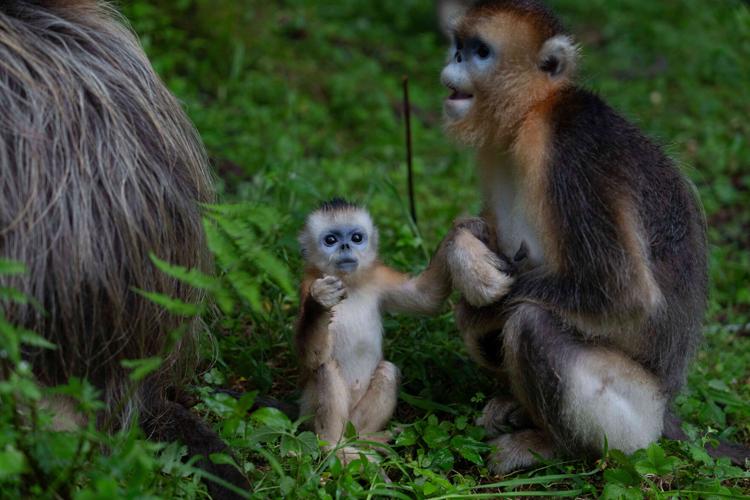
A baby golden snub-nosed monkey climbs on a branch June 18 in the Shennongjia National Park in Shennongjia, central China's Hubei province.
Conservation efforts
Golden snub-nosed monkeys live across a swath of central and southwestern China that includes parts of Sichuan, Shaanxi, Gansu and Hubei provinces.
At the Shennongjia National Park in Hubei, conservation efforts since the 1980s helped increase the region's population threefold to about 1,600 monkeys today, said Yang Jingyuan, president of the Academy of Sciences at the park.
It's unclear exactly how to evaluate the diplomatic track record of furry ambassadors.
Still, "Pandas open up an opportunity for people to think something positive about China — they're cute, they don't do anything bad," said James Carter, a China historian at Saint Joseph's University in Philadelphia.
"China's golden snub-nosed monkeys aren't globally iconic yet," Brownell said, "but there may be potential for them to be in the future."
Photos: Insect and animal life around the globe

Two-month-old baby hippo Moo Deng and her mother Jona are seen at the Khao Kheow Open Zoo in Chonburi province, Thailand, Thursday, Sept. 19, 2024. (AP Photo/Sakchai Lalit)

A crow and a seagull fight for a prey in Tallinn Bay, Tallinn, Estonia, Sunday, Sept. 29, 2024. (AP Photo/Sergei Grits)

A Stag in rut bellows in early morning mist Bushy Park southwest London, Saturday, Sept. 28, 2024. (AP Photo/Alastair Grant)

Deer cross a road in the woods of the Taurus region near Frankfurt, Germany, Saturday, Sept. 28, 2024. (AP Photo/Michael Probst)

A deer walks on a road in the woods of the Taurus region near Frankfurt, Germany, Saturday, Sept. 28, 2024. (AP Photo/Michael Probst)

A raptor after killing a pigeon in a garden in Frankfurt, Germany, Saturday, Sept. 21, 2024. (AP Photo/Michael Probst)

A one horned rhinoceros and its calf graze in Pobitora wildlife sanctuary on the outskirts of Guwahati, India, Wednesday, Sept. 25, 2024. (AP Photo/Anupam Nath)

A spider waits for his prey at the center of its net covered by water droplets in the forest outside Tallinn, Estonia, Friday, Sept. 20, 2024. (AP Photo/Sergei Grits)

Giraffes roam their enclosure at the Living Desert Zoo and Gardens in Palm Desert, Calif., Thursday, Sept. 19, 2024. (AP Photo/Jae C. Hong)

A visitor looks at male Hippo Tony, at the Khao Kheow Open Zoo in Chonburi province, Thailand, Thursday, Sept. 19, 2024. (AP Photo/Sakchai Lalit)

A fawn and its mother stand together in a forest of the Taunus region in Frankfurt, Germany, Tuesday, Sept. 17, 2024. (AP Photo/Michael Probst)

A swan family watches Sunday walkers at Lake Baldeney in Essen, Germany, Sunday, Sept. 15, 2024. (AP Photo/Martin Meissner)

A beetle basks in the sun on a city meadow in Tallinn, Estonia, Monday, Sept. 9, 2024. (AP Photo/Sergei Grits)

Seagulls fly over Al Arish beach, 50 km (32,5 miles), West of Rafah border crossing between Egypt and the Gaza Strip in Al Arish, Egypt, Monday, Sept. 9, 2024. (AP Photo/Amr Nabil)

Butterflies feed on flowers nectar in a forest outside Tallinn, Estonia, Tuesday, Sept. 3, 2024. (AP Photo/Sergei Grits)

A bee and a sunflower are silhouetted against the setting sun in a field Saturday, Sept. 7, 2024, near Lawrence, Kan. The field, planted annually by the Grinter family, draws thousands of visitors during the weeklong late summer blossoming of the flowers. (AP Photo/Charlie Riedel)

Panda Yuanyuan eats her birthday cake for her 20 years old at the Taipei Zoo in Taipei, Taiwan, Friday, Aug. 30, 2024. Yuanyuan was a gift from China to mark warming ties with Taiwan in 2008. (AP Photo/Chiang Ying-ying)

A sea lion is covered in sand on San Carlos beach in Monterey, Calif., Friday, Aug. 23, 2024. (AP Photo/Nic Coury)

Flamingos in their enclosure at the Tierpark zoo in Berlin, Germany, Thursday, Aug. 22, 2024. (AP Photo/Markus Schreiber)

A snail looks up as it carries its house on the back at a terrace in Gelsenkirchen, Germany, Thursday Oct. 3, 2024. (AP Photo/Martin Meissner)

Emily, a new born Rothschild's Giraffe, born on Aug. 11, 2024. stands in front of her mother Katharina, during a name giving event at the Tierpark zoo in Berlin, Germany, Thursday, Aug. 22, 2024. (AP Photo/Markus Schreiber)

Two storks stand in their nest in Wehrheim near Frankfurt, Germany, Tuesday, Oct. 1, 2024. (AP Photo/Michael Probst)

A flock of birds fly past turbines at a wind farm, Sunday, Sept. 29, 2024, near Spearville, Kan. (AP Photo/Charlie Riedel)

Icelandic horses play at a stud farm in Wehrheim near Frankfurt, Germany, Monday, Sept. 30, 2024. (AP Photo/Michael Probst)

A raptor after killing a pigeon in a garden in Frankfurt, Germany, Saturday, Sept. 21, 2024. (AP Photo/Michael Probst)

A spider waits for his prey at the center of its net covered by water droplets in the forest outside Tallinn, Estonia, Friday, Sept. 20, 2024. (AP Photo/Sergei Grits)

Giraffes roam their enclosure at the Living Desert Zoo and Gardens in Palm Desert, Calif., Thursday, Sept. 19, 2024. (AP Photo/Jae C. Hong)

A visitor looks at male Hippo Tony, at the Khao Kheow Open Zoo in Chonburi province, Thailand, Thursday, Sept. 19, 2024. (AP Photo/Sakchai Lalit)

A lion cub, born on July 31, and mother "Indi" play in an area visible to zoo visitors for the first time, at Schwerin zoo, in Schwerin, Germany, Wednesday, Sept. 18, 2024. (Jens Büttner/dpa via AP)

Two-month-old baby hippo Moo Deng and her mother Jona are seen at the Khao Kheow Open Zoo in Chonburi province, Thailand, Thursday, Sept. 19, 2024. (AP Photo/Sakchai Lalit)

Geese stand on an outdoor table in a flooded neighbourhood in Ostrava, Czech Republic, Tuesday, Sept. 17, 2024. (AP Photo/Darko Bandic)

A fawn and its mother stand together in a forest of the Taunus region in Frankfurt, Germany, Tuesday, Sept. 17, 2024. (AP Photo/Michael Probst)

A swan family watches Sunday walkers at Lake Baldeney in Essen, Germany, Sunday, Sept. 15, 2024. (AP Photo/Martin Meissner)

A fourteen-pointer rests in the forest as rutting time begins in the Taunus region in Frankfurt, Germany, Tuesday, Sept. 17, 2024. (AP Photo/Michael Probst)

Seagulls fly over Al Arish beach, 50 km (32,5 miles), West of Rafah border crossing between Egypt and the Gaza Strip in Al Arish, Egypt, Monday, Sept. 9, 2024. (AP Photo/Amr Nabil)

A beetle basks in the sun on a city meadow in Tallinn, Estonia, Monday, Sept. 9, 2024. (AP Photo/Sergei Grits)

A bee and a sunflower are silhouetted against the setting sun in a field Saturday, Sept. 7, 2024, near Lawrence, Kan. The field, planted annually by the Grinter family, draws thousands of visitors during the weeklong late summer blossoming of the flowers. (AP Photo/Charlie Riedel)

A stork stands in the nest in Wehrheim, near Frankfurt, Germany, Monday, Sept. 9, 2024. (AP Photo/Michael Probst)

Butterflies feed on flowers nectar in a forest outside Tallinn, Estonia, Tuesday, Sept. 3, 2024. (AP Photo/Sergei Grits)

A bee flies to a sunflower on a field in the outskirts of Frankfurt, Germany, Wednesday, Aug. 28, 2024. (AP Photo/Michael Probst)

Panda Yuanyuan eats her birthday cake for her 20 years old at the Taipei Zoo in Taipei, Taiwan, Friday, Aug. 30, 2024. Yuanyuan was a gift from China to mark warming ties with Taiwan in 2008. (AP Photo/Chiang Ying-ying)

A sea lion is covered in sand on San Carlos beach in Monterey, Calif., Friday, Aug. 23, 2024. (AP Photo/Nic Coury)

Flamingos in their enclosure at the Tierpark zoo in Berlin, Germany, Thursday, Aug. 22, 2024. (AP Photo/Markus Schreiber)

Emily, a new born Rothschild's Giraffe, born on Aug. 11, 2024. stands in front of her mother Katharina, during a name giving event at the Tierpark zoo in Berlin, Germany, Thursday, Aug. 22, 2024. (AP Photo/Markus Schreiber)

A fourteen-pointer rests in the forest as rutting time begins in the Taunus region in Frankfurt, Germany, Tuesday, Sept. 17, 2024. (AP Photo/Michael Probst)

A stork stands in the nest in Wehrheim, near Frankfurt, Germany, Monday, Sept. 9, 2024. (AP Photo/Michael Probst)

A bee flies to a sunflower on a field in the outskirts of Frankfurt, Germany, Wednesday, Aug. 28, 2024. (AP Photo/Michael Probst)

Two storks stand in their nest in Wehrheim near Frankfurt, Germany, Tuesday, Oct. 1, 2024. (AP Photo/Michael Probst)

