


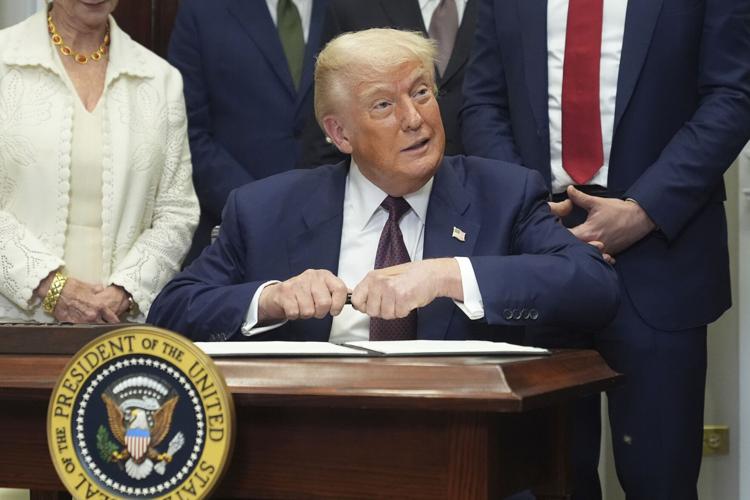

WASHINGTON — U.S. hiring slowed sharply last month, the Labor Department reported Friday, as President Donald Trump’s erratic and radical trade policies paralyze businesses and raise doubts about the outlook for the world’s largest economy.
After the report was released, Trump fired the head of the agency that produces the monthly jobs figures.
On his social media platform, Trump claimed the figures were manipulated for political reasons and said Erika McEntarfer, the director of the Bureau of Labor Statistics who was appointed by former President Joe Biden, should be fired. He provided no evidence for the charge.
“I have directed my Team to fire this Biden Political Appointee, IMMEDIATELY,” Trump posted. “She will be replaced with someone much more competent and qualified.”
Trump’s move to fire McEntarfer represented another extraordinary assertion of presidential power. He has wielded the authority of the White House to try to control the world’s international trade system, media companies, America’s top universities and Congress’ constitutional power of the purse, among other institutions.
“Firing the Commissioner … when the BLS revises jobs numbers down (as it routinely does) threatens to destroy trust in core American institutions, and all government statistics,” Arin Dube, an economist at the University of Massachusetts-Amherst, said on social media. “I can’t stress how damaging this is.”
“What does a bad leader do when they get bad news? Shoot the messenger,” Senate Minority Leader Chuck Schumer, D-N.Y., said in a Friday speech.
After Trump's initial post, Labor Secretary Lori Chavez-DeRemer said on social media that McEntarfer was no longer leading the bureau and William Wiatrowski, the deputy commissioner, would serve as the acting director.
“I support the President’s decision to replace Biden’s Commissioner and ensure the American People can trust the important and influential data coming from BLS,” Chavez-DeRemer said.
McEntarfer was nominated by Biden in 2023 and became the Commissioner of the Bureau of Labor Statistics in January 2024. Commissioners typically serve four-year terms but, since they are political appointees, they can be fired. The commissioner is the only political appointee of the agency, which has hundreds of career civil servants.
U.S. employers added just 73,000 jobs last month, the Labor Department reported, well short of the 115,000 expected.
Worse, revisions shaved a stunning 258,000 jobs off May and June payrolls. The unemployment rate ticked higher to 4.2% as Americans dropped out of the labor force and the ranks of the unemployed rose by 221,000.
"A notable deterioration in U.S. labor market conditions appears to be underway," said Scott Anderson, chief U.S. economist at BMO Capital Markets. "We have been forecasting this since the tariff and trade war erupted this spring and more restrictive immigration restrictions were put in place. Overall, this report highlights the risk of a harder landing for the labor market."
Revisions are a standard part of the monthly jobs report. The Labor Department revises its numbers as more data comes in. Particularly since COVID-19, businesses have taken longer to respond to the government's survey on hiring. As more data comes in later than in the past, the potential for large revisions increased.
Economists warned the rift with every U.S. trading partner will begin to appear this summer and the Friday jobs report appeared to sound the bell.
"We're finally in the eye of the hurricane," said Daniel Zhao, chief economist at Glassdoor. "After months of warning signs, the July jobs report confirms that the slowdown isn't just approaching — it's here."
Revelations in the new data raise questions about the health of the job market and the economy as Trump pushes forward an unorthodox overhaul of American trade policy.
Trump discarded decades of U.S. efforts to lower trade barriers globally, instead imposing hefty import taxes, or tariffs, on products from almost every country on Earth. Trump believes the levies will bring back manufacturing to America and raise money to pay for the massive tax cuts he signed into law July 4.
Trump’s new tariff rates of up to 41% on U.S. imports from dozens of countries drew expressions of relief Friday from some countries that negotiated a deal or managed to whittle them down from rates announced in April.
Others expressed disappointment or frustration over running out of time after hitting Trump’s Aug. 1 deadline for striking deals.
Canadian Prime Minister Mark Carney said his government is disappointed by Trump’s move to raise the U.S. tariff on goods from America’s northern neighbor to 35% from 25%.
Mainstream economists warned that the cost of the tariffs will be passed along to Americans, both businesses and households.
That has begun.
Walmart, Procter & Gamble, Ford, Best Buy, Adidas, Nike, Mattel, Shein, Temu and Stanley Black & Decker all hiked prices due to U.S. tariffs. Economists at Goldman Sachs estimate that overseas exporters absorbed just one-fifth of the rising costs from tariffs, while Americans and U.S. businesses picked up the lion's share of the tab.
Trump sowed uncertainty in the erratic way he rolled out the tariffs — announcing, then suspending them, then coming up with new ones. He signed an executive order that set new tariffs on a wide swath of U.S. trading partners to that go in effect Aug. 7 after a flurry of unexpected tariff-related actions this week.
"There was a clear, significant, immediate, tariff effect on the labor market and employment growth essentially stalled, as we were dealing with so much uncertainty about the outlook for the economy and for tariffs," said Blerina Uruci, chief U.S. economist for the brokerage T. Rowe Price.
On Wednesday, Trump said on his social media platform, “THE AUGUST FIRST DEADLINE IS THE AUGUST FIRST DEADLINE — IT STANDS STRONG, AND WILL NOT BE EXTENDED.”
Thursday afternoon, White House representatives — and Trump — still insisted no more delays were possible. But when Trump signed the order Thursday night, the start date of the punishing import taxes was pushed back seven days so the tariff schedule could be updated.

