

PARIS (AP) — The humble baguette — the crunchy ambassador for French baking around the world — is being added to the U.N.'s list of intangible cultural heritage as a cherished tradition to be preserved by humanity.
UNESCO experts gathering in Morocco this week decided that the simple French flute — made only of flour, water, salt, and yeast — deserved United Nations recognition, after France's culture ministry warned of a "continuous decline" in the number of traditional bakeries, with some 400 closing every year over the past half-century.
The U.N. cultural agency's chief, Audrey Azoulay, said the decision honors more than just bread; it recognizes the "savoir-faire of artisanal bakers" and "a daily ritual."

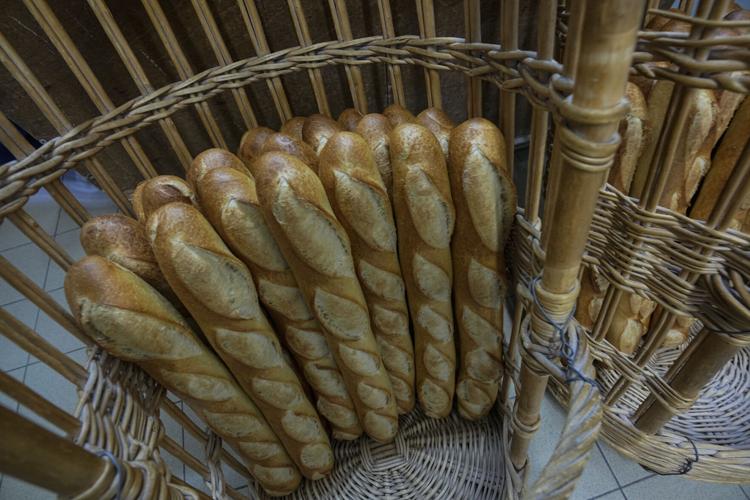
Baguettes in a basket are pictured at a bakery, in Versailles, west of Paris, Tuesday, Nov. 29, 2022. The humble baguette -- the crunchy ambassador for French baking around the world -- is being added to the U.N.'s list of intangible cultural heritage as a cherished tradition to be preserved by humanity. UNESCO experts gathering Wednesday Nov. 30, 2022 in Morocco decided that the simple French flute deserved U.N. recognition. (AP Photo/Michel Euler)
"It is important that such craft knowledge and social practices can continue to exist in the future," added Azoulay, a former French culture minister.
The agency defines intangible cultural heritage as "traditions or living expressions inherited from our ancestors and passed on to our descendants."
With the bread's new status, the French government said it planned to create an artisanal baguette day, called the "Open Bakehouse Day," to connect the French better with their heritage.

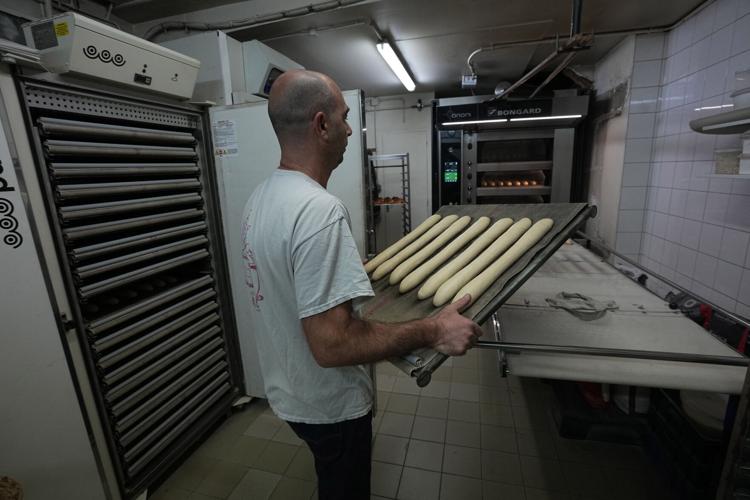
Baker David Buelens carries uncooked baguettes to the oven at a bakery in Versailles, west of Paris, Tuesday, Nov. 29, 2022. The humble baguette -- the crunchy ambassador for French baking around the world -- is being added to the U.N.'s list of intangible cultural heritage as a cherished tradition to be preserved by humanity. UNESCO experts gathering Wednesday Nov. 30, 2022 in Morocco decided that the simple French flute deserved U.N. recognition. (AP Photo/Michel Euler)
Back in France, bakers seemed proud, if unsurprised.
"Of course, it should be on the list because the baguette symbolizes the world. It's universal," said Asma Farhat, baker at Julien's Bakery near Paris' Champs-Elysees avenue.
"If there's no baguette, you can't have a proper meal. In the morning you can toast it, for lunch it's a sandwich, and then it accompanies dinner."
Although it seems like the quintessential French product, the baguette was said to have been invented by Vienna-born baker August Zang in 1839. Zang put in place France's steam oven, making it possible to produce bread with a brittle crust yet fluffy interior.

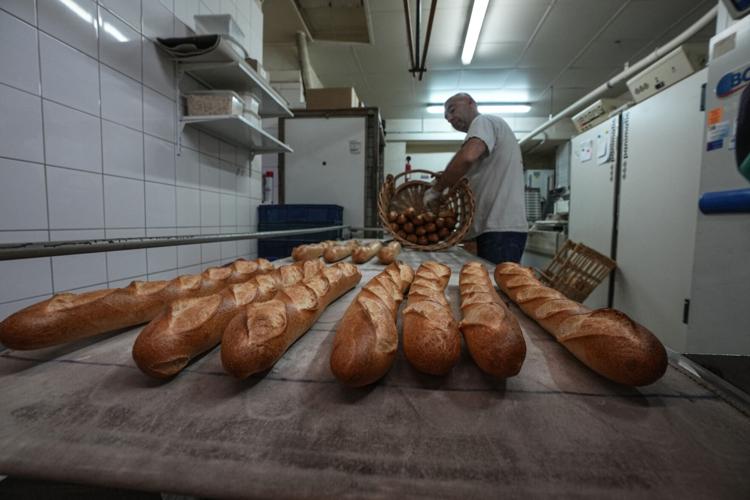
Baker David Buelens puts the baguettes into a basket at a bakery, in Versailles, west of Paris, Tuesday, Nov. 29, 2022. The humble baguette -- the crunchy ambassador for French baking around the world -- is being added to the U.N.'s list of intangible cultural heritage as a cherished tradition to be preserved by humanity. UNESCO experts gathering Wednesday Nov. 30, 2022 in Morocco decided that the simple French flute deserved U.N. recognition. (AP Photo/Michel Euler)
The product's zenith did not come until the 1920s, with the advent of a French law preventing bakers from working before 4 a.m. The baguette's long, thin shape meant it could be made more quickly than its stodgy cousins, so it was the only bread that bakers could make in time for breakfast.
Despite the decline in traditional bakery numbers today, France's 67 million people still remain voracious baguette consumers — purchased at a variety of sales points, including in supermarkets. The problem is, observers say, that they can often be poor in quality.
"It's very easy to get bad baguette in France. It's the traditional baguette from the traditional bakery that's in danger. It's about quality not quantity," said one Paris resident, Marine Fourchier, 52.
In January, French supermarket chain Leclerc was criticized by traditional bakers and farmers for its much publicized 29-cent baguette, accused of sacrificing the quality of the famed 65-centimeter (26-inch) loaf. A baguette normally costs just over 90 euro cents (just over $1), seen by some as an index on the health of the French economy.

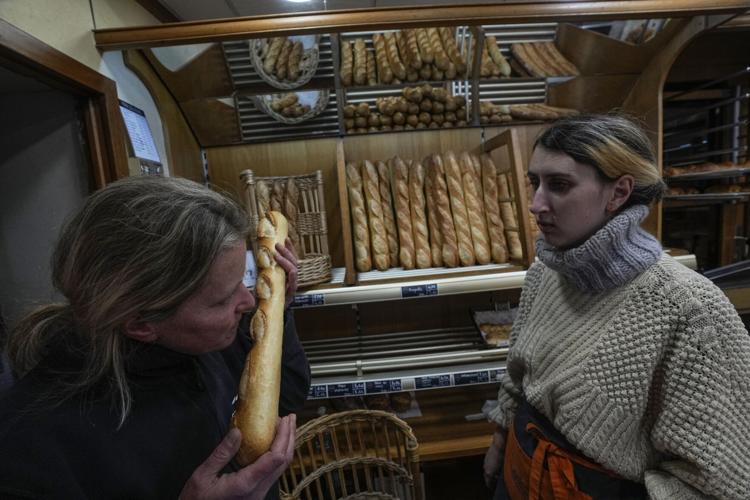
Bakery owner Florence Poirier, LEFT, smells the fresh baguette who comes out of the oven as Mylene Poirier stands next to her at a bakery, in Versailles, west of Paris, Tuesday, Nov. 29, 2022. The humble baguette -- the crunchy ambassador for French baking around the world -- is being added to the U.N.'s list of intangible cultural heritage as a cherished tradition to be preserved by humanity. UNESCO experts gathering Wednesday Nov. 30, 2022 in Morocco decided that the simple French flute deserved U.N. recognition. (AP Photo/Michel Euler)
The baguette is indeed serious business. France's "Bread Observatory" — a venerable institution that closely follows the fortunes of the flute — notes that the French munch through 320 baguettes of one form or another every second. That's an average of half a baguette per person per day, and 10 billion every year.
The "artisanal know-how and culture of baguette bread" was inscribed at the Morocco meeting among other global cultural heritage items, including Japan's Furyu-odori ritual dances, and Cuba's light rum masters.
___

50 fascinating cultural UNESCO World Heritage Sites around the world
50 fascinating cultural UNESCO World Heritage Sites around the world
Updated
With domestic and international travel finally opening up again as COVID-19 restrictions have begun to loosen, many of us find ourselves itching to go somewhere new after nearly two years spent inside. The World Travel & Tourism Council told Travel + Leisure that 2022 will likely be an even busier year for travel than pre-pandemic times. More specifically, they’re expecting 28.4% growth in domestic travel in the new year, as well as a 228% bump in spending by international travelers in the U.S.
That being said, knowing that we want to go somewhere new and where that somewhere new actually is are two very different things. With the sheer amount of places waiting to be seen, it can sometimes be overwhelming to decide where your next destination should be. That’s where we come in. Using the UNESCO website as well as travel blogs and city guides, Stacker compiled a list of 50 fascinating cultural UNESCO World Heritage Sites from around the world.
From Buddhist temples to Knights Templar initiation sites to ancient dwelling places, these sites cover six of the seven continents and include modern wonders as well as artifacts from antiquity. From the most adventurous and the most laid-back traveler to the international veterans and those without a passport, there’s a special vacation destination for everyone on this list.
You may also like: Countries most dependent on tourism

Karnak Temple, Luxor, Egypt
Updated
The Karnak Temple Complex, which was developed over the course of more than 1,000 years, was once considered the largest and most important religious complex in Egypt. Its most important building was the Temple of Amun-Re, which was believed to be the sun god’s earthly dwelling.
Machu Picchu, Peru
Updated
Discovered in 1911, Machu Picchu is believed to be the Inca Empire’s most amazing architectural feat. Composed of temples, palaces, terraces, monuments, complexes, and water channels, the citadel receives over 1.5 million visitors each year.
Hierapolis, Pamukkale, Turkey
Updated
The Pamukkale thermal pools have been a popular tourist destination since antiquity; wealthy Romans used to retire here in order to enjoy the healing waters as frequently as possible. Their cottony appearance (the word Pamukkale literally means “cotton castle”) is caused by the high levels of calcium carbonate in the mineral water.
Spiš Castle, Slovakia
Updated
Built in the 12th century, Spiš Castle was an important political, cultural, and economic center for the Kingdom of Hungary. In the centuries since, several movies have been filmed on the castle’s grounds, including, “Dragonheart,” “The Lion in Winter,” and “The Last Legion.”
Potala Palace in Tibet
Updated
The Potala Palace is located on Red Mountain, some 12,000 feet above sea level. For hundreds of years, the palace was the winter residence of the Dalai Lama, and, as a result, is an important location in the history and development of Tibetan Buddhism.
You may also like: Most popular national parks in America
Petra, Jordan
Updated
The first building one sees when entering the ancient city of Petra is Al-Khazneh, or the Treasury, as it is known. Built in the first century BC, archaeologists believe the intricately decorated building served as either a temple or a place to store documents.
Ksar of Aït Benhaddou, Morocco
Updated
This wood and earthen fortress used to be a popular stop on the caravan route between the Sahara desert and Marrakech in Morocco. Thought to be built in the 17th century, the well-preserved citadel is still home to five families.
Chefchaouen, Morocco
Updated
Founded in 1471 by a descendant of the Prophet Muhammad, the city of Chefchaouen is best known for the various shades of blue that cover its walls. Theories abound as to the color choice—some believe it was intended to honor Jewish custom, others believe it was a mosquito deterrent, and there are also those who argue it was simply a way to keep homes cool in the summer.
Pompeii, Italy
Updated
On August 24, 79 AD, Mount Vesuvius erupted, burying the Roman towns of Pompeii and Herculaneum and killing an estimated 2,000 to 16,000 people. In an ironic twist of fate, the massive amounts of volcanic mud, debris, and gasses that claimed these lives almost perfectly preserved the towns, giving modern-day archeologists an unrivaled glimpse at what life was like in ancient times.
Meteora, Greece
Updated
Meteora, which means “suspended in air” in Greek, is the perfect descriptor for these monasteries built on top of a complex of rock pillars (some of which reach over 600 meters). The area was first used by monks in the ninth and 10th centuries, and today six of the 24 original monasteries remain active.
You may also like: 100 monumental novels from literary history
Piazza San Pietro in Vatican City
Updated
The Piazza San Pietro (or St. Peter’s Square) was constructed between 1656 and 1667 at the site where St. Peter—one of Jesus’ apostles and the first Catholic Pope—was killed. Massive in scale, it is 320 meters long, 240 meters wide, and can hold 300,000 people.
Stonehenge, England
Updated
Theories abound as to who constructed Stonehenge, ranging from the wizard Merlin to aliens. First built nearly 5,000 years ago, most experts agree the arrangement of menhirs (which took an estimated 20 million hours to construct) is either a religious site or a scientific observatory.
Wat Mahathat, Ayutthaya, Thailand
Updated
The headquarters of the Mahanikai school of Buddhism, Wat Mahathat predates the founding of Bangkok. It is believed that the complex houses a relic of the Buddha, though what exactly that relic is, and where it is hidden, remains a mystery.
Mausoleum of First Qin Emperor China
Updated
First buried in 210 BC, these terracotta warriors, which surround Emperor Qin’s tomb, weren’t discovered until 1974. Thousands of soldiers, each with a unique facial expression, are arranged by rank, guarding the still uncovered final resting place of the man who united China.
Teotihuacan, Mexico
Updated
Built sometime in the first century, the Pyramid of the Sun (pictured) and the Pyramid of the Moon are among the largest structures in ancient America. The crowning achievements of Teotihuacan culture, experts aren’t sure exactly what the buildings were used for, as very few records remain.
You may also like: Top 100 city destinations in the world
Bryggen, Bergen, Norway
Updated
Pictured above is the Bryggen harbor district in Bergen, Norway, one of Northern Europe’s oldest port cities. The colorful houses are made of wood, and though several fires over the centuries have destroyed many of the original buildings, they have always been rebuilt using traditional materials and construction techniques.
Mont Saint Michel, Normandy, France
Updated
Construction on the Benedictine abbey Mont Saint-Michel began around the 11th century. Romanesque and Gothic in style, the stunning church has been a popular pilgrimage destination over the years despite its difficult-to-access location (on a rocky islet that’s exposed to tides coming from both Normandy and Brittany).
Hawa Mahal Palace, Jaipur City, India
Updated
Built in the form of Krishna’s crown, the five-story Hawa Mahal palace has a whopping 953 windows. These windows, as well as their surrounding latticework panels, allow for breezes to flow freely throughout the palace, making it an ideal summer dwelling and earning it the nickname “The Palace of Winds.”
Meroë Pyramids, Kabushiya, Sudan
Updated
Located in Meroë, the capital city of the Kingdom of Kush, these pyramids were built up to 4,600 years ago. Done in the Nubian style, the roughly 200 pyramids (which served as royal burial sites) still exist in this city—more than in the entirety of the country of Egypt.
Djenné, Mali, West Africa
Updated
One of the oldest towns in sub-Saharan Africa, Djenné is an excellent example of ancient adobe architecture. The once-thriving city was a key stop on trans-Saharan trade routes as well as a thriving center for Islamic scholarship.
You may also like: Every US president’s and first lady’s official portraits
Amarbayasgalant Monastery, Mongolia
Updated
The Amarbayasgalant monastery was built between 1727 and 1737 as a monument to the famous sculptor Zanabazar. Communists destroyed several buildings in the 1930s, though much of it has since been restored, allowing about 50 monks to call the place home.
Kathmandu Valley, Nepal
Updated
The Boudhanath Stupa, a meditative monument and offering site, is one of the most significant pieces of Buddhist architecture. Built in the 14th century, the dome and tower are covered in pairs of eyes meant to remind visitors of the all-knowing nature of Buddha.
Great Wall, China
Updated
One of the longest construction projects of all time, the Great Wall of China was continuously worked on from about 220 BC, when China’s first Emperor Qin Shi Huang ordered existing sections to be joined together to create a universal defense system, to the 17th century. In all, the wall measures 20,000 km (or 12,427 miles) in length.
La Sagrada Familia, Barcelona, Spain
Updated
Another construction project that’s taken an abnormally long time to finish, La Sagrada Familia (or the Church of the Sacred Family) began in 1882 and is projected to be finished in 2026. The Gothic-with-a-twist cathedral was designed by the famous architect Antoni Gaudí, and has been described by critics as “a feast for the eyes and full of symbolism.”
Palmyra, Syria
Updated
The crossroads of ancient civilizations, Palmyra, by nature of the fact that it was a major city on a trade route, linked China, Persia, and India with the Roman Empire. Its ancient ruins were discovered in the 17th and 18th centuries and, after being nearly destroyed by ISIS in the 2010s, conservators have begun rebuilding.
You may also like: 50 most peaceful countries in the world
Kew Gardens, London England
Updated
Kew Gardens, a botanic garden located in the heart of London, has one of the largest and most diverse collections of living plants in the world. Princess Augusta, the mother of King George III, began the garden back in 1759, and various royals and government agencies have been adding to it ever since.
Sintra, Portugal
Updated
Located on the Quinta da Regaleira, a private estate in Sintra, Portugal, the Initiation Well is not a water source but an inverted underground tower that was once used for rituals for the Knights Templar organization. Visitors to the site today can retrace the steps potential knights would have taken before being initiated into the group.
Honghe Hani Rice Terraces
Updated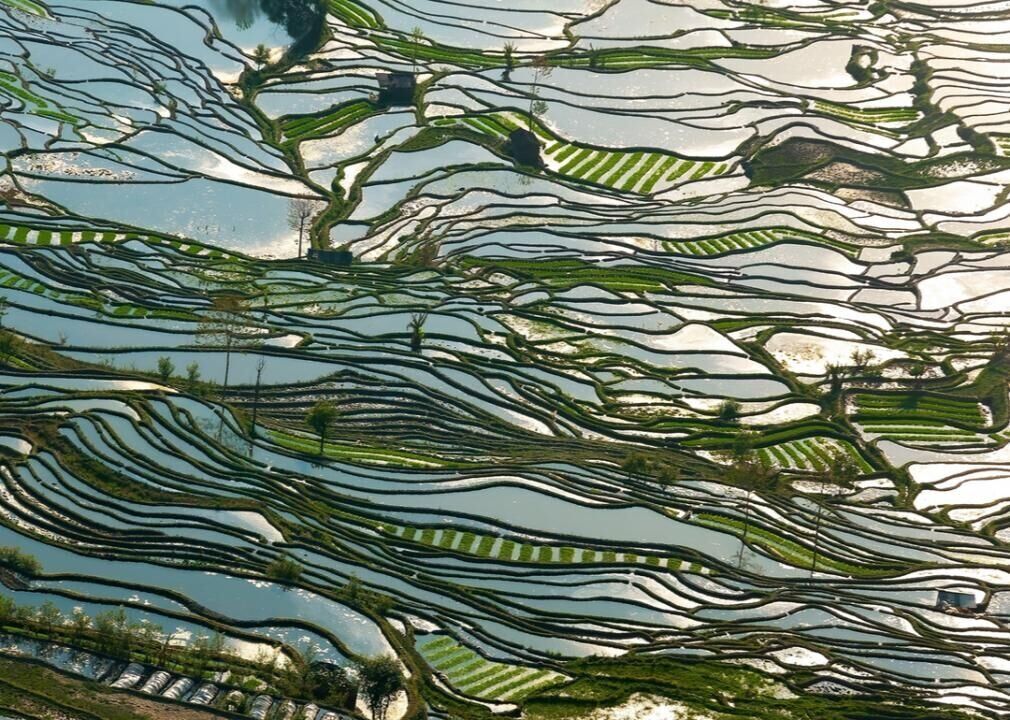
Some 1,300 years ago, the Hani people began the engineering marvel that is the Honghe Hani Rice Terraces. Covering about 160 square kilometers, the terraces are arranged in such a way that water can travel from the top of the Ailao Mountains to the Hong River, weaving around the 82 villages that are incorporated into the area.
Bete Giyorgis, Lalibela, Ethiopia
Updated
Commissioned by Emperor Gebre Meskel Lalibela, the Bete Giyorgis (or Church of St. George) was one of 11 churches built as a part of a new “Ethiopian Jerusalem,” according to Atlas Obscura. Created from a single piece of stone—it was carved from the inside out—the church is the most elaborate surviving example of the project.
Masada, Israel
Updated
Built between 37 and 4 BC by King Herod, Masada is a palatial fortress overlooking the Dead Sea. In 73 AD, it was co-opted by a group of Jews, who, having been expelled from their homes by the Romans, used it as a final stronghold, living there for three years before they chose to die rather than fall into the hands of their persecutors alive.
You may also like: 50 famous paintings and the stories behind them
Skellig Michael, Ireland
Updated
In the sixth century, a group of Catholic monks moved to the jagged rock, Skellig Michael, just off the coast of County Kerry in Ireland. They lived and prayed in beehive-shaped huts (like the one pictured above), only abandoning the settlement in the 13th century.
Douro Valley, Portugal
Updated
The oldest demarcated wine region in the world, folks have been growing grapes in the Douro Valley for some 2,000 years. The primary product of these vineyards is port, a strong and sweet wine that is often served with dessert.
Palpa Geoglyphs, Peru
Updated
Over the course of about 2,000 years, several pre-Hispanic societies carved massive geoglyphs (pictures of figures, animals, plants, and bugs as well as geometrical shapes) into the hillsides and flat arid ground of the Peruvian plains. The how and why of these drawings remains a mystery, but they demonstrate a religious and social homogeneity among these early cultures.
Bamiyan Buddhas, Afghanistan
Updated
Two enormous and highly decorated Buddhas were carved into the mountainside outside Bamiyan, Afghanistan, between 550 and 615 AD by the Gandhara civilization. Commonly referred to as the Bamiyan Buddhas, the popular pilgrimage destinations stood for more than 1,000 years, until the Taliban destroyed them in 2001.
Borobudur Temple, Indonesia
Updated
Located on the island of Java, the Borobudur Temple complex was built during the Syailendra Dynasty between the eighth and ninth centuries. It was an important place of worship until sometime between the 10th and 15th centuries, when it was inexplicably abandoned, only to be rediscovered in the 19th century.
You may also like: The most popular book the year you were born
Hohensalzburg Castle, Salzburg, Austria
Updated
An imposing medieval castle and fortress, the Hohensalzburg castle was built at the behest of the prince bishops (bishops who also ruled principalities) in the late 11th century. Set atop a steep, conical rock, the castle has never been captured by foreign troops.
Khiva, Uzbekistan
Updated
Khiva, Uzbekistan was once a major town on the Great Silk Road. Believed to have been founded by one of Noah’s sons, Shem, the city quickly became an important center of Islam with 94 mosques and 63 madrassahs.
Kizhi Pogost, Kizhi Island, Russia
Updated
On an island in Lake Onega lies a group of wooden buildings known as the Kizhi Pogost. The centerpiece of these buildings is the Church of the Transfiguration, a Russian Orthodox house of worship, which is rumored to have been built with a single ax and without a single nail.
Cliff Palace, Mesa Verde National Park, Colorado, USA
Updated
At one point, it was believed that 100 people lived in the 150 rooms and 23 kivas (rooms for religious rituals) located in Cliff Palace. One of the best-preserved examples of the cliff-side homes inhabited by ancient Pueblo people, the palace is made of sandstone, mortar, and wooden beams.
Old City Prague, Czech Republic
Updated
Historic Prague is one of the only examples of a medieval urban city that exists on earth. Set along both banks of the Vltava River, the city hasn’t fallen victim to any large-scale renewals or demolitions, which means it remains, largely, exactly as it did during the 11th-18th centuries.
You may also like: 30 incredible photos that show the true power of nature
Cappadocia, Turkey
Updated
Forces of erosion and large quantities of volcanic material are responsible for the mountain ridges, valleys, and “fairy chimneys” that give Cappadocia, Turkey, its unique landscape. The area, which is often visited by hot air balloon tour, is home to several underground cities and churches that are carved directly into the rock.
Thingvellir, Iceland
Updated
Thingvellir, Iceland, is the only place in the world where the rift between the North American tectonic plate and the Eurasian tectonic plate is above sea level. This unique geological attribute has lent the area a sacred feeling, and, as a result, some of the biggest moments in the country’s history (like its renunciation of the Norse pagan belief system for Christianity, and its declaration of independence from Denmark) have taken place here.
Struve Arc Triangulation Point, Hammerfest, Norway
Updated
Friedrich Georg Wilhelm von Struve, a German scientist, used a chain of survey triangulations—which begin in Hammerfest, Norway, and end in the Black Sea—to help establish the exact shape and size of the earth. Stretching through 10 countries, these 34 station points (called the Struve Geodetic Arc) are an incredible example of global collaboration in the name of science.
Eiffel Tower, Paris, France
Updated
The undisputed symbol of France, the Eiffel Tower is 1,023 feet tall. The “Iron Lady,” as she is often called, receives over 7 million visitors each year, the vast majority of whom are international travelers.
Taos Pueblo, New Mexico
Updated
The only living Native American community to be dubbed a UNESCO World Heritage Site and National Historic Landmark, Taos Pueblo is believed to be one of the oldest continuously inhabited settlements in the United States. For over 1,000 years, the Taos Indians have lived in these adobe dwellings, and most of the current buildings were constructed between 1000 and 1450 AD.
You may also like: Famous works of art from 30 countries around the world
Alberobello, Puglia, Italy
Updated
Alberobello, in the Puglia region of Italy, has the highest concentration of trulli houses anywhere in the country. The round dwellings are made of limestone boulders and topped with dome-, pyramid-, or cone-shaped roofs made of limestone slabs.
Itsukushima Shinto Shrine, Miyajima, Hiroshima
Updated
Deemed one of the most scenic spots in all of Japan, Miyajima is a holy place in the Shinto religion, dedicated to the gods that protect people from sea disasters and wars. The earliest shrines on the island were built around the sixth century, but the enormous torii gate (and its companion shrine pavilion) that are there today were built more recently in the 12th century.
Our Lady of the Rocks, Kotor Bay, Montenegro
Updated
In the Bay of Kotor, Montenegro there are two small man-made islands. One of them, Our Lady of the Rocks, boasts a Catholic chapel built in 1722 that houses a 15th-century icon of the Virgin Mary.
Venice, Italy
Updated
No city in the world boasts as many artistic riches as Venice, Italy. Almost every building in the 118-island city contains works by visionaries like Titan, Veronese, and Tintoretto.
Ha Long Bay, Vietnam
Updated
More than 1,600 limestone islands and islets dot Ha Long Bay in Vietnam. Most of these islands are uninhabitable and have been essentially unaffected by human interference, meaning that a wide variety of flora, fauna, and animal life that can’t be found anywhere else flourish here.
You may also like: Architectural history from the year you were born

