


Noah Hawley’s goal isn’t to rewrite what others have written, but to expand upon the worlds they’ve created.
In the case of the television versions of “Fargo,” and “Alien,” “I thought there were a lot of really powerful ideas still to be explored,” he says.
With the Coen Brothers’ “Fargo,” the Emmy winner was able to find five other stories that fit nicely in the quirky world they had created.

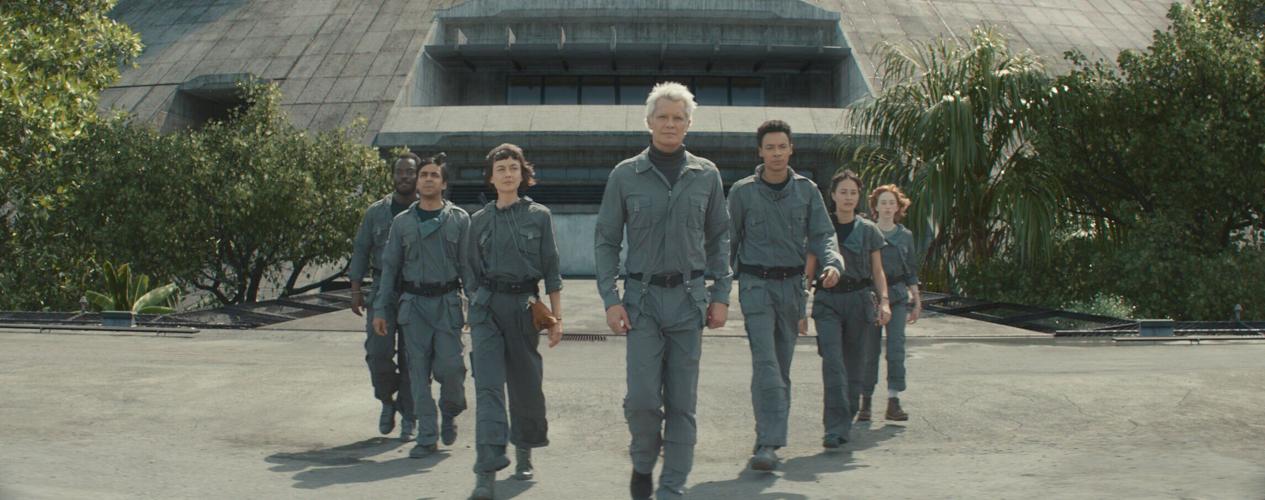
From left, Jonathan Ajayi, Adarsh Gourav, Sydney Chandler, Timothy Olyphan, Kit Young, Erana James and Lily Newmark star in "Alien: Earth."
Now, in “Alien: Earth,” he’s expanding upon the idea Ridley Scott created with “Alien.”
Because fans of the 1979 film have already “discovered” the creature Scott introduced, Hawley had to find other lures. “When we put the monsters in, that’s the money-back guarantee, right?” he says. “So, we had to create this human drama in which you have a lot of human monsters as well and explore a lot of issues about the world that we’re living in, just projected into the future.”
In “Alien: Earth,” creatures other than the Xenomorph are circulating; the world they inhabit is run by five corporations and the idea of “man vs. machine” takes a slight bent when you discover there are hybrids also lurking.
Set two years before the events of “Alien,” “Alien: Earth” focuses on inhabitants of the spaceship Maginot. It crashes on Earth and a hybrid (played by Sydney Chandler), is part of a team discovering new fears.
'Alien' encounters: Sydney Chandler goes boldly into an unexplored world
“At the heart of ‘Alien’ is humanity trapped between nature and technology and they’re both trying to kill us,” Hawley says. “The question becomes, in an ‘Alien’ movie, can these two or three human beings survive? In the (series), it’s can humanity itself survive?”
Spread over eight episodes, the series requires a deft hand to give it some sense of closure. “Endings are what give stories meaning,” Hawley says. “If you don’t think about where you’re going, you’re just sort of vamping.”
“Alien: Earth” touches on all sorts of changes since the first film: Artificial intelligence, corporate greed, scientific advancements, bio-warfare.
To give audiences something to latch onto, Hawley offers a “Peter Pan” analogy.

From left, Alex Lawther as Hermit, Diêm Camille as Siberian, Moe Bar-El as Rashidi in "Alien: Earth."
“If I had done the 1970s version of capitalism, it wouldn’t have felt right for the world we live in today,” he says. “Once the ‘Peter Pan’ analogy emerged in the storytelling, it became clear that the CEO who invents this hybrid technology should be the Peter Pan character himself.”
In the first “Alien,” two characters suggested they were at the whim of a larger corporation.
“Here, we really feel like it’s about the whim of Boy Kavalier: ‘Yeah, let’s send these billion-dollar prototypes to a crash site,’” Hawley says. “We’re in a different sort of state where the individual is at the mercy now, not just of this nameless, faceless corporation, but these boy geniuses.”

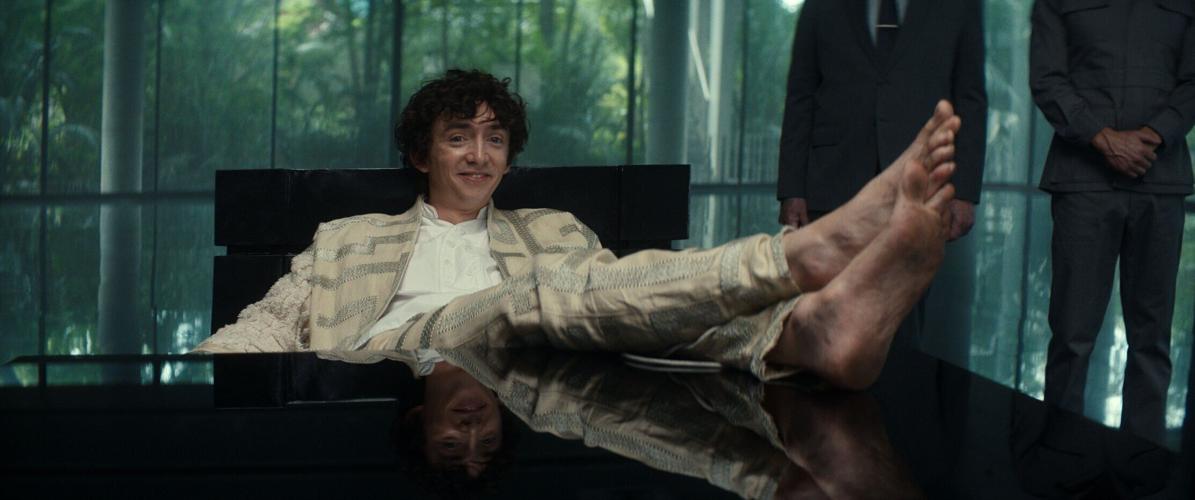
Samuel Blenkin as Boy Kavalier
Samuel Blenkin, who plays Kavalier, leaned into the Peter Pan references. “There was a moment when we were thinking about, ‘Maybe this guy just wears pajamas and waltzes around,’” he says.
Expanding on the idea, he, Hawley and costume designer Suttirat Larlarb decided that maybe it would be best for him to be barefoot, too.
“I fought really hard for the bare feet,” Blenkin says. “We got to the end of the shoot, and I realized I hadn’t worn a pair of shoes for the whole shoot. My feet became leather-hard.”
Collaboration, Hawley adds, is important to something as expansive as “Alien: Earth.”
“Science fiction has a responsibility to really look at the issues we’re wrestling with on this Earth and try to envision a future in which we can solve them,” he says. “My hope is that people come out of (the series) still thinking about the show and talking about it.”
“Alien: Earth” airs on FX and Hulu.
Review: There's plenty to unpack in 'Alien: Earth'

