

Axel Kramer knows exactly where to find amber.
He walks down the boardwalk of the village of Dahme on the German Baltic coast, checks the wind and the surf, looks at the different kinds of mussels and algae that washed up, and points to a small bulge on the beach.
A dozen people who followed his every move eagerly jump down to the waterline, then pull up seagrass and kelp. One of them triumphantly holds up a little piece of shiny, honey-colored amber.
"Unbelievable. I'm 57 now and grew up on the Baltic Sea, and I've never found it before," Frank Philipp said. "I'm really excited about it. Now I'm digging around more and I'm hooked."

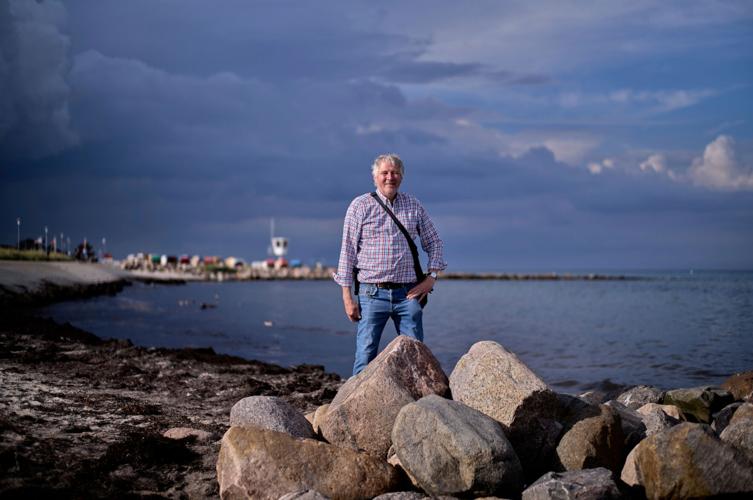
Axel Kramer a tourist guide and amber expert poses for a photo during a guided amber hunt for tourists on the beach of the Baltic resort of Dahme, Germany, Tuesday, Sept. 2, 2025. (AP Photo/Markus Schreiber)
Ancient pursuit
Kramer, a 66-year-old nature guide, has been collecting amber since he was 6 years old. At some point he realized that he has talent — or just decades of experience — for discovering the coveted pieces and started offering amber collecting tours.
People living along the Baltic Sea — from Denmark and Germany to Poland, the Baltic states, and up north to Sweden — have collected amber for thousands of years. They made beautiful jewelry out of it, used it in barter and placed it in graves.
Today, amber stores line the Baltic coastal towns, and many tourists take home necklaces, earrings and rings as souvenirs.

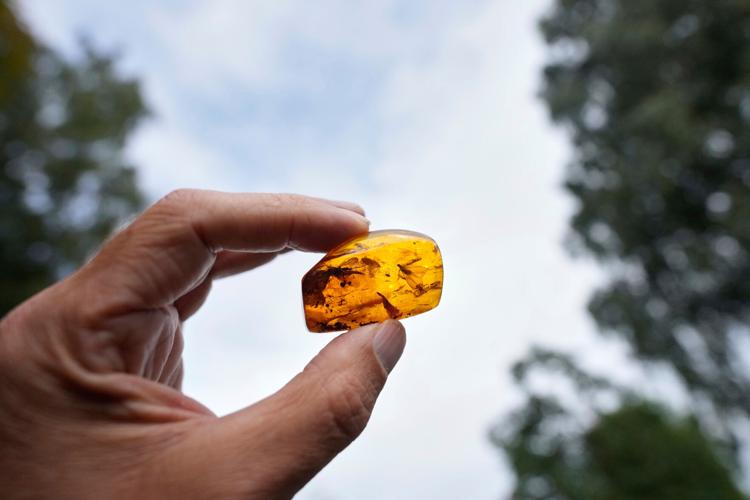
Vollrath Wiese shows a piece of amber with insects trapped inside, at the "Nature House" museum in the village of Cismar near the Baltic Sea resort of Dahme, Germany, Tuesday, Sept. 2, 2025. (AP Photo/Markus Schreiber)
Not a stone
Amber — also dubbed the "gold of the ocean" — is not a gemstone or jewel, but fossilized resin.
While some kinds of amber are up to 400 million years old, Baltic amber is only about 45 million years old. It originates from the forests in Finland and Sweden and was brought to the Baltic coast by glaciers during the Ice Age.
One can sometimes find so-called inclusions of insects or plants inside amber — they got stuck to the resin when it dropped off the trees.
"There used to be 120 commercial grades of amber, all very different, from practically black to practically white," said Vollrath Wiese, a biologist and expert on amber. "Bony white forms with lots and lots of bubbles inside and beautiful, almost clear amber, honey-colored."
"Whether amber is transparent or not actually depends on the number of microscopic (air) bubbles it contains," Wiese said, showing pieces from the amber collection at the House of Nature museum in Cismar, which he runs.

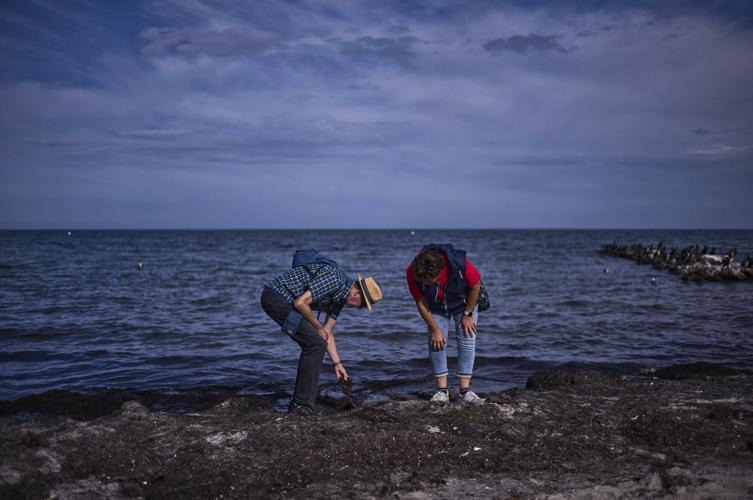
Tourist couple Guenter Hildebrandt, left, and Giesela Hildebrandt search for amber during a guided amber hunt for tourists at the beach of the Baltic Sea resort of Dahme, Germany, Tuesday, Sept. 2, 2025. (AP Photo/Markus Schreiber)
'Happy' hunting
The value of amber — called Bernstein in German — depends on its quality and runs from a few dollars per gram for regular pieces to up to more than $1,170 for especially beautiful, big pieces with rare inclusions such as scorpions, small lizards or spiders.
For Kramer, the value can't really be measured in money. "Collecting amber makes you happy," he said with a smile. "Many people tell me that collecting amber is better than yoga. It's pure therapy."
He said everyone, from children to older people, enjoys his amber collection tours and people often come back again and again.
"I've had CEOs who crawled around on all fours on the beach and were delighted when they found a small piece of amber," he said.

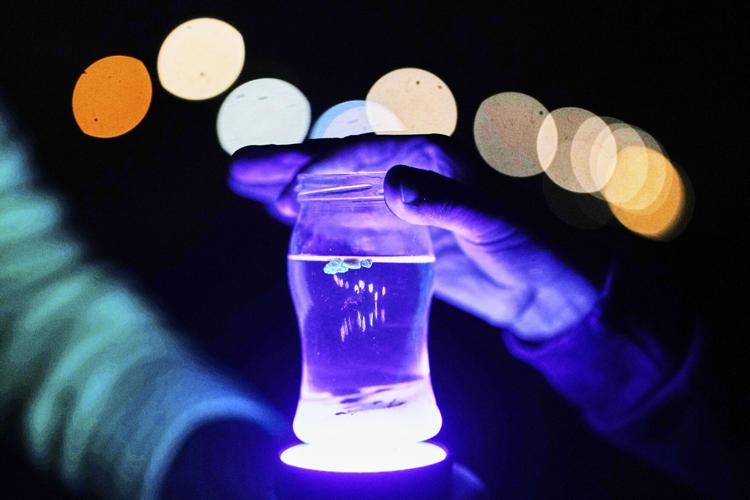
Participants hold a glass of salt water and a black light lamp in their hands to examine amber during a guided amber hunt for tourists on the beach of the Baltic Sea resort of Dahme, Germany, Tuesday, Sept. 2, 2025. (AP Photo/Markus Schreiber)
Is it really amber?
When a newbie finds a piece, they ask Kramer to check it — to find out if it's real amber or just an ordinary stone or piece of plastic.
Kramer pulls out a small glass jar with highly concentrated saltwater inside and drops the piece in. If it sinks, it's a stone; if it swims, it's amber.
A wool cloth also does the job: dry amber becomes electrostatically charged when rubbed and attracts paper scraps.
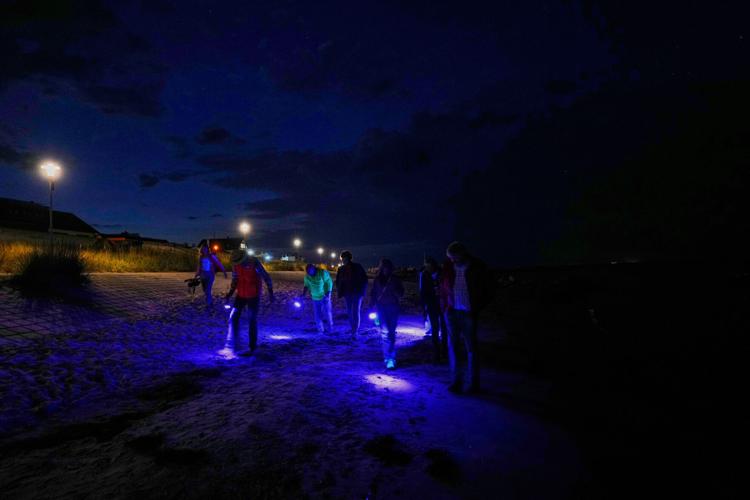
In recent years, collectors came up with another unique way of identifying amber. They go out at night, lighting up the beach with black light flashlights. When amber is exposed, it glows a bright yellow color. This way, collectors also can find tiny pieces hidden between stones and wood that they might not notice in daylight.

Participants search with a black light lamps in their hands for amber during a guided amber hunt for tourists on the beach of the Baltic Sea resort of Dahme, Germany, Tuesday, Sept. 2, 2025. (AP Photo/Markus Schreiber)
Tours along the sea
While many beach lovers collect amber on their own, organized collection tours, like the ones offered by Kramer, sprang up in recent years in almost every resort town on the Baltic Sea in Germany. The walking tours cost about $11.70 to $23.50 and often include lectures about folk customs surrounding amber.
In the Middle Ages, people attributed magical powers to amber and believed it protected them against witches and demons. Nowadays, many parents in Germany put amber necklaces on their babies because they are supposed to help with teething. Many jewelry stores on the Baltic Sea offer amber collars for dogs, which supposedly keep away ticks.
Collecting amber seems to be fulfilling, says Marion Ruprecht. The 54-year-old from the western city of Bochum, who works in the administration of a hospital, has vacationed in Dahme for more than 40 years.
"I find it absolutely thrilling, exciting, and also a lot of fun," she said, as she proudly held up two pieces she found during a night tour with Kramer. "I just think there's nothing better to do in the evening — it is relaxing and slows me down."
20 of the most surreal places to visit in the US
20 of the most surreal places to visit in the US
Updated
You know those places that feel so dreamlike that you ask yourself, "Did I just fall into a screensaver?" No? Well, that's probably because you've been visiting all those usual tourist traps. Let Way.com get you on the right track with the top 20 most surreal yet underrated places to visit in the U.S.
We're going to start with surreal places to visit in the U.S. because there's no place quite like home, is there? Add to that no passports or visas needed, and lo and behold, you have the recipe for a perfect getaway.

Fly Geyser, Nevada
Updated
This geyser isn't something nature originally intended. In fact, a geothermal company's drilling caused this happy geothermal accident. The geyser has created a bunch of travertine terraces, making about 30 to 40 pools spread across 74 acres. The water from the geyser is full of thermophilic algae that thrive in hot, wet conditions, painting the surrounding rocks in vibrant shades of green and red. The result—a place that looks almost like it's desperately trying to be part of James Cameron's next movie.
- Best time to visit: Spring or fall for pleasant weather.
- Nearest airport: Reno-Tahoe International Airport (RNO).
- How to get there: Two-hour drive north from Reno, Nevada. It's on private land, so book a guided tour through Friends of Black Rock-High Rock or Fly Ranch Burning Man Project.
- Pro tip: You can't just roll up and explore. Access is limited and controlled for conservation, so be sure to book.
Great Sand Dunes National Park, Colorado
Updated
Sheer drama. That's what the Great Sand Dunes are. Starkly beautiful desert dunes set against a backdrop of pretty, snow-capped mountains—not something you'll usually see in any popular places you'll visit in the U.S. It's part Sahara, part Colorado postcard, and entirely surreal.
- Best time to visit: October to April is cooler and has fewer crowds.
- Nearest airport: San Luis Valley Regional Airport (ALS) or Colorado Springs Airport (COS).
- How to get there: One-hour drive from El Paso, Texas.
- Pro tip: Rent a sled at the visitor center and embrace your inner desert child. No, really—the dunes are perfect for sliding.
Bonneville Salt Flats, Utah
Updated
Imagine a horizon so flat and so blindingly white that it messes with your sense of depth. After the rain, the whole place turns into a mirror. You'll be left wondering if the sky is on the ground or if you're in the clouds.
- Best time to visit: Late spring to early fall; post-rain for those mind-bending mirror effects.
- How to get there: One-and-a-half-hour drive from Salt Lake City via I-80 West.
- Nearest airport: Salt Lake City International Airport (SLC).
- Pro tip: Bring sunglasses (blinding white = eye squinting galore). Also, wear sturdy shoes and avoid walking barefoot on salt flats—it can cut your feet pretty badly.
White Sands National Park, New Mexico
Updated
The name is a dead giveaway, of course. But what the name does not prepare you for is how surreal and gorgeous White Sands is. Here's a fun fact—the dunes are pure white gypsum, not sand. So yes, it crunches underfoot like freshly fallen snow. Way.com recommends you go to sunset and stay for a moonrise. Trust us—when you experience it, you'll understand why.
- Best time to visit: October to April for cooler weather and fewer crowds.
- Nearest airport: El Paso International Airport (ELP).
- How to get there: One-hour drive from El Paso, Texas.
- Pro tip: Sledding on white sand is highly encouraged. Buy a sled at the visitor center and embrace your inner dune kid.
Mono Lake, California
Updated
There's old, and then there's Mono Lake old. This ancient saline lake is a weird yet wonderful place. Besides the fact that there are no fish in this lake, its most surreal feature is the tufa towers. These otherworldly-looking limestone spires erupt out of the water like alien sculptures. Be prepared for a distinct sulfur smell when you get up close.
- Best time to visit: Late spring or fall.
- Nearest airport: Mammoth Yosemite Airport (MMH) or Reno-Tahoe International Airport (RNO).
- How to get there: You can drive there from Lee Vining, California, or from Yosemite's east entrance.
- Pro tip: Sunrise or sunset is when the tufas look most haunting and magical.
The Wave (Coyote Buttes), Arizona/Utah Border
Updated
This is nature's lava lamp, frozen forever in sandstone. It's, no doubt, one of the most mind-bending places to visit in the U.S. but also one of the hardest to access. First-timers might feel they've walked into a painting. The surreal, swirling sandstone formations, with their vibrant reds, oranges, and yellows, look like something out of a dream or a sci-fi movie. The undulating patterns and smooth curves, sculpted by millions of years of wind and water, mess with your sense of scale and reality, making it feel both ancient and alive.
- Best time to visit: Spring or fall for mild weather.
- Nearest airport: Page Municipal Airport (PGA) or St. George Regional Airport (SGU).
- How to get there: Drive from Kanab, Utah, or Page, Arizona.
- Pro tip: You need a permit to enter. Apply in advance or try the local lottery system.
Glass Beach, California
Updated
A beach covered in colorful sea glass instead of sand sounds like a real-life Pinterest board. It's peaceful, sparkly, and oddly therapeutic, all thanks to years of wave-polished glass debris. Yup—the beauty of the beach is all thanks to trash, quite literally. This area used to be a dumping ground for trash, including glass, up until the mid-20th century. But then the Pacific Ocean did a magical thing and transformed the trash into the smooth, colorful sea glass that now awes travelers, young and old.
- Best time to visit: Year-round; though fall and winter sunsets are extra special.
- Nearest airport: Charles M. Schulz–Sonoma County Airport (STS).
- How to get there: Scenic three-and-a-half-hour coastal drive from San Francisco.
- Pro tip: Don't pocket the glass. It's protected and better left for others to enjoy.
Devils Tower, Wyoming
Updated
It rises straight out of the prairie like it was dropped there by another planet. Devil's Tower is just a couple of hours from the more popular Mount Rushmore near Keystone, South Dakota. This massive monolith is sacred, cinematic, and unforgettable. The natural structure is believed to have been created from the remains of a volcano. It has also been the site of many Native American religious ceremonies. Be warned—the path to walk up has a steep incline. There is a sidewalk that lets you get close to the formation and walk around it to see the grooves up close.
- Best time to visit: May to October.
- Nearest airport: Rapid City Regional Airport (RAP).
- How to get there: Two-hour drive from Rapid City, South Dakota.
- Pro tip: Go around sunset for the best views and colors. Stargazing here is also next level.
Painted Hills, Oregon
Updated
It's unreal when you drive around a corner, and woah, there's a painted hill. Because these hills certainly live up to their name, rich layers of red, gold, and black sweep across the land like brushstrokes. The colors shift depending on the angle of the sun, time of day, and moisture levels. Whatever the reasons, every visit feels slightly different because of these daily shifts, and that's why this is one of the most surreal places to visit in the U.S.
- Best time to visit: Spring and early fall.
- Nearest airport: Roberts Field (RDM) in Redmond, Oregon.
- How to get there: Two-hour drive from Bend, Oregon.
- Pro tip: The colors shine brightest in the late afternoon. Remember your camera and some water.
Apostle Islands Ice Caves, Wisconsin
Updated
This one's a real doozy in more ways than one. To start with, these ice caves look like something straight out of a fantasy novel with their shimmering icicles, frozen chambers, and glowing ice walls sculpted by nature. But here's the kicker: Access depends entirely on Lake Superior freezing solid, which rarely happens anymore. The last time conditions allowed safe access was in 2015, so it's become a rare event.
- Best time to visit: Winter, but only if the lake freezes solid enough for safe access.
- Nearest airport: Duluth International Airport (DLH).
- How to get there: Drive to Bayfield, Wisconsin.
- Pro tip: Watch for local park announcements and ice condition reports. If you ever get lucky enough to visit when it opens, drop everything and go. It's that spectacular and you may not get another chance.
Carlsbad Caverns, New Mexico
Updated
Descending into Carlsbad feels like walking into a fantasy film set. Way.com would not blame you if you expect to bump into an orc around the corner, because that's how otherworldly the caverns look. They stretch endlessly underground, with bizarre formations and echoing silence that's more calming than creepy.
- Best time to visit: Year-round.
- Nearest airport: El Paso International Airport (ELP).
- How to get there: Two-and-a-half-hour drive from El Paso, Texas
- Pro tip: Take the Natural Entrance trail on your way down. The elevator is fine, but the slow descent feels like an adventure.
Bisti/De-Na-Zin Wilderness, New Mexico
Updated
No trails, no signs, no crowds. Just strange rock formations and a desolate beauty that feels like you've been transported to another planet. It's one of the most underrated desert landscapes in the country. It's not just about the rock formation; keep your eye out for petrified trees, animal tracks of deer, and wild mustangs.
- Best time to visit: Spring and fall.
- Nearest airport: Four Corners Regional Airport (FMN) or Albuquerque International Sunport (ABQ).
- How to get there: Drive from Farmington, New Mexico.
- Pro tip: Bring offline maps, extra water, and a good sense of direction. It's easy to get turned around.
Cholla Cactus Garden, Joshua Tree, California
Updated
You know, those funny dancing cacti toys? They ain't a patch on what you'll find at Cholla Cactus Garden. These cacti aren't just cute—they glow like they've been plugged in when the light hits them at the right angle. Sunrise and sunset are pure magic here.
- Best time to visit: Spring or golden hour year-round.
- Nearest airport: Palm Springs International Airport (PSP).
- How to get there: 45-minute drive from Palm Springs.
- Pro tip: Look, don't touch. The spines are clingy and unforgiving.
Valley of Fire State Park, Nevada
Updated
Bright red rocks, ancient petroglyphs, and landscapes that look like a Martian backdrop. Valley of Fire delivers the drama without the crowds of the national parks. The colors and patterns in the rocks are amazing. The petroglyphs are interesting, and the designs that were carved into the rock are captivating. Valley of Fire is quite close to Las Vegas.
- Best time to visit: October to April.
- Nearest airport: Harry Reid International Airport in Las Vegas (LAS).
- How to get there: One-hour drive from Las Vegas.
- Pro tip: The Fire Wave trail is short but stunning. Carry extra water, even on cooler days.
Thor's Well, Oregon Coast
Updated
Let's get one thing straight—if you're expecting Chris Hemsworth, you might just be disappointed. But if you aren't, quite a treat awaits. Thor's Well is a swirling hole on the coastline that appears to drain the sea. It's mesmerizing to watch and makes for jaw-dropping photos—from a safe distance.
- Best time to visit: Winter storms for drama, low tide for safety.
- Nearest airport: Eugene Airport (EUG).
- How to get there: Drive to Cape Perpetua via Highway 101.
- Pro tip: Never turn your back to the ocean here. It's wild, unpredictable, and a little moody.
Antelope Island, Utah
Updated
Antelope Island is one of those places that feels like it shouldn't exist. You've got bison herds roaming freely, a salty desert landscape that turns otherworldly at golden hour, and surreal reflections on the Great Salt Lake that look like they've been Photoshopped. It's quiet, peaceful, and oddly hypnotic.
- Best time to visit: Spring or fall.
- Nearest airport: Salt Lake City International Airport (SLC).
- How to get there: One-hour drive from Salt Lake City.
- Pro tip: Summer brings intense bugs. Trust us—spring and fall are your best bet.
Horseshoe Bend, Arizona
Updated
A sweeping curve carved by the Colorado River, Horseshoe Bend is one of those places that feels unreal even when you're standing right in front of it. The red rock walls drop dramatically to reveal water that looks almost too perfect to be natural. You've seen the photos, yes—but show up at the right time, and it's a whole different experience.
- Best time to visit: Early morning or sunset.
- Nearest airport: Page Municipal Airport (PGA).
- How to get there: Short hike from a parking area just outside Page, Arizona.
- Pro tip: Bring a wide-angle lens and water. The trail is short but completely exposed to the sun.
Badlands National Park, South Dakota
Updated
Striking rock formations, layered cliffs, and sweeping views that seem to go on forever. The Badlands are wild in every sense, with rugged terrain, unpredictable weather, and a quiet kind of beauty that sneaks up on you. It's not polished or postcard-pretty, but that's exactly the charm.
- Best time to visit: May to September.
- Nearest airport: Rapid City Regional Airport (RAP).
- How to get there: One-hour drive from Rapid City, South Dakota.
- Pro tip: The Notch Trail is a must-do. It's short, steep, and rewards you with unforgettable views.
Lava Beds National Monument, California
Updated
This is where geology gets weird in the best way, with lava tube caves, jagged volcanic rock, and a landscape that feels like it belongs in a sci-fi movie. Above ground, the terrain is stark and dramatic. Below ground, it's an entire world of tunnels, chambers, and complete silence.
- Best time to visit: Spring or early fall.
- Nearest airport: Klamath Falls Airport (LMT).
- How to get there: One-and-a-half-hour drive from Klamath Falls, Oregon.
- Pro tip: Bring a headlamp and gloves. The lava rock can be rough, and phone flashlights won't cut it.
Zebra Slot Canyon, Utah
Updated
Tucked away in the Escalante region, Zebra Slot Canyon feels like nature's abstract art gallery. The narrow canyon walls are striped in soft pinks and reds, curving and twisting just enough to make you feel like you've stepped inside a painting. It's smaller and quieter than Antelope Canyon but just as unforgettable.
- Best time to visit: Spring and fall.
- Nearest airport: Page Municipal Airport (PGA) or St. George Regional Airport (SGU).
- How to get there: Drive to Escalante, Utah, and hike in.
- Pro tip: Avoid visiting after rain. This area is prone to flash floods and not worth the risk.
No matter which surreal corner of the U.S. you choose to explore, the journey should be just as smooth as the destination is stunning.
This story was produced by Way.com and reviewed and distributed by Stacker.

