

Once you spot the telltale signs of writing generated by artificial intelligence, you can’t unsee them.
They appear in the chipper press releases that crash my inbox, opening with “I hope this note finds you well!” The perfectly crafted text from your friend who typically has awful grammar. The barrage of self-promoting LinkedIn announcements (hint: look for the bolded text and string of emojis).
AI has taken over so much of the writing we encounter every day that it’s changing language itself. It already transformed the way we write, and it will inevitably change the way we speak and think.
But don’t take my word for it.

Tom Juzek, a computational linguistics professor at Florida State University, says some buzzwords favored by ChatGPT accelerated in their usage “from near zero to breaking the ceiling.” It’s rare to see this scale and speed of language disruption over the centuries, he added.
Common culprits
For instance, researchers noted the skyrocketing frequency of words like “delve,” “nuanced,” “intricate” and “underscore” that appear in academic papers. From 2020 to 2024, the use of “delves” in scientific abstracts increased by more than 6,000%, according to a study authored by Juzek and his colleague Zina Ward, an FSU philosophy professor.
This led to a swift backlash among humans suspicious of AI-created text. As people in academic circles caught onto the sudden overuse of “delve,” they began to shun it and self-correct.
“When I write ‘delve,’ I change it,” Ward concedes. “It has this stigma now.”
Asking AI to write everything for us will homogenize language, and that troubles me. But lately I’ve had an equally disturbing thought: Do I write like AI?
Take the em dash — my most beloved form of punctuation. Ask any journalist, and they’ll probably admit it’s their favorite, too. It can force the reader to slow down on an important part — like so — and it’s more elegant than a comma, less stuffy than a semicolon. However, most laypeople don’t adopt it into their writing, so it’s been one of the most obvious signs that someone’s copy was outsourced to ChatGPT.
In a cheeky self-own, the company recently posted an apology for “ruining the em dash,” admitting that things got out of hand with its gratuitous usage. (If the em dash isn’t your jam, you can prompt ChatGPT to avoid the punctuation, and the bot is now trained to oblige.)
Another apparent tell is sentence structure. ChatGPT likes to say, “It’s not x. It’s y.” How is that a problem? I do that all the time.
Worse yet, my go-to intro for emails over the years has been “I hope this note finds you well.” (Insert facepalm here.)

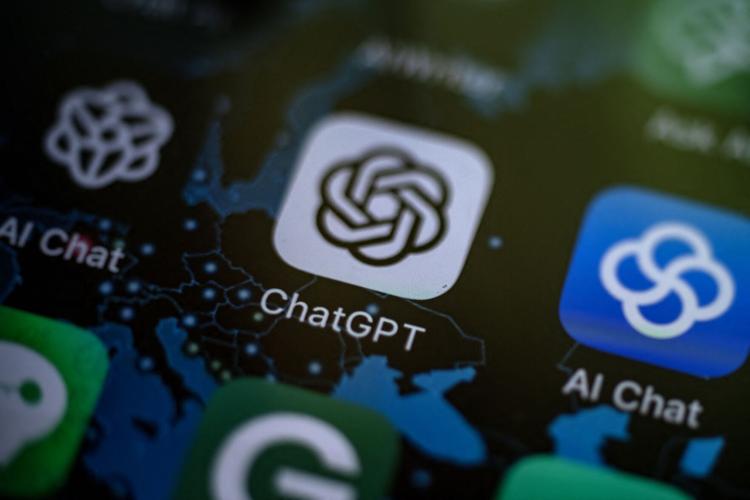
This illustration picture shows the AI (Artificial Intelligence) smartphone app ChatGPT on June 6, 2023.
Mimicking reality
Juzek assured me that I’m not a walking, writing cliché. Large language models, the type of artificial intelligence that ChatGPT is built on, choose sentence patterns and words that result in effective communication. Human “raters” who help develop the models have shown a preference for generic but salient words that can be applied to numerous situations. It makes sense that AI would attempt to mimic how professional writers string words together, he said.
Ward has studied the issue so much that she can confidently identify AI-generated text in the wild. She recalled a time when she received a handful of emails from students asking to enroll in a course, all saying something to the effect of, “This class will serve me well in my future.”
When pressed, the fifth student admitted that, yes, he did use a bot to compose his request.
“A part of me dies inside when I get five identical emails,” Ward said.
And that’s just the emails. Grading essays in this era? “It’s unquestionably the biggest challenge of my teaching career,” she said.
Pros and cons
AI is a tool, but one that is, shall we say, nuanced. It can empower people who’ve felt self-conscious about their writing communicate with more polish. It can level the playing field for non-native English speakers or those who’ve struggled with grammar and spelling.
We gain something as a society when that polish is accessible to all. We lose something, too.
I’ve started to wonder if typos and sloppy grammar might one day become a proxy for authenticity, a sign that something was written by a beating heart rather than a computer model. Sometimes the point of writing, Ward reminds me, is not the final product. It’s that someone took the trouble to write it.
“Like wedding vows — you care that your spouse sat down and thought about your relationship," she said. “You care about the writing. In those cases, it’s a negative for people to outsource it.”
One way to stand out from the ocean of autogenerated text, Ward said, is to be quirky. Settle on an unusual greeting or sign-off in your emails.
What the bots do is write toward the average. What we humans can do is depart from the norm. We can feel things. We can be original. We can write like freaks.
That’s something worth embracing — at least, until AI catches up.



