

U.S. regulators gave the green light Monday to a pill version of the blockbuster weight-loss drug Wegovy, the first daily oral medication to treat obesity.
The U.S. Food and Drug Administration's approval handed drugmaker Novo Nordisk an edge over rival Eli Lilly in the race to market an obesity pill. Lilly's oral drug, orforglipron, is still under review.
Both pills are GLP-1 drugs that work like widely used injectables to mimic a natural hormone that controls appetite and feelings of fullness.

FILE - The U.S. Food and Drug Administration building is seen behind FDA logos at a bus stop on the agency's campus in Silver Spring, Md., Aug. 2, 2018. (AP Photo/Jacquelyn Martin, File)
Revolution in obesity treatment
In recent years, Novo Nordisk's injectable Wegovy and Lilly's Zepbound revolutionized obesity treatment globally and in the U.S., where 100 million people have the chronic ailment.
The Wegovy pills are expected to be available within weeks, company officials said. Availability of oral pills to treat obesity could expand the booming market for obesity treatments by broadening access and reducing costs, experts said.
About 1 in 8 Americans used injectable GLP-1 drugs, according to a survey from KFF, a nonprofit health policy research group. But many more have trouble affording the costly shots.
"There's an entire demographic that can benefit from the pills," said Dr. Fatima Cody Stanford, a Massachusetts General Hospital obesity expert. "For me, it's not just about who gets it across the finish line first. It's about having these options available to patients."
The Novo Nordisk obesity pill contains 25 milligrams of semaglutide. That's the same ingredient in injectables Wegovy and Ozempic and in Rybelsus, a lower-dose pill approved to treat diabetes in 2019.
In a clinical trial, participants who took oral Wegovy lost 13.6% of their total body weight on average over about 15 months, compared with a 2.2% loss if they took a placebo, or dummy pill. That's nearly the same as injectable Wegovy, with an average weight loss of about 15%.

Trial participants saw results
Chris Mertens, 35, a pediatric lung doctor in Menomonee Falls, Wisconsin, joined the Novo Nordisk trial in 2022 and lost about 40 pounds using the Wegovy pill. The daily medication worked to decrease his appetite and invasive thoughts of food, he said.
"If there were days where I missed a meal, I almost didn't realize it," Mertens said.
Participants in a clinical trial who took the highest dose of Lilly's orforglipron lost 11.2% of their total body weight on average over nearly 17 months, compared with a 2.1% loss in those who took a placebo.
Both pills resulted in less weight loss than the average achieved with Lilly's Zepbound, or tirzepatide, which targets two gut hormones, GLP-1 and GIP, and led to a 21% average weight loss.
All the GLP-1 drugs, oral or injectable, have similar side effects, including nausea and diarrhea.
The National’s Erica Johnson asks Dr. Daniel Drucker — whose research helped develop GLP-1 drugs — about side effects from using the drugs for weight loss, like potential muscle loss, and what to expect if you use the drugs for the rest of your life.
Lower costs expected for patients
Both daily pills promise convenience, but the Wegovy pill must be taken with a sip of water in the morning on an empty stomach, with a 30-minute break before eating or drinking.
That's because Novo Nordisk had to design the pill in a way that prevented the drug from being broken down in the stomach before it could be absorbed by the bloodstream. The drugmaker added an ingredient that protects the medication for about 30 minutes in the gut and makes it easier to take effect.
By contrast, Lilly's orforglipron has no dosing restrictions. That drug is being considered under the FDA's new priority voucher program aimed at cutting drug approval times. A decision is expected by spring.
Producing pills is generally cheaper than making drugs delivered via injections, so the cost for the new oral medications could be lower. The Trump administration this year said officials worked with drugmakers to negotiate lower prices for the GLP-1 drugs, which can cost upward of $1,000 a month.
The company said the starting dose would be available for $149 per month from some providers. Additional information on cost will be available in January.

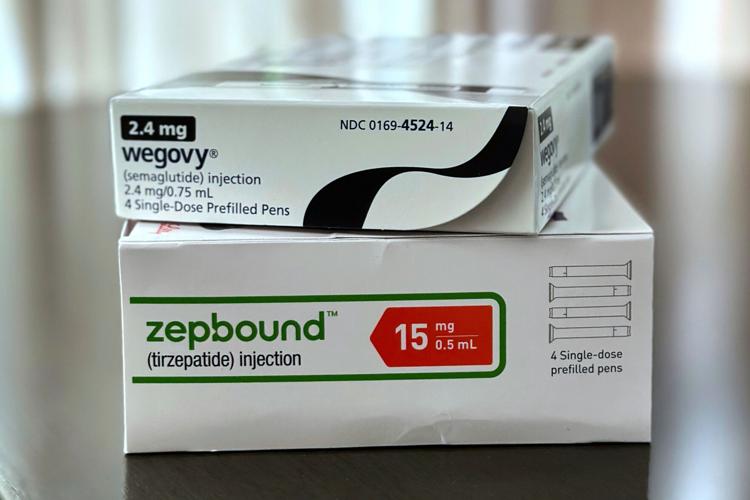
Boxes for the medications Wegovy and Zepbound are arranged for a photograph May 8 in California.
Pill offers patients a second option
It's not clear whether daily pills or weekly injections will be preferred by patients. Though some patients dislike needles, others don't seem to mind the weekly injections, obesity experts said. Mertens turned to injectable Zepbound when he regained weight after the end of the Wegovy pill clinical trial.
He said he liked the discipline of the daily pill.
"It was a little bit of an intentional routine and a reminder of today I'm taking this so that I know my choices are going to be affected for the day," he said.
Dr. Angela Fitch, an obesity expert and chief medical officer of knownwell, a health care company, said whatever the format, the biggest benefit will be in making weight-loss medications more widely accessible and affordable.
"It's all about the price," she said. "Just give me a drug at $100 a month that is relatively effective."
Read more:


10 tips to push you past a weight-loss flatline
1. Review your habits
UpdatedMake sure you haven’t slowly reverted back to some of your old habits, like eating larger portions, stopping at the coffee shop for a mocha grande and a muffin, or deciding to skip your exercise routines. An honest review may find that the relaxation of some of your good habits is contributing to your plateau.

2. Eat lean proteins at each meal and snack
UpdatedProtein-rich foods suppress ghrelin, a hormone secreted by the stomach that stimulates appetite. Foods high in fat actually raise this hormone, causing increased hunger. And meals and snacks that are mostly carbohydrate often make people feel hungry shortly after eating. It’s the protein-rich foods that really help to keep people feeling full.

3. Step it up
UpdatedTo burn more calories, increase your workout by 15 minutes, add another day to your weekly routine, or increase the intensity of your exercise. Try alternating intervals of high and moderate intensity. Add strength training to increase your muscle mass which will help burn more calories even at rest. And to give your muscles a new challenge, vary your physical activity.

4. Think outside the gym
UpdatedIncrease your general activity throughout the day by walking more, using your car less, taking the stairs, doing more gardening and yard work and cleaning your house.

5. Use an activity tracker
Updated10,000 steps a day is the goal for overall good health, but you may need to aim for 12,000 to 15,000 for weight loss.

6. Be careful about cutting too many calories
UpdatedLowering your caloric intake is important for weight loss, but make sure you’re not going below 1,400 calories if you’re a woman or 1,700 calories if you are a man.

7. Get seven to eight hours of restful sleep each night
UpdatedTurn off your electronic devices at least an hour before bed. Keep your room at a comfortable temperature. Go to bed at the same time every night.

8. Manage stress eating
UpdatedUse a distracting activity like drinking a cup of hot tea, going for a walk, calling a friend, or writing in a journal. Cravings usually last only about 45 minutes. If you distract yourself, you should find you’ve gotten past them without the need to stress eat.

9. Watch restaurant overeating
UpdatedShare food with a friend or order a takeout container with your meal; put half your food in the container before you start eating and you have lunch for tomorrow.

10. Reassess your weight goal
UpdatedIf you’ve tried all these tips and you still are unable to lose more weight, you may want to revisit your weight-loss goal. Celebrate the success you’ve had and the weight you’ve lost. Perhaps the number you’re striving for is unrealistic for you. Consider a consult with a registered dietitian to discuss your concerns.


