

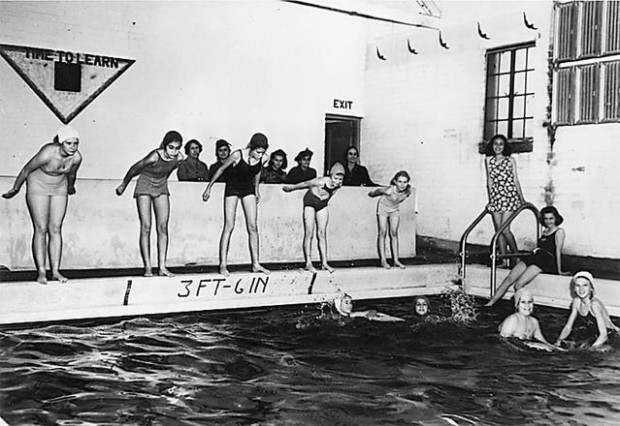
Nobody sings "Kumbaya" at the YWCA anymore. Or makes potholders. Or learns to swim.
Nope, the YWCA of my childhood is long gone — replaced by counseling services, leadership programs and training in everything from computers to job skills.
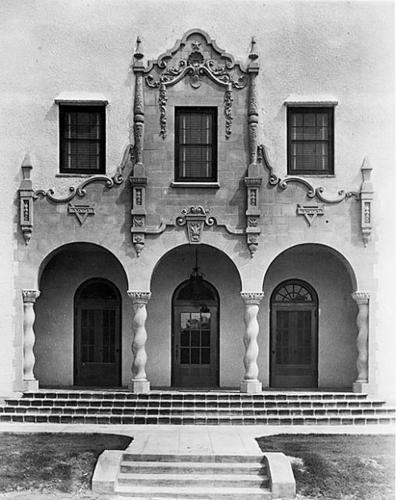
In another year, the YWCA will be vacating the building generations of us grew up in, as well.
This time next year, they'll be moving into their spiffy new headquarters Downtown, at 525 N. Bonita Ave., west of Interstate 10.
Ah, well. Truth be told, the YWCA hasn't owned its namesake at 738 N. Fifth Ave. since 1986.
That was the year it sold the building, described by executive director Janet Marcotte in her history of the Y as being "in need of extensive renovations" and a "serious financial drain on the organization's budget."
After the sale, the Y leased back only what it needed for offices and storage, leaving excess space for other tenants to fill.
"Before, we were trying to fit in programs that would fit the building instead of doing the programs the community really needed," says Marcotte.
"When we sold the building, we had this freedom to do other things. So we said, 'OK, what can we do that nobody else is doing?' "
That turned out to be "Your Sister's Closet," which donates clothing to homeless and low-income women, as well as programs that help women develop leadership skills.
In a way, the Y was returning to its roots: helping the working woman.
It all began began in 1917, when 150 members of the Tucson Business and Professional Women's Club raised enough money to start up a YWCA over the old State Theater.
The idea was to create a room where working women could go to relax.
Incidentally, the first president of Tucson's YWCA was Henrietta Franklin, who was Episcopalian — despite the fact that the organization she headed was called the Young Women's Christian Association.
"It was a very Tucson thing," says Marcotte, who says some Y's at one time — but not Tucson's — also discriminated against Catholics.
"In Salina, Kansas, I was one of the few Catholic students in the high school," says Marcotte. "Every Thursday when they had Y-Teens, they sent me to the library. I was not nuts about the Y."
After a series of Downtown moves, the Tucson Y moved into its new home on Fifth Avenue in 1930. Hull House founder Jane Addams turned the first shovel of dirt at the groundbreaking for the building, which was designed by architect Ann Rockfellow.
Here, the Y housed both permanent residents and women just passing through.
"I've heard when the dorms closed at the UA for the holidays, they set up cots in the basement for the students," says Marcotte.
In a town where Jim Crow still reigned at the swimming pool, the Y was one of the few places in town where blacks could swim.
"We would go to the Y after school and on weekends," says Laura Banks-Reed, who would serve two terms as Y president in the early '60s.
The Y, says Banks-Reed, was also one of the few places in town that would rent a room to a black woman.
Esther Tang also dipped her toes in the old Y pool, beginning in the 1930s. During the war, she formed a Chinese women's group. "We came to the Y and folded bandages," she says.
Tucson native and YWCA leader Anna Jolivet remembers doing craft projects at the Y back in the 1930s. But she also approves of the Y's shifting mission. "The things they are doing are more meaningful than perhaps the things done earlier."
But even though its focus may have shifted, today's Y is still coming up with new programs for girls, such as TechGYRLS, which is teaching 400 girls computer skills and engineering at six sites around town.
When the new Y opens next year, it will boast a computer center for those girls. Call it a tech camp.
Who know? Maybe they'll even sing a rousing chorus or two of "Kumbaya."
Never fear.
While the YWCA is leaving its namesake building next year, the building will go on.
"I have several tenants who have told me they already want that space," says Shawn Burke, the building's owner.
Currently, the Y leases only 2,000 square feet of the building's 45,000 square feet, says Burke, whose tenants include an architect, a massage therapist, a charter school and the Tucson Audubon Society.
"A lot are nonprofits, organizations related to art, nature, culture and education," says Burke. "It's the type of building that certain types of people want to be there. It's self-selective."
While the Y is considered a "contributing building" to the historic West University Neighborhood, it is not listed on the National Register of Historic Places, says Burke.
Developers regularly approach him with ideas, he adds. That includes lofts, which seem to be the in-thing these days for older buildings.
"I would consider four lofts for the 4,200-square-foot auditorium," says Burke, who's owned the Y since July 2004.
As for renovating the 76-year-old building, he says, "I'd like to do it if there were monies available, such as grant monies."
But he also admits that renovation would mean "I'd have to get rid of all the tenants. There's so much history in the building, so many who love it the way it is."

