

Before the internet, people commonly burned Polaroids and love letters in a fire as an act of closure following a breakup.
Nowadays, it isn’t so simple. People produce and consume massive amounts of digital stuff – 33 trillion gigabytes of online data in 2018 alone, a number that has surely grown.
Even as more and more of daily life is experienced and documented online, there’s no playbook for how to navigate breakups in the digital age. In the past, if bonfires weren’t your thing, you could simply throw out love letters, gifts and photographs, or put them in a box and store them in the attic – out of sight and out of mind.
Now, as you scroll through your accounts, you might find yourself returning to your own memories – including reminders of your former partners, which live on long after the dissolution of a relationship.
As communication researchers, we’ve conducted a series of studies investigating how people decide whether to keep or delete something following the end of a romantic relationship – and how these decisions affect their ability to move on.
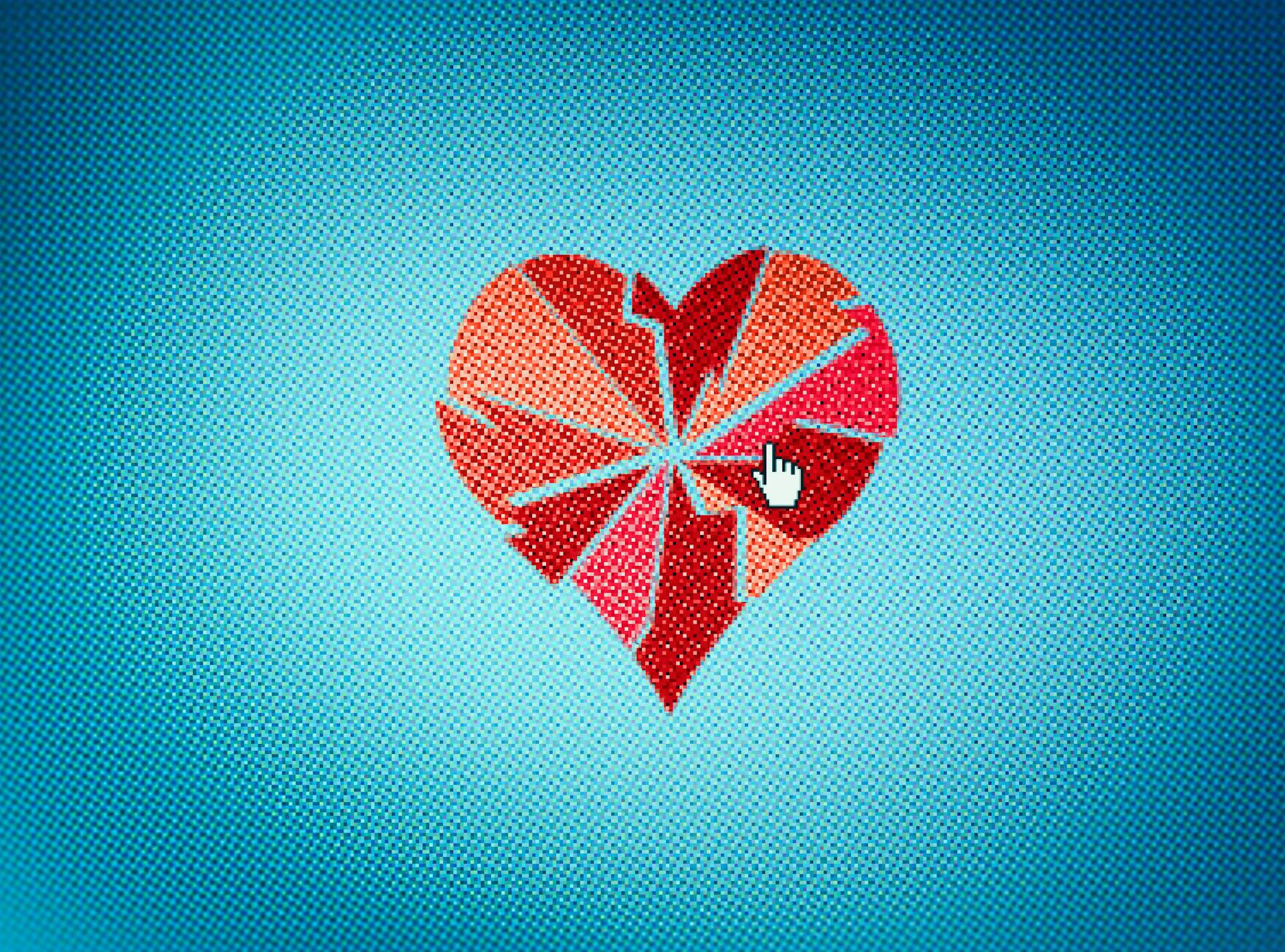 There's no playbook for how to navigate breakups in the digital age. Sean Gladwell/Moment via Getty Images
Relationship ‘cleansing’
In some of our earlier research – all the way back in 2013 – we studied how people used social media after a breakup.
We found that they often carried out what we call “relational cleansing” by hiding their relational status, deleting photos or scrubbing old social media posts.
In another study, we found that people who spent a good deal of time looking at old digital photos of their relationships and those who monitored their previous partners on social media following a breakup had a harder time moving on.
To explore these findings in more depth, we conducted a follow-up study that looked at whether keeping or deleting virtual objects following a breakup helped people move on and emotionally recover following the end of their relationship.
We found that people who were more nostalgic – that is, those who tended to have a sentimental longing for the past – were more likely to keep digital objects from their previous relationship, and that preserving those objects tended to make it harder to adjust to the relationship’s end.
In the analysis of the results, we speculated that when people continually revisit these digital memories, they’re unable to fully detach from the relationship.
Based on this research we came up with a model called Virtual Relational Memory. Specifically, we suggest that individuals going through a breakup consider three components of their digital lives: objects, stories and networks.
To purge or not to purge?
In relationships, people produce a trove of digital objects, such as messages and photos, that represent and document their relationships.
Those happy and joyous photos of past anniversaries and trips linger in online photo albums long after the relationship ends.
Because many of these digital objects are distributed across platforms and accounts – many of which people don’t have access to – they’re more likely to persist. Old photos memories can algorithmically appear at inopportune times, too, spurring unanticipated thoughts about your partner.
Still, you can exert some control over whether to delete or keep the memories you have access to.
By keeping the objects, maybe you can continue to reflect on the relationship, prompting personal growth. By deleting them, perhaps you can more quickly move on from your previous partner and prepare for your next relationship.
Losing control of the narrative
Beyond considering how to manage things like photos and old messages, people going through a breakup should also think about the narrative, or story, of the breakup.
The stories people tell about their breakups are powerful reminders of their relationships. But they also help people reconcile and move on to new ones.
When a relationship ends, people often construct a story, and that story varies for different audiences. When your parents ask why you broke up, you might tell a story about your differing life goals. When your friends ask why you broke up, you might tell a story about your inability to manage conflict.
Social media complicates the story-creation process, because it is more difficult to construct distinct stories for different audiences. For instance, some people have both a main Instagram account and a “Finsta” that presents their more authentic identity. Someone who shares the gritty details of their breakup on their finsta would have a difficult time reconciling that version of the narrative with the one they present on their more curated main profile.
Also, people tend to change the story they tell about breakups over time as they move on from a relationship. Their story might evolve to be less hostile to their partner, or more accepting of the need for the end of the relationship. When people are exposed to virtual objects such as old photos or texts, their narratives can quickly revert back to the stories they created shortly after the relationship ended.
Adapting your network
Next, it’s important to think about your network, which refers to the connections in which our relationships are embedded.
When you’re in a relationship, you often connect with your partner’s family members and friends on Facebook, Instagram and Snapchat. Those networks often linger following the end of the relationship unless you make an active effort to disconnect.
You may ask yourself whether you really care what your previous boyfriend’s childhood best friend is doing on vacation. Even worse, your previous partner could appear in those very vacation photos.
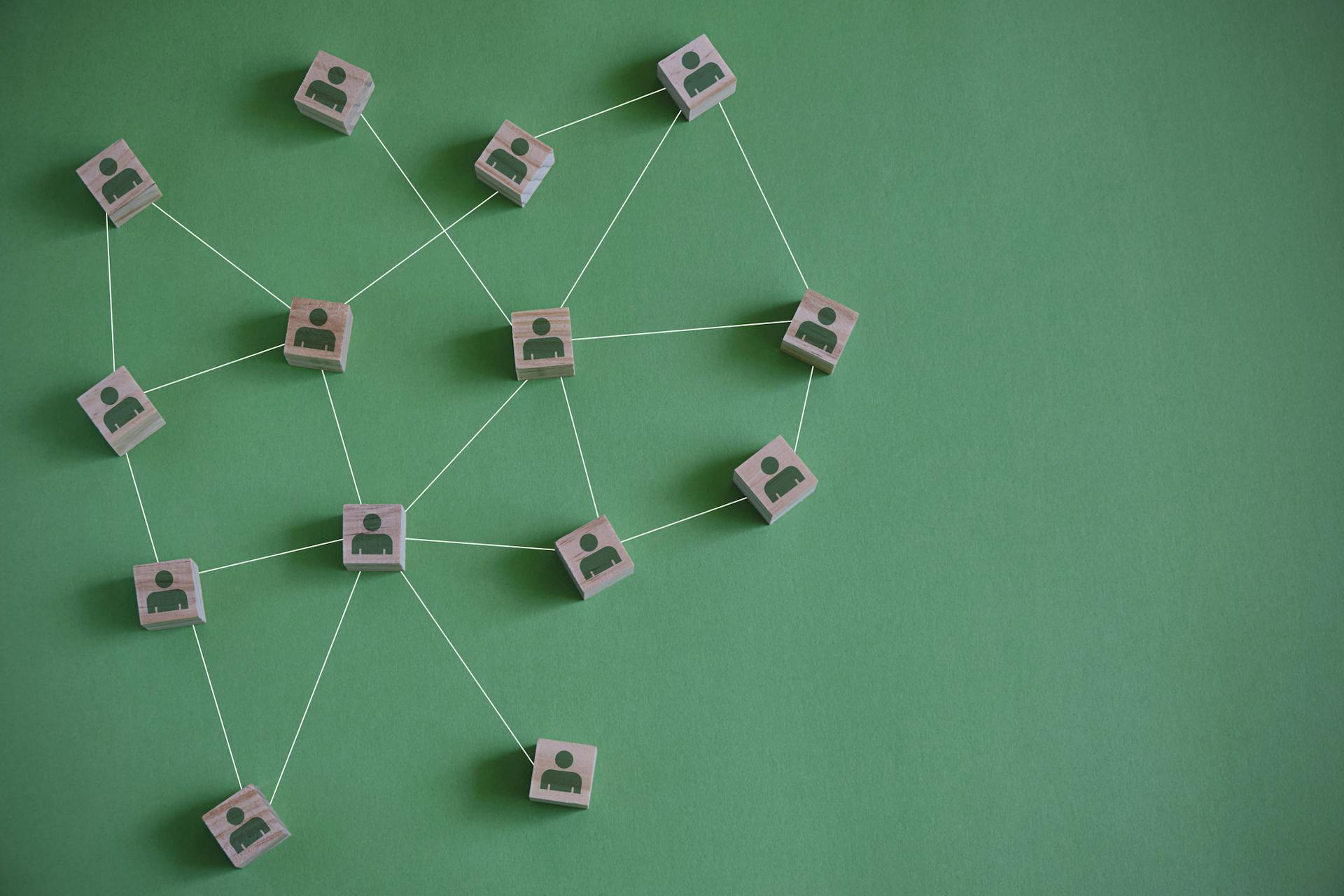 Unfollowing your ex on social media is straightforward enough. But what about their friends? aydinynr/iStock via Getty Images
The persistence of these networks makes ending relationships harder. In a sense, these networks act as a brain, archiving virtual memories through social connections that can be reactivated by the social network.
Although research into the effects of these factors is ongoing, especially as technology continues to evolve, we suggest that people think carefully about which objects, stories and networks they want to retain, and which they want to jettison. Though tentative, the findings across our studies suggest that people who selectively keep some objects and delete others fare better following a breakup than those who obsessively keep or delete. In other words, everything in moderation.
Perhaps, as country singer Sam Hunt put it, breaking up was easier in the 1990s. But that doesn’t mean you can’t reassert control over how you want to move on – and decide which digital relics of your relationships to preserve and which to purge for good.
___
The authors do not work for, consult, own shares in or receive funding from any company or organisation that would benefit from this article, and have disclosed no relevant affiliations beyond their academic appointment.
___
7 tips for modern dating
Texting is the death of the first date
Updated
When you are conversing with someone on a dating app and that person asks to switch over to direct texting on your phone instead (by giving or asking for a phone number), there is a 60% chance the date will no longer happen. (This is based on evidence from my clients’ experiences over the last decade.)
Why is this? Because someone drops the ball and doesn’t text, the plans don’t get finalized, someone texts something inappropriate, it turns into a pen pal relationship … the list goes on.
Make your plans for the first date directly within the dating app.
Once the date is scheduled, feel free to exchange numbers just for contingencies by saying, “In case you need to reach me tomorrow, my number is ___.” Your conversation-to-date conversion rate will be much higher.
You get what you allow
Updated
If someone is treating you in a way you don’t like but you accept it, that is the treatment you will get.
For example, let’s say you prefer phone calls, but the person you’re dating only texts you. If you don’t tell the other person your preferences and simply reply to all the texts, then that is what you get.
You should never be shy to ask for what you need, which leads to the next point …
Telling someone what you need is not needy
Updated
I hear all the time, primarily from women, that they are afraid to express their needs and expectations to their (often new) partner.
Assuming what you’re asking isn’t unreasonable, it’s up to the other person to decide whether to do that or not. If they can, great. If they can’t, then it is up to you to decide how important it is to you.
You can always add dinner, but you can’t take it back
Updated
Go on a first date for a drink, coffee or a walk. Then, if you’re having a good time, you can stay longer and get food.
If you arrange for dinner and can’t stand each other — no one hopes for this, but it happens — you are stuck at dinner.
Wine bars are great — they usually have good food menus.
If you don’t know, ask
Updated
I get questions all the time about what something means that someone said. I can make an educated guess, but in the end, only the person who said it knows. If you’re not sure what something meant, ask the person who said it.
No one is a mind reader
Updated
If you want something from your partner, they won’t know you want it unless you explicitly say it. Use direct language.
Everything short of finding ‘your person’ is not a failure
Updated
We learn a lot about ourselves and other people in the dating process. This is necessary.
Some relationships work and some don’t. And many work until they don’t.
But remember that the ones that don’t work out are not failures, and neither are you. It wasn’t a “failed marriage” or a “failed relationship.”
Hopefully it was a positive experience (for at least some period) that couldn’t withstand the test of time.
Each date or relationship is a learning experience that gets us one step closer to the one that lasts.
___
Erika Ettin is the founder of A Little Nudge, where she helps others navigate the often intimidating world of online dating. Join her newsletter for updates and tips.

