

Editor’s note: This is part of an occasional series following Handi-Dogs’ first pairing through its Rescue to Service program, which matches dogs who need homes with people who have disabilities.
Doug Mueller’s new roommate is a little challenging.
He’s messy and leaves his stuff everywhere. Then there’s his total lack of boundaries.
His first day at Mueller’s house, he just barged in and made himself at home.
“He came right on in, he tried getting on the couch,” Mueller recalled. “We had a chat about that.”
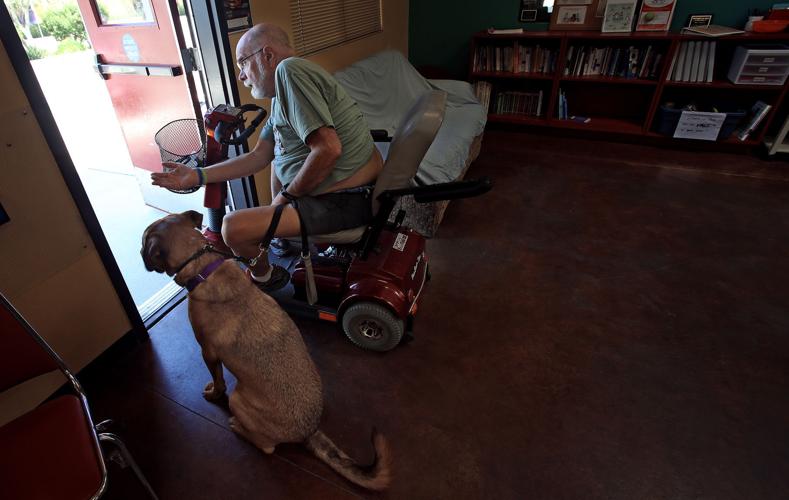
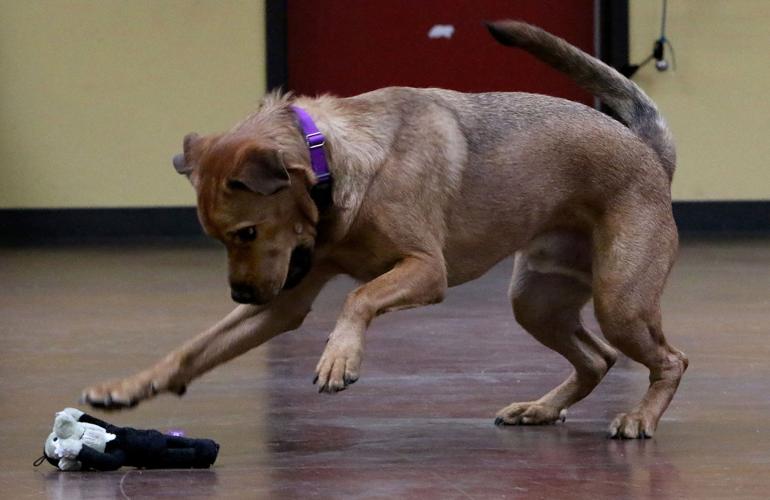
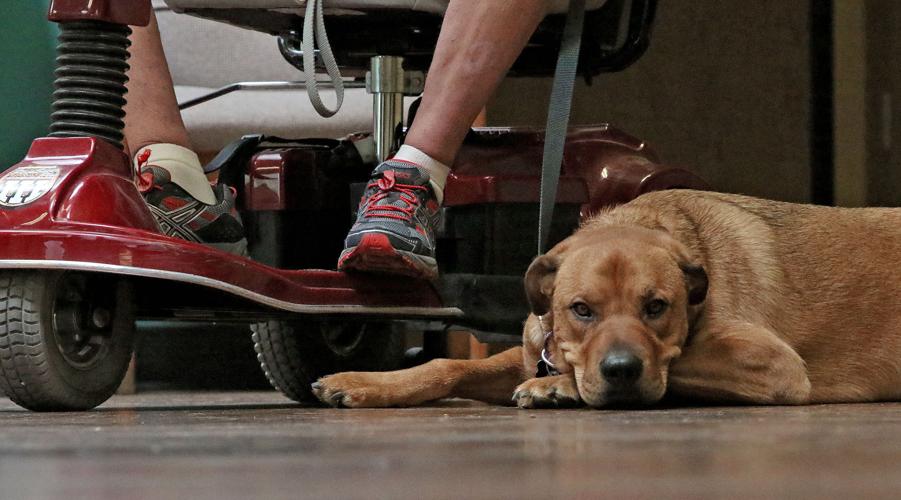
Mueller’s roomie is Chazz, a big — 80 pounds, to be exact — sweet-faced, brown dog with a black-tipped tail. He’s Mueller’s new buddy and may one day also be his service dog.
Mueller, 74, and Chazz, 2, are part of a pilot program by Handi-Dogs that trains abandoned dogs to become service animals. Called Rescue to Service, it aims to save canine lives that may very well one day return the favor — or at the very least, make life a lot easier for their human companions.
The program, which began in January, partners Handi-Dogs with Pima Animal Care Center, the Humane Society of Southern Arizona and Arizona Greyhound Rescue. Mueller and Chazz are the program’s first match.
Mueller, who has epilepsy and suffers from neuropathy, was ready to get a Doberman pinscher puppy to train as a service dog. When things fell through, he started noodling around the internet and landed on Handi-Dogs’ website.
“You can save a dog, which I think is cool — I didn’t realize I was going to be the first person through the program,” said Mueller, a married father of four and grandpa to six, with a good-natured chuckle.
A retired computer engineer, Mueller relocated to Tucson five years ago for his health. He needs a “brace” dog, one he can train to stay still when he needs support to steady himself or get up from a fall. He’d also like his four-legged companion to know how to push the red button on his med-alert device if he needs help.
Everyone thinks Chazz can be that dog. Time — and lots of training — will tell.
The inaugural Rescue to Service class started with six potential trainees. Two washed out early on, one suffered from severe separation anxiety and the other was too high energy for someone with a disability to handle. That left Kush, Buster, Trick and Chazz, who landed at the Humane Society of Southern Arizona after his family moved to an apartment and couldn’t take him.
Chazz looked like a strong candidate because of his confidence and willingness to learn, said Glenda Laird, Handi-Dogs training manager.
“He’s very people oriented,” said Laird, and then laughed because who should charge in during that very point of the interview but Chazz, reporting for training class. He immediately launched himself onto the — no surprise here — sofa.
“His manners are still to be worked on,” she said, as she fixed the paperwork he sent flying over the cushions.
To further evaluate Chazz’s potential as a service animal, he moved in with a foster “mom,” Nancy McDonald, a former certified public accountant-turned canine massage therapist whose job was to teach Chazz obedience basics. A dog lover, McDonald has long had pooches as pets, but this was her first time fostering. When she first met him, McDonald, who’s petite, wasn’t sure she could handle Chazz.
“I never had a dog that big,” McDonald said. “He came up to me, and he was wagging his tail. He leaned on me — my heart just opened up. I thought, ‘OK, I can do this.’”
Chazz adores people but does tend to be more reserved with men, so McDonald was heartened when he naturally gravitated toward Mueller during their first meeting. Even the electric cart Mueller relies on outside his home didn’t faze him. In fact, Chazz has been known to shimmy up onto the cart to get into better ear-scratching position.
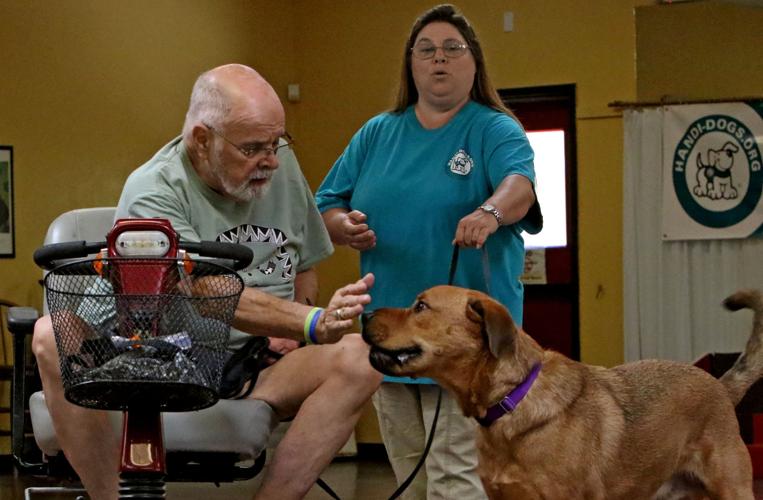
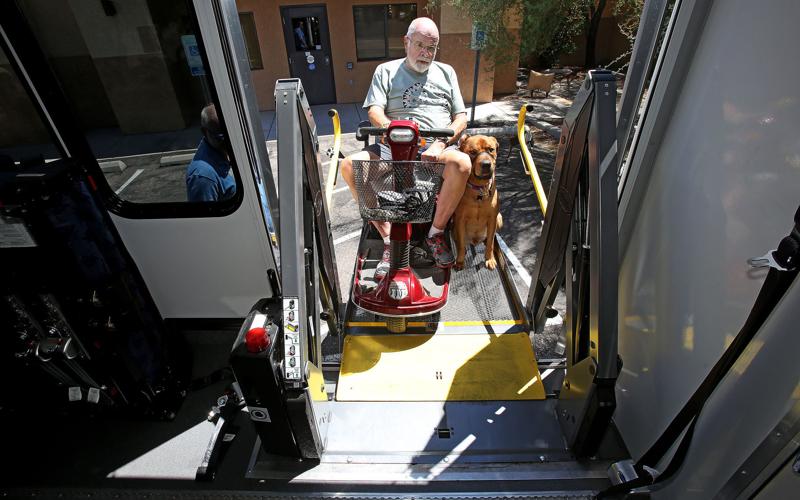
Since Mueller, who adopted Chazz from the Humane Society, took custody in early August, the duo have been taking trips around the neighborhood, practicing loose-leash walking. With the help of Handi-Dogs trainer Rama Heisey, they’re fine-tuning basic commands like “sit” and “touch.” Chazz, who enjoys riding a shuttle with Mueller to get around, is also learning to contain himself when faced with the incredibly exciting prospect of meeting new people.
Mueller and Chazz’s first step toward becoming a service team is passing the American Kennel Club’s Canine Good Citizen test, a certification program that evaluates dogs in simulated everyday situations. After that, they’ll begin task-based service training. It can take about a year to a year and a half to train a service dog, which charges program participants roughly $1,200-$1,600, about a third of what it costs Handi-Dogs, according to JoAnn Turnbull, Handi-Dogs’ president and CEO. The organization relies on community donations to supplement the cost, she said.
In the meantime, Mueller and Chazz are still getting to know each other and their quirks. For instance, Chazz is an early riser, as in 5:30 a.m. early. It’s been an adjustment for Mueller, but a nice one.
“Actually, I’m enjoying it,” Mueller said. “I love it — it’s so nice out.”
And even though the couch is off-limits to Chazz, Mueller relented on another piece of furniture, “I let him on the bed.”

