


About 40 toddlers and babies, and their “big people” — also known as parents or grandparents — find their spots on the library floor.
Some look through books. Some laugh and play. Some fuss.
All wait for toddler story time at Nanini Library to begin.
Story time is a “very popular” event for the 5-and-under set, says Cat Strong, senior children’s librarian at Nanini Library.
So popular, in fact, that Nanini hosts an average of 27 story time events each month. In September, they drew 875 people.
A recent toddler story time drew 90 people to the library, practically filling the room, Strong says. The average attendance is 65.
“In the past, we’ve had to turn people away because it was at capacity,” Strong notes. And while she doesn’t want to have to turn people away, she is glad to see so many people at the library.
Toddler story time at Nanini Library is just one of 57 weekly story time events held by the Pima County Public Library system across its 27 locations.
Story times are held for different age groups, each one offering a fun introduction to reading and language through stories, songs and activities: Baby time for babies up to 18 months, toddler story time for kids ages 18-to-36 months, preschool story time for children ages 3-to-5 years and family story time for the whole family.
The events are geared toward teaching early literacy, building a community of readers and acting as models for parents to continue the lessons, Strong says.
“Early literacy is very important,” Strong says. “Focusing on talking, singing, reading, writing and playing lays the foundation for children to learn to become readers. Research shows that success in reading leads to success in school.”
The free events provide access to literacy opportunities to thousands of families across Tucson.
“Having access to books and literacy opportunities, including story time, ensures that children are ready to learn and ready to read when they begin school,” says Amber Mathewson, deputy director of the Pima County Public Library. “Story time at the public library is free and open to all and is an excellent way for parents to learn about early literacy and brain development. As a child’s first teacher it is important for parents to have access to those skills and tools.”
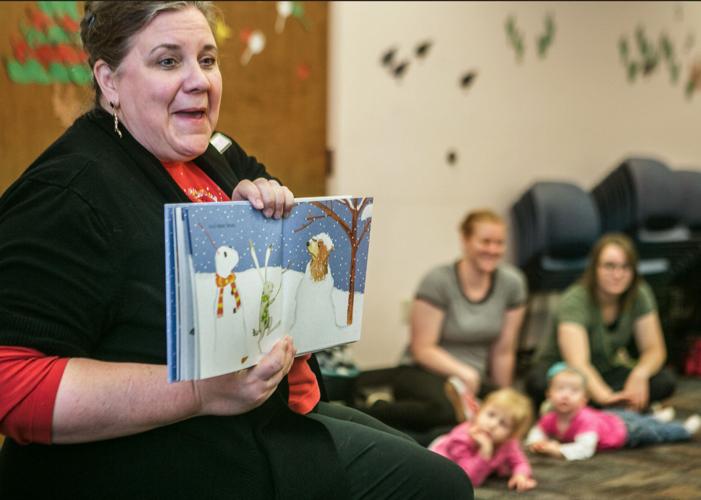
Story time isn’t just about sitting on the floor, listening as someone reads. Rather, Strong keeps kids engaged by interacting with them and having them make movements or sounds that correspond with the story.
For example, if a character in the story is cold, Strong directs the children to make shivering movements. When a story calls for an animal sound, the kids get to make them.
As she makes her entrance, Strong greets each family with the story time mascot, a puppet named “Lola the Lopp-Eared Bunny.”
“How are you doing today?” she asks the children, through Lola. “Are you happy today?”
“Good,” a child answers, shyly.
Little hands take turns petting Lola.
It’s time to start — with song and dance, of course.
Strong stands in front of the room and demonstrates the movements to “Wheels on the Bus.”
Most children and parents follow suit.
Before you know it, story time is in full swing, with Strong reading and most parents and children participating.
There’s no pressure on kids to do everything, Strong says.
“Toddlers are active, mobile little people and their attention spans vary. I try to get everyone to focus, but sometimes you get some looking around,” Strong says. “I try to make everybody comfortable and let the child take the lead on how they participate.”
Concepts such as book handling, socializing, being good listeners and rhyming words are a focus of each event. Those concepts can be built upon at home with handouts and takeaways Strong sends with participants.
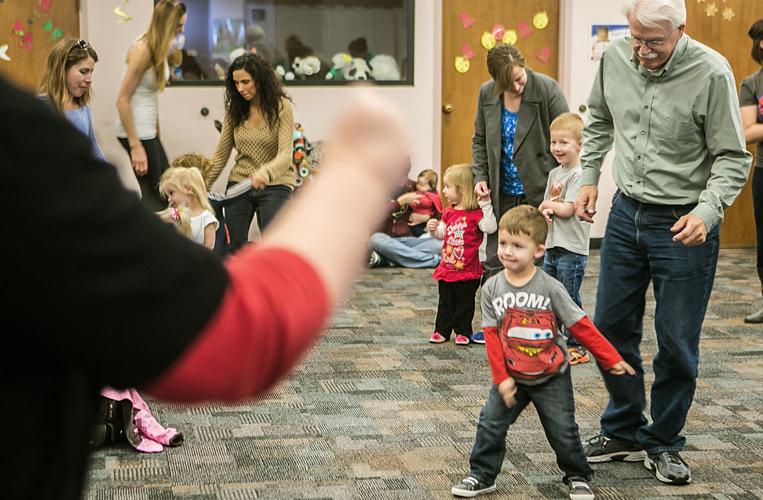
“Now we’re going to do our freeze dance,” Strong says to the group. “So you have to be good listeners. When the music stops, you freeze.”
As the music plays, the group dances around the circle.
When it stops, each child freezes in place.
Cat commends their listening skills.
The social aspect of story time events keeps participants coming — for the kids and parents.
“At the end of baby time, they have time to play,” Strong says of another story time event. “And the parents start to connect. A library is all about connections. We’re connecting children with learning, parents with learning, parents to parents and educators and community groups.”
It also helps parents see what kind of learners their children are.
Strong recalled a mother who brought her son to baby time for the first time. She was uncertain how he would react because he is very active and she worried he wouldn’t pay attention.
“I said, ‘That’s totally normal,’” Strong says. “It turns out he observed the whole time and participated at the very end. He’s the type of child who likes to observe before he participates.”
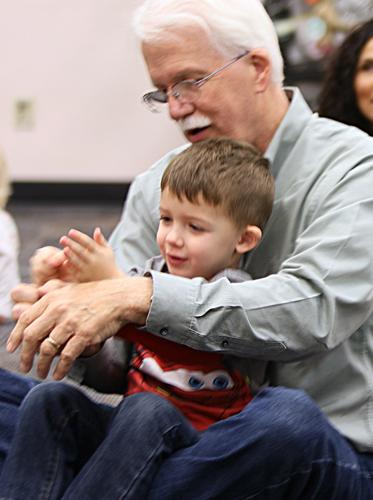
Timarie Phillips dances with her smiley 20-month-old son Tytus, during the event. The duo attend every week.
“I think it’s a fun outing and it gets him to be around kids his age,” Phillips says. “And it gets him to do things with people other than mom.”
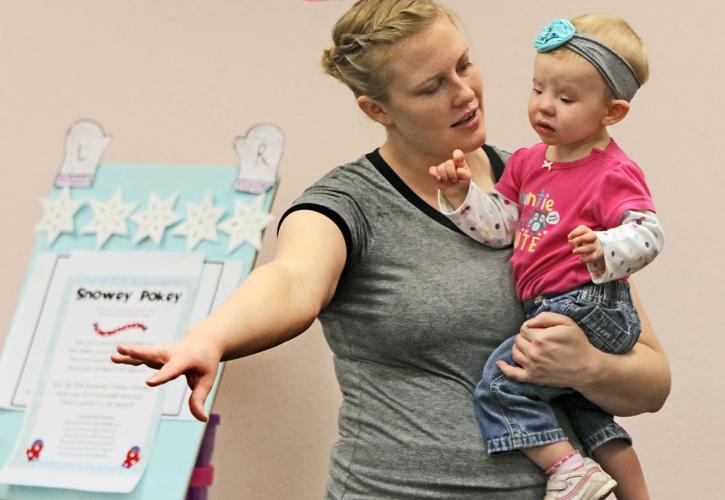
As Strong leads the group in the “Snowey Pokey,” a winter version of the “Hokey Pokey,” Amber Hunt follows along with her 1-year-old daughter in her arms.
Hunt attends toddler story time almost every week with her two kids and has been doing so for “a couple years.”
“It’s something great to do out of the house and it’s interactive,” Hunt says. “I love to read and I want to instill that in my kids.”
After attending for a while, children get the hang of things and start to change, Strong says.
“It’s wonderful to see children blossom,” Strong says. “Babies are in tune to what I’m doing and their big person. Their eyes are glued to you. They blossom. They put books back and are sharing toys. They go from parallel play to playing together.”
At the end of story time, Strong goes over the take-home projects — a snowflake made of popsicle sticks, paper mittens to color and a song — and commends them for being there.
“Early literacy begins with you,” Strong says to the group. “I applaud all the big people for bringing their kids here.”

