

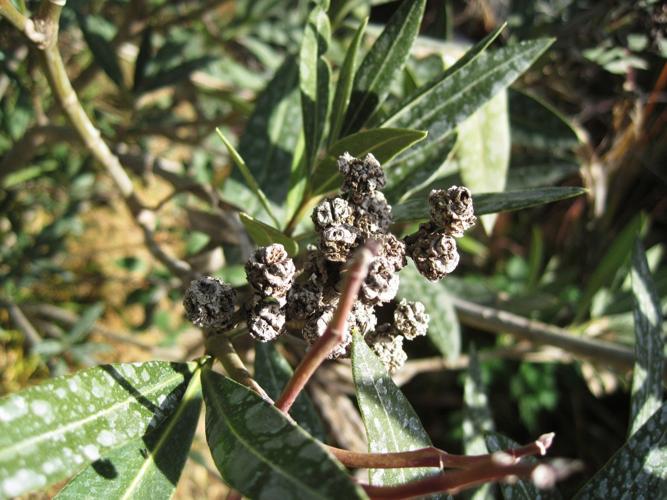
Question: I have several mature oleander plants in my backyard. One of them has developed a growth on some pruned branch tips that resembles broccoli. Also, the leaves that have fallen from several of the plants are much smaller than they used to be. Not many blooms either, now that I think about it. I am concerned because they all seem like they are “thinning out.” Can you help me with this problem?
Answer: The growths you are seeing are the result of the bacteria Pseudomonas syringae inside the plant. The bacteria can enter the plant through wounds caused by pruning or other injury or through natural openings in the leaf, blossom and stem. Water can carry the bacteria from diseased plants to healthy ones in the splash from rain or sprinklers. The bacteria are also moved from infected plants to healthy ones by unsuspecting gardeners on their pruning tools. You can remove the galls by pruning several inches below each one. Treat each cut with a 10 percent bleach solution. Dip pruning tools in that bleach solution between each cut to reduce the possibility of spreading the bacteria. Make sure you dispose of the cuttings and do not compost diseased plant material. It’s best to prune during the dry seasons to avoid infection of wounds and avoid sprinkler irrigation while pruning wounds are fresh. Severe infections of large shrubs are often difficult to control by selective pruning. Even if you cut down the entire shrub, the new succulent growth will still be extremely susceptible to infection. In certain situations, removal of the diseased plant and replanting may be the best management method.
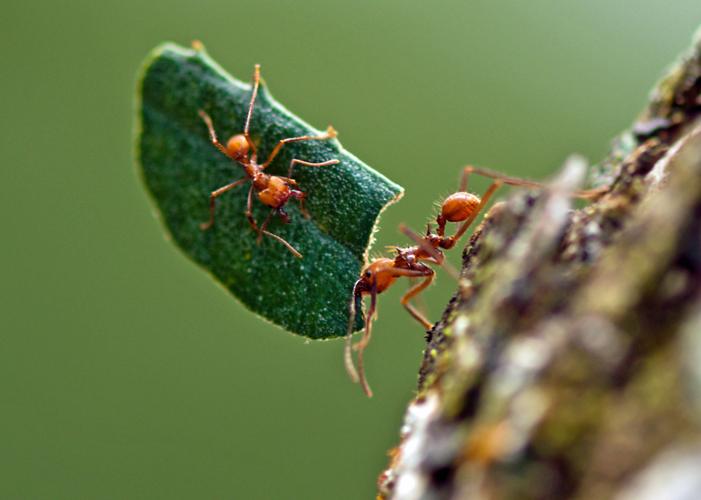
Q: Our hopseed bushes suddenly had no leaves, and we think it is from leaf-cutter ants. We also noticed our palo verde tree near their mound has no leaves. Attached are pictures. There are a few mounds near the hopseed bushes and palo verde tree. We also just put in a brick paver driveway and are concerned that the ants will damage it. What should we do?
A: Leaf-cutting ants are often difficult to manage. Although plants can be protected temporarily using insecticides, they need to be reapplied frequently, and these chemicals kill other insects that may be beneficial or harmless. The best solution is to eliminate the underground nest. The nests may be very large, hard to find and difficult to mange with insecticides. Typically, underground ant nests are managed best with poison baits that the ants transport down below as food. Because these ants don’t eat the leaves directly, they do not respond to most ant baits you might find at your local hardware or grocery store. I believe Amdro Ant Block is currently the only widely available bait product labeled for control of leaf-cutting ants. Apply the bait according to label directions while ants are foraging. Ant activity in the treated colony will decline over a four- to six-week period. However, it’s possible the ant colony will survive and activity will return in four to six months, requiring a second treatment. Before using any pesticide, please be sure to read the label and follow all instructions and safety precautions to protect you and the other animals nearby.
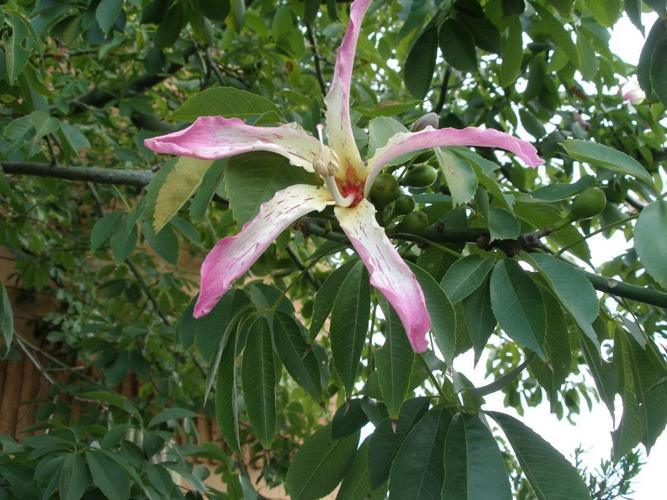
Q: What is this tree? It is spectacular, blooming now at the southwest corner of Fort Lowell Road and Fontana Avenue. It’s growing right up against a building and loses its leaves in the winter. We call it the jewel of the neighborhood.
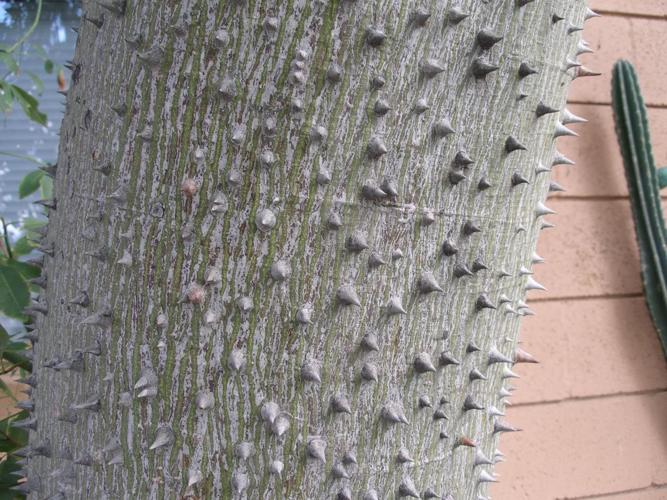
A: The tree is commonly called the silk floss tree (Ceiba speciosa). It is native to South America. There is a different one (Ceiba aesculifolia) in the Campus Arboretum next to the Mathematics Building at the University of Arizona. They are deciduous as you noticed and are famous for their spiny bark and beautiful flowers. They also produce a lot of nectar and are visited by a variety of pollinators including bats, hummingbirds and insects.

