

Virus basics: 12 of your COVID-19 questions answered
Each week the Associated Press fact-check team answers reader questions about the coronavirus and how it's changing our lives. Here are a dozen questions on our minds lately.
How will office life be different in a pandemic?
UpdatedThe office you once knew is likely to look vastly different.
Companies are taking a variety of steps to keep people a safe distance apart, such as using staggered shifts or asking people to come in on alternating days. Cubicles may also have higher walls or there may be new partitions between desks for added protection.
Kitchens, conference rooms and other common areas may be closed, and some offices have implemented one-way paths to keep people from passing each other. For essential shared spaces like elevators and bathrooms, face coverings could be required and there may be more frequent cleanings and limits on how many people can enter at one time. That could mean longer waits to use them.
Even with such social distancing measures, expect to wear a mask, especially when you're not at your desk. Your company will also likely ask you to report if you are having any symptoms.
The U.S. Centers for Disease Control and Prevention offers guidelines on keeping offices safe. But the specific measures at your office will vary depending on the company and any local rules. In the latest phase of New York state's reopening plan, for example, office capacity is capped at 50%.
The pandemic may also prompt changes that aren't directly about safety. At Bergmeyer, a design firm in Boston, the lights were adjusted to make Zoom calls look better.
Can you get the coronavirus twice?
Updated
FILE - This 2020 electron microscope made available by the U.S. Centers for Disease Control and Prevention image shows the spherical coronavir…
Health experts think people who had COVID-19 will have some immunity against a repeat infection. But they don't know how much protection or how long it would last.
There have been reports of people testing positive for the virus weeks after they were believed to have recovered, leading some to think they may have been reinfected. More likely, experts say people were suffering from the same illness or the tests detected remnants of the original infection. There's also the chance tests could have been false positives.
Scientists say there has been no documented instance of a patient spreading the virus to others after retesting positive.
With similar viruses, studies have shown that people could fall sick again three months to a year after their first infections. It's still too early to know whether that's also possible with the coronavirus.
"It's very much emerging science," said Dr. Philip Landrigan, director of the global public health program at Boston College.
A small U.S. study published last week also found the antibodies that fight the coronavirus may only last a few months in people with mild illness, suggesting people could become susceptible again. But antibodies aren't the only defense against a virus, and the other parts of the immune system could also help provide protection.
Settling the question of whether reinfection is possible is important. If it can occur, that could undermine the idea of "immunity passports" for returning back to workplaces. And it would not bode well for hopes of getting a long-lasting vaccine.
Why are coins hard to find during the pandemic?
UpdatedThe Federal Reserve has seen a significant decline of coins in circulation because people are not spending them as regularly at businesses, many of which are either temporarily closed or not accepting cash.
Coins are still plentiful. In April, the U.S. Treasury estimated more than $47.8 billion were in the market, up by more than a billion dollars compared to last year.
But in recent months, people have not been spending those coins at places like laundromats, banks, restaurants, or shops because the businesses are closed, or people are not visiting them as often as they were before the pandemic.
"The typical places where coin enters our society have slowed or even stopped the normal circulation of coin," said the Federal Reserve, which manages coin inventory, in a June statement.
Sales at restaurants, bars and gas stations dropped more than 40% in April compared with a year ago. Sales have since picked up, but some businesses — like bars — remain shuttered in certain states, while others can only operate at a limited capacity.
The Federal Reserve has encouraged banks to order only the coins they need and to make depositing coins easy for customers. One Wisconsin bank system offered its customers a $5 bonus for every $100 in coins they brought into exchange at a branch.
The program was so successful, the bank suspended it after only a week.
Is it safe to go to the gym during the coronavirus pandemic?
UpdatedIt depends on where you live and the precautions you and the gym take.
If cases of COVID-19 are poorly controlled where you live, experts say it's best to stay away. But if you live in an area where the spread is being contained, there are ways to minimize risk when going for a workout.
To ensure everyone stays at least 6 feet apart, gyms should take steps such as moving machines, blocking off areas and limiting the number of people allowed inside, says Dr. Marybeth Sexton, an assistant professor of infectious diseases at Emory University.
Avoiding the locker room, bringing your own water bottle and using hand sanitizer also helps reduce risk, Sexton says.
The U.S. Centers for Disease Control and Prevention also suggests checking in online, rather than in person, and seeking activities that are outdoors instead of indoors when possible.
Gym staff should be cleaning exercise machines between uses and regularly wiping down other frequently touched areas with products that kill viruses.
And experts say face coverings should be worn at the gym whenever possible.
Sexton also suggests bringing a backup mask. If the one you're wearing gets really damp with sweat, she says it might not be as effective.
Even for those being careful, gyms pose a risk. Many are indoors, where ventilation is limited and social distancing can be challenging. In an ongoing pandemic, if you can manage to break a sweat without returning to the gym just yet, that's the best option, according to Sexton.
"If you can exercise by yourself outside, that's safer than being at the gym," she said.
___
The AP is answering your questions about the coronavirus in this series. Submit them at: FactCheck@AP.org.
Has the coronavirus mutated in any significant way?
UpdatedCoronavirus doesn't seem to have changed in a way that makes people less or more sick. There's some evidence that a specific mutation called D614G may have made it easier for the virus to be transmitted between people. But not all scientists are convinced, and it's hard to say how strong any such effect might be.
The D614G mutation, which appeared quite early in the pandemic, has since become so common that most outbreaks are caused by strains that carry it.
It's normal for viruses to mutate over time, but most genetic changes don't affect their behavior.
———
The AP is answering your questions about the coronavirus in this series. Submit them at: FactCheck@AP.org.
Pima County close to meeting metrics for gyms, theaters, some bars to reopen
UpdatedArizonans waiting to get back into exercise routines in gyms may not have to wait much longer. Same if they’re hoping to go to theaters, and even to some bars.
Such businesses in Cochise, Coconino, Greenlee, La Paz and Yavapai counties already can reopen, providing they follow certain health protocols, pandemic data from the Arizona Department of Health Services shows. Those steps include everything from physical distancing and mask requirements to enhanced cleaning procedures, and for bars to operate more like restaurants.
The state has set limits of 25% capacity for gyms and 50% for movie theaters and bars.
Pima, Pinal and Maricopa counties are just one benchmark shy of hitting the numbers for such businesses to reopen, an analysis of statistics by Capitol Media Services shows.
That could happen Thursday, when the latest COVID-19 figures are released.
As a result, all the legal wrangling over whether the state is being arbitrary about who can open and who cannot during the pandemic could disappear for much of the state.
One chain, which has been waging a court battle with the health department, is not waiting for the new numbers Thursday to see whether it can legally allow customers. Mountainside Fitness of the Phoenix area announced Tuesday it intends to reopen at 4:30 a.m. that morning — with or without the state’s blessing and regardless of whether the health department finds that coronavirus conditions in Maricopa County have reached the “moderate” level.
Mountainside CEO Tom Hatten, said he has provided “third-party certification … supported by medical professionals” that the company’s 18 facilities are safe to reopen. But the state health department has so far denied his request to reopen.
He isn’t alone. The latest figures from the health department show it has denied 99 requests by gyms and fitness centers to reopen; another 90 locations have been given the go-ahead.
Hatten, accusing the state of “subjective enforcement,” said he is not going to wait.
If he follows through, that puts the burden on the health department to decide what to do next. There was no immediate response.
Hatten has had some luck in court. He got a judge to order the state to provide a “roadmap” of sorts to show when it is safe for various kinds of businesses to reopen automatically, and under what conditions, as well as an appeals process for those who seek a waiver.
It is that roadmap that will allow gyms and fitness centers to reopen at 25% capacity if individual counties pass a three-part test.
First, there have to be two weeks where there are fewer than 100 COVID-19 cases for every 100,000 residents. It also requires that fewer than 10% of tests for the virus come back positive for two weeks straight. The final benchmark is that fewer than 10% of people showing up at hospitals have COVID-like symptoms. The most recent data posted on the health department’s website indicated Pima County still needed to meet the first test.
All 15 counties meet the last category, with five hitting the other two benchmarks. What’s left now is to see when the other 10 counties can reach the same levels.
Nothing that’s happening in any of the counties will lead to the reopening of bars and nightclubs, at least not the way they used to operate with dancing, standing around and chatting, or hanging around the pool tables.
The standards set by the health department prohibit these establishments from reopening with those practices until all three benchmarks in a county reach what the state considers “minimal” levels. That means fewer than 10 cases per 100,000, fewer than 5% of test results coming back positive, and fewer than 5% of hospital visits by patients with COVID-like symptoms.
And no county is even close.
There is a way around that, though.
Bars will be allowed to open in any county where the levels of infection have reached just the moderate standard, the same one that will allow gyms and fitness centers to reopen at 25% capacity.
But they would have to convert to what the health department calls “restaurant service.”
That doesn’t mean no alcohol. What it does mean is customers escorted to tables, groups limited to no more than 10, no standing or mingling, and limited waiting areas. And forget dancing.
Under those conditions, the facility could have up to 50% occupancy.
Schools and in-person instruction present a different set of issues.
They use the same benchmarks for number of cases at fewer than 100 per 100,000 residents and that 10% standard for hospital visits. But it requires that the percentage of tests for the virus turning up positive is below 7 for two weeks — not 10% like for businesses.
Photos: Tucson's fitness world leans on technology and the internet
Body Works in Tucson online workout class
Updated
Alessangra Lima, teacher at Body Works in Tucson, helps Kyria Sabin Waugaman, pilates instructor at Body Works in Tucson, host an online workout class at Body Works, 1980 E. River Rd., in Tucson, Ariz., on April 17, 2020. More people have joined the online group Zoom classes said Sabin Waugaman. "They have more time on their hands and are making health a priority," said Sabin Waugaman.
Top Physique online personal training
Updated
Patricia Gonzales, personal trainer and owner of Top Physique Personal Training, instructs her client Helen Hargrove how to hold a gallon of water for an exercise during an online personal training session at Top Physique Personal Training studio, 1802 W. Grant Road, in Tucson, Ariz., on April 20, 2020. Gonzales has switched her in-person private training to sessions on Zoom. A client performs a workout instructed by Gonzales in front of the clients computer while Gonzales helps motivate and correct form during their training session. Taking time with clients and keeping that vital was Gonzales main goal. "My clients want to see me," said Gonzales.
Tucson Phoenix Rising Fitness and Defense video instruction
Updated
Jesse James Tucker, owner and trainer at Tucson Rising Phoenix Fitness and Defense, records a video response on techniques for one of his members outside his home in Tucson, Ariz., on April 14, 2020. Tucker is talking with clients through videos. When a member has a question on a certain exercise or technique, Tucker will record the answer with added tips and information. Then send the video response back to the member. Tucker, also, records daily workout videos for his members. "I have been putting in more hours in since this quarantine started then ever before," said Tucker. "I am constantly in front of the camera and editing videos."
Boxing Inc. workout videos
Updated
Danny Lopez, trainer at Boxing Inc., works out in his backyard using one of Boxing Inc.'s online home workout videos as well as his own abdominal workout in Tucson, Ariz., on April 21, 2020.
Boxing Inc. workout videos
Updated
Danny Lopez, trainer at Boxing Inc., works out in his backyard using one of Boxing Inc.'s online home workout videos as well as his own abdominal workout in Tucson, Ariz., on April 21, 2020. Personal trainers at Boxing Inc., Tucson gym specializing in boxing, Jiu Jitsu, mixed martial arts, Muay Thai and kickboxing, are no longer doing any in person workouts but record workouts for their clients as well as the public to do at home. Workouts are then posted to their Youtube channel, social media account and emailed, according to Amy Moraga, corporate manger at Boxing Inc. Lopez creates videos as well as use other Boxing Inc. trainer videos. "It's different but it is what it is," said Lopez.
CrossFit Milo group workouts
Updated
From left to right, Jessica Fraver, Rebekah Bonilla, Sina Meissgeier and Alessia Alaimo, friends and members of CrossFit Milo, perform wall sits from an at-home workout, provided by CrossFit Milo, at Fraver's house in Tucson, Ariz., on April 28, 2020. There is a way to get a workout in without using equipment but having equipment helps to add a greater challenge said Alan Williams, co-owner of CrossFit Milo. "We're all in this together," said Williams, "we will suffer but we will survive."
Arizona Football at-home workouts
Updated
Brian Johnson, left, director of strength and condition for Arizona Football, demonstrates a plank pull through using a bag filled with books for student athletes at home while Johnson's wife Angela Johnson records video in their backyard in Oro Valley, Ariz., on April 20, 2020. Johnson records daily videos of workouts players can do from home. Some items Johnson incorporates into their daily workouts include suitcases, bags and resistance bands. After recording the workouts, Johnson then puts them on instagram for the players to view. "I know they are all on their phones and social media," said Johnson.
CrossFit Milo group workouts
Updated
Sina Meissgeier, front center, CrossFit Milo member, performs a burpee along with friends and fellow gym members Jessica Fraver, left, Alessia Alaimo and Rebekah Bonilla, at Fraver's house in Tucson, Ariz., on April 28, 2020. Common equipment that people borrow, that can be used in the daily workouts, are small items such as kettle bells and dumbbells, said Kare Williams, co-owner of CrossFit Milo, but people miss the gym and the community. "I totally miss the gym 100% but I am trying to focus on what we have with the home workouts," said Meissgeier.
At-home garage workouts
Updated
Courtney Bear, owner of BearPal Nutrition and member of CrossFit Milo, performs barbell cleans with her daughter Darrian Bear (not shown) inside their garage in Vail, Ariz., on April 27, 2020. Even though gyms are closed, Courtney and her daughter are getting more workouts in. Courtney's daughter Darrian has worked out a total of 14 days in a row, said Bear while Darrian shook her head yes. "We are working out more because it's easy to get to and we walk by it every day," said Courtney Bear. "You just make do with what you got," added Darrian Bear.
At-home garage workouts
Updated
Courtney Bear, left, owner of BearPal Nutrition and member of CrossFit Milo, writes down an at home tabata workout, which Bear will do with her daughter, inside Bear's garage in Vail, Ariz., on April 27, 2020. Tabata training, a staple in CrossFit Milo's workouts, is a common training used in their at-home workouts, as well as in their in-person classes. Exercises included in some of their workouts are air squats, planks, kettle bell swings, power cleans and burpees.
CrossFit Milo equipment borrowing
Updated
Kare Williams, co-owner of CrossFit Milo, sprays workout gear that was returned by a gym member at CrossFit Milo, 301 W. 4th st. in Tucson, Ariz., on April 28, 2020. To help keep members working out, CrossFit Milo allows members to borrow and exchange equipment which members will need for at-home workouts. Each equipment returned is soaked with bleach and left outside for a couple of minutes. Kare Williams along with Alan Williams, owners of CrossFit Milo, want to make sure, in the event they reopen, the equipment is clean, said Williams. Williams is hopefull they will begin classes on Monday May 3, Williams told members, but they are not sure.
Student athlete online check-in's and workouts
Updated
A pile of papers are spread out on a bed while Jim Krumpos, Arizona Athletics associate director of sports performance, hosts a weekly Zoom meeting with Arizona Baseball players inside his home in Marana, Ariz., on April 17, 2020. Having to switch to online and using technology was not a drastic change for Krumpos and his coaches, said Krumpos. Krumpos, his coaching staff and the University of Arizona student athletes have access to an app which they have used in the past. What is challenging is modifying exercises to fit different students situations. "Everything is laid out in detail, it's very time consuming," said Krumpos. One thing that was added to Krumpos and his staffs job were weekly check-in's with their students. "It's all about motivation," said Krumpos.
CrossFit Milo group workouts
Updated
From left to right, Rebekah Bonilla, Sina Meissgeier, Jessica Fraver, and Alessia Alaimo, friends and members of CrossFit Milo, perform snatches and kettle bell swings at Fraver's house in Tucson, Ariz., on April 28, 2020. For Bonilla, Meissgeier, Fraser and Alaimo, they knew working out by themselves would be tough so they made a plan to workout together. "We have this group that workouts together and I doubt other people have that," said Jessica Fraver. "The motivation is a bit harder so we made a plan," said Alessia Alaimo.
BearPal Nutrition
Updated
Courtney Bear, owner of BearPal Nutrition, has a weekly Zoom call with her client and daughter-in-law Cassie Ault inside her home office in Vail, Ariz., on April 27, 2020. For Bear, switching to online wasn't much of a difference. "Ninety percent of my business is online," said Bear. "It was pretty effortless for me." Bear used her business to help her clients navigate the different times. "I provide them with options," said Bear. "If there's no rice, then buy sweet potatoes. If there are no sweet potatoes, then buy regular potatoes."
At-home family workouts
Updated
Kina Barton, left, and Darren Barton, right, members of CrossFit Milo, perform sit-ups while working out at home with their daughter Abby Barton, center, inside their living room in Tucson, Ariz., on April 27, 2020. Despite gyms being closed, some families are choosing to workout together. "Our 7-year-old is enjoying us home more and she's participating," said Darren. "It's been kind of nice to be together for a bit," added Kina. "I love burpees," said Abby.
At-home garage workouts
Updated
Courtney Bear, left, owner of BearPal Nutrition and member of CrossFit Milo, and her daughter Darrian Bear stretch inside their garage in Vail, Ariz., on April 27, 2020 after a quick at home tabata workout. "We have done a lot together since the quarantine," said Courtney Bear.
At-home garage workouts
Updated
Courtney Bear, left, owner of BearPal Nutrition and member of CrossFit Milo, high-fives her daughter Darrian Bear inside their garage in Vail, Ariz., on April 27, 2020 after a quick tabata workout. Darrian Bear does some workouts by herself but it's nice to workout with her mom for some motivation. Courtney helps push her, said Darrian Bear.
Tucson Phoenix Rising Fitness and Defense video instruction
Updated
Jesse James Tucker, owner and trainer at Tucson Rising Phoenix Fitness and Defense, edits a video for a one of his members outside his home in Tucson, Ariz., on April 14, 2020. Tucker had already planned on creating an online platform prior to the Coronavirus Disease (COVID-19) but never had a chance to add "coal to the fire," said Tucker. COVID-19 gave him the chance. "No I am not going to stop doing this," said Tucker. "I am going, now, to the next level."
Body Works in Tucson online workout class
Updated
Kyria Sabin Waugaman, pilates instructor at Body Works in Tucson, thanks her members for joining one of her online workout class at Body Works, 1980 E. River Rd., in Tucson, Ariz., on April 17, 2020. In addition to online workout classes, Sabin Waugaman, is creating an online video library for members to access 24/7 as well as adding to her movement encyclopedia that she has been working on for the past three years. "Online is going to be part of the normal," said Sabin Waugaman.
Tucson has been a popular stop of Presidential candidates for more than 70 years. From Kennedy to Goldwater to Reagan, they harnessed the diverse electorate in Pima County. Photos are from the Tucson Citizen archives. Produced by Rick Wiley / Arizona Daily Star
Who does a facemask really protect? Me or others?
UpdatedDoes a face mask protect me, or just the people around me? It likely provides protection for both.
Studies on the new coronavirus and other germs show wearing a mask helps stop infected people from spreading disease to others. Evidence also suggests that masks may offer some protection for the people wearing them.
The virus spreads from droplets people spray when they cough, sneeze or talk. Surgical or cloth face masks can block most of those particles from spreading.
While some droplets may still spread out, wearing a mask could reduce the amount, providing a benefit to others. Research shows people don't get as sick when exposed to smaller amounts of virus, said Dr. Monica Gandhi, a virus expert at University of California, San Francisco.
And masks may protect the people wearing them by reducing the amount of droplets from others that might make contact with them.
In two U.S. food processing plants where masks were required and infection clusters occurred, Gandhi noted that most workers who developed COVID-19 had mild illness or no symptoms.
Research on a different coronavirus has also found low infection rates among people who frequently wore masks in public.
Experts say masks are particularly important with the new coronavirus because infected people can be contagious even if they don't have symptoms.
___
The AP is answering your questions about the coronavirus in this series. Submit them at: FactCheck@AP.org.
Some hospitals across metro Tucson loosening visitor rules
UpdatedTucson Medical Center, Northwest Medical Center and Oro Valley Hospital have each modified visitor policies this week and are now allowing loved ones to see those hospitalized during certain times.
It’s a shift from earlier this year when hospitals and medical centers stopped allowing visits because of concerns about the spread of COVID-19.
“When people have medical issues, they need their loved ones, especially when they first arrive, when they need emergency care and on their day of discharge,” said Judy Rich, CEO of TMC HealthCare. “Those connections are vital to healing and recovery.”
TMC, at 5301 E. Grant Road, was already allowing patio or window visits since nearly all of the hospital’s rooms are on the ground floor and have access to a patio or window. About 125 people per day have visited that way.
The modified visitor policy started this week and includes the following changes:
In the emergency department, each patient can have one visitor once the patient has been put into a room. Visitors will need to wait in the visitor tent just outside of the emergency department until the patient has a room.
On the day of admission, patients in single rooms can have one visitor for a short “tuck in” time to assist with getting oriented to the room.
On the day of discharge, one visitor can be in the patient’s room to allow clinical staff to communicate home-discharge and follow-up instructions to the patient and support person. This is limited to patients who are discharging directly to home.
The policy does not apply to COVID-19 patients or COVID-19 symptomatic patients. All visitors will be screened and must be masked before entering the building.
At Northwest Medical Center, 6200 N. La Cholla Blvd., and Oro Valley Hospital, 1551 E. Tangerine Road, the following changes are now in place:
Emergency-room patients are allowed one visitor at bedside only. Visitors will not be able to leave the patient’s room. If the patient is admitted, the visitor will be asked to leave the hospital.
Outpatient surgery patients will be allowed one visitor at discharge only. Visitors will be called when patients are nearing discharge to assist with discharge instructions.
Inpatients will be allowed one visitor on the day of discharge. Visitors will be called when patients are nearing discharge to assist with discharge instructions.
Visitation guidelines for other areas of the hospital remain as follows:
Labor and delivery and postpartum patients will be allowed one adult visitor. The visitor must remain the same throughout the entire stay.
Neonatal intensive care unit (NICU) babies will be allowed two adult visitors. Visitors must remain the same throughout the entire stay.
Pediatric patients in other areas of the hospital/clinics can have one parent or adult caregiver with them.
End-of-life patients will be allowed one visitor.
All visitors at these two facilities will have their temperature taken when they enter the hospital and will be screened for other COVID-19 symptoms.
Banner-University Medical Center Tucson, 1625 N. Campbell Ave., and Banner-University Medical Center South, 2800 E. Ajo Way, are discussing plans to change their visitation policies.
“Based on COVID-19’s prevalence within our communities, we anticipate announcing changes to our visitor restrictions policy within the next week,” said Rebecca Ruiz Hudman, the Southern Arizona media manager for Banner Health.
“We advise patients or visitors to please call ahead to learn details on visitor policies in advance of any clinic appointments or hospital visits.”
Carondelet St. Joseph’s Hospital, 350 N. Wilmot Road, and Carondelet St. Mary’s Hospital, 1601 W. St. Mary’s Road, are still limiting entry points, and anyone entering the buildings is subject to screening.
Exceptions are made for patients with disabilities who require support from family members in order for them to effectively communicate with medical personnel or otherwise receive equal access to medical treatment, said spokesman Keith Jones.
The visitation policies in place for Carondelet include the following:
In labor and delivery and postpartum areas of the hospital, patients are limited to one designated visitor, who must remain the same during the course of the patient’s stay. No one under the age of 16 is allowed.
NICU patients are allowed two visitors, who must remain the same during the course of the patient’s stay.
Photos: April coronavirus patient drill at Tucson Medical Center
Tucson Medical Center, coronavirus drill
Updated
Tucson firefighters treat a practice patient "dummy" entering the emergency room at Tucson Medical Center during a drill on processing patients experiencing respiratory emergencies or symptoms of COVID-19 on April 10, 2020.
Tucson Medical Center, coronavirus drill
Updated
Tucson Medical Center is estimating a $20 million loss in revenue for April alone — nearly 40 percent of its average monthly income — but the hospital says it is in a strong position to endure the pandemic.
5 million — this would account for nearly 40 percent of their average monthly income. Nurses and technicians in the emergency room at Tucson Medical Center during a drill on processing patients experiencing respiratory emergencies or symptoms of COVID-19 on April 10, 2020.
Tucson Medical Center, coronavirus drill
Updated
Tucson hospitals believe a resumption in elective surgeries, possibly soon, will help stabilize their operations.
Emergency room staff at Tucson Medical Center watch coworkers and Tucson fire paramedics during a drill on processing patients experiencing respiratory emergencies or symptoms of COVID-19 on April 10, 2020.
Tucson Medical Center, coronavirus drill
Updated
An empty emergency-room waiting area at Tucson Medical Center. About 100 fewer patients pass through the ER daily.
ergency room waiting area at Tucson Medical Center on April 10, 2020.
Tucson Medical Center, coronavirus drill
Updated
Tucson Fire personnel and emergency room workers from Tucson Medical Center work on a "dummy" patient at TMC during a drill on processing patients experiencing respiratory emergencies or symptoms of COVID-19 on April 10, 2020.
Tucson Medical Center, coronavirus drill
Updated
Seating in a Coronavirus disease (COVID-19) testing tent outside of the Tucson Medical Center's Emergency Room, on April 10, 2020.
Tucson Medical Center, coronavirus drill
Updated
Tucson Fire EMTs and paramedics prepare to run a drill at the Tucson Medical Center's Emergency Room, on April 10, 2020.
Tucson Medical Center, coronavirus drill
Updated
Tucson Fire Department EMTs and paramedics prepare biohazard suits before running a drill at the Tucson Medical Center's Emergency Room, on April 10, 2020.
Tucson Medical Center, coronavirus drill
Updated
Emergency room workers at Tucson Medical Center talk with Tucson Fire Department EMTs and paramedics prior to a drill on processing patients experiencing respiratory emergencies or symptoms of COVID-19 on April 10, 2020.
Tucson Medical Center, coronavirus drill
Updated
Opportunities to donate and support health-care workers, including but not limited to housing, will be forthcoming online at www.hcwhosted.org.
Tucson Medical Center, coronavirus drill
Updated
Nurses and technicians in the emergency room at Tucson Medical Center during a drill on processing patients experiencing respiratory emergencies or symptoms of COVID-19 on April 10, 2020.
Tucson Medical Center, coronavirus drill
Updated
EMTs in masks personnel load up a gurney into the back of an ambulance after dropping off a patient at the Tucson Medical Center's emergency room, on April 10, 2020.
Tucson Medical Center, coronavirus drill
Updated
Tucson Fire paramedics help each other with biohazard suits before running a drill at the Tucson Medical Center's Emergency Room, on April 10, 2020.
Tucson Medical Center, coronavirus drill
Updated
A Tucson Fire paramedic peers out the back of a TFD rescue ambulance during a drill at Tucson Medical Center Emergency Room on April 10, 2020.
Tucson Medical Center, coronavirus drill
Updated
Emergency room staff watch as coworkers and Tucson Fire EMTs and paramedics at Tucson Medical Center during a drill on processing patients experiencing respiratory emergencies or symptoms of COVID-19 on April 10, 2020.
Tucson Medical Center, coronavirus drill
Updated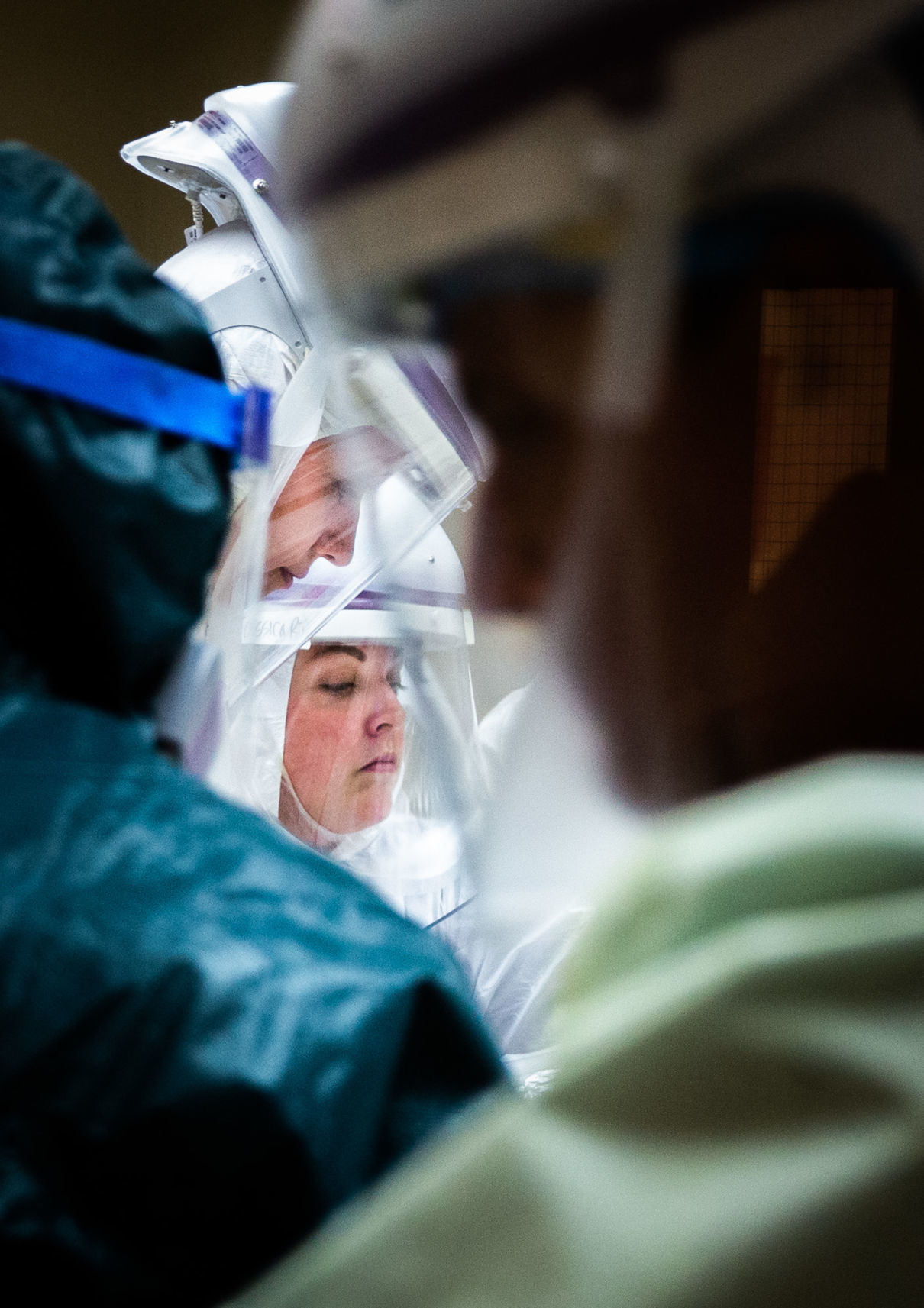
Nurses and technicians in the emergency room at Tucson Medical Center during a drill on processing patients experiencing respiratory emergencies or symptoms of COVID-19 on April 10, 2020.
Arizona governor touts COVID vaccine coming soon; spurns calls for curfews, other rules
UpdatedPHOENIX — Arizona is expected to receive “hundreds of thousands” of COVID-19 vaccine doses by the end of this month, with priority for health-care workers, teachers, vulnerable populations and long-term-care residents, the state’s health chief said Wednesday.
The announcement came as Dr. Cara Christ also disclosed that 1 person out of every 7 who got tested for the virus last week in Arizona was infected. She also reported a new one-day record for cases.
But Gov. Doug Ducey, standing by her side, refused to put any new mitigation measures or restrictions in place to get the state to the point where a majority of Arizonans can be inoculated.
He specifically rejected a proposal by the chief medical officers of several Arizona hospitals to put in place a curfew, close restaurants to indoor dining and cancel group athletic activities. Instead, Ducey said he is relying on the idea that Arizona will have sufficient hospital beds to treat those who get ill in the interim.
However, that assumes hospitals can find the qualified medical personnel to staff these beds.
Earlier Wednesday, Marjorie Bessel, chief clinical officer for Banner Health, said the problem now, unlike this summer when virus cases peaked here, is that Arizona is no longer the state with the biggest surge. That makes it difficult to recruit help from elsewhere.
And while Banner is in the process of filling 1,500 positions, she said efforts are still underway to hire 900 more.
Ducey did agree Wednesday to provide an additional $60 million to Arizona hospitals to help them find the staff they need to handle the surge of people needing medical care. That is on top of a $25 million infusion less than a month ago.
“Grim” forecasts for this month and next
Bessel said the picture in Arizona is “grim,” predicting that Banner hospitals will hit 125% of bed capacity this month and exceed that, at least briefly, in January.
That trend is not unique to Banner.
Intensive-care-unit bed use is already at 90% of capacity in the state, the most recent data from the Arizona Department of Health Services shows.
Hitting 125% is not necessarily a problem as hospitals are required to have plans in place for such a surge, including converting non-ICU beds and other facilities for intensive-care use.
But the Institute for Health Metrics Evaluation predicts the demand for ICU beds will hit 300% of capacity in Arizona by the middle of January unless there are additional steps taken to curb the spread of the virus.
It was for that reason that Bessel and medical officers from Mayo Clinic and Dignity Health specifically asked Christ this week to impose the additional restrictions.
Bessel specifically praised Tucson Mayor Regina Romero and the City Council for voting Tuesday to impose a 10 p.m. curfew for three weeks.
“A curfew is mitigation that absolutely can work,” Bessel said. “It can work and it will work if we deploy it.”
Ducey is not willing to take such steps, even as he conceded that the vaccines, which will only start to be available later this month — and only for those in the highest priority classes — won’t make any immediate dent in an increasing trend in cases.
“We are in for a tough several weeks here,” the governor said at his news conference Wednesday.
He said he was giving his “most sincere condolences” to the families of the 6,739 people in Arizona who have died so far from COVID-19.
“We grieve every death in Arizona and want to continue to do everything we can to contain the spread of this virus and protect lives,” Ducey said.
Ducey: Curfews “not the right approach”
But that won’t include the kind of new restrictions being urged by the hospital medical chiefs and others, and not the kind of curfew that takes effect Friday, Dec. 4, in Tucson.
“I don’t think it’s the right approach,” Ducey said. “We want to do things that will allow businesses to operate safely.”
He said the continuing restrictions imposed in late June, like occupancy limits on in-house restaurant dining, movie theaters and fitness centers, along with enforcement, “will be the best things we can do to continue to slow the spread.”
He brushed aside questions about the fact that the spread is not slowing, even as Christ acknowledged that 15% of the tests for the virus conducted last week are coming back positive.
“This week we’re trending higher,” she said.
The number of new cases reported per day hit a record on Nov. 23 in the state. Figures for more recent dates are still being updated.
For Ducey, the focus is on the economy.
“I don’t think the right answer is to throw hundreds of thousands of Arizonans out of work before the holidays to slow this spread because I don’t think it would slow the spread,” he said.
He said there are other complications of restrictions, “like suicide attempts, like depression, like emotional and social disconnection, like child abuse and like domestic violence.”
Safety measures for large events
The lone new regulation of sorts that Ducey did impose Wednesday is not anything the state would enforce.
His current executive orders prohibit gatherings of more than 50 unless local governments approve. Now, he said, these governments will have to have a written agreement with event organizers that they will require and enforce certain safety measures, like distancing and the use of masks.
Nothing in Ducey’s orders affects activities he said are protected by the First Amendment, like the rallies the governor attended this year during President Trump’s campaign.
That, then, leaves the vaccines.
More financial help for restaurants
Ducey said first priority will go to health-care and essential public-safety workers, residents of long-term-care facilities and other “vulnerable” populations.
He is specifically including teachers in that first group.
That dovetails with his often-repeated argument that he wants more in-classroom teaching and less online education. The premise is that once teachers have immunity, they will be more willing to return to work in classrooms.
The date for vaccines for all Arizonans has yet to be determined.
Ducey issued an executive order Wednesday spelling out that all residents will be able to get inoculated “without financial barriers.”
Ducey also set aside $1 million in grants to help restaurants and other dining facilities expand their outdoor dining operations.
There is a separate $100,000 going to the Arizona Restaurant Association for the same purpose, and another $100,000 to the Arizona Lodging and Tourism Association to aid hotels and their restaurants in strengthening their sanitation and mitigation practices to protect patrons and staff.
Not everything being done for restaurants is financial.
Ducey is suspending a provision in law that says restaurants can serve alcoholic beverages only to patrons dining in-house or at an outdoor patio directly connected to the business. That has proven to be a barrier for restaurants that have received local permission to operate in parking lots and on cordoned-off areas of the street where there is a sidewalk in between.
Tucson Medical Center and the Tucson Fire Department held a drill on April 10, 2020, to help establish procedures and solve problems when hand…
Pima County keeps voluntary curfew, enhances penalties for violating COVID-19 rules
UpdatedThe Pima County supervisors voted Friday to strengthen penalties related to noncompliance with COVID-19 regulations, including the potential suspension of restaurant licenses and civil penalties for people not wearing a mask in public.
In addition to several new enforcement actions, the Board of Supervisors also endorsed a strengthened public-health advisory by the Pima County Health Department that now requires businesses to report any known coronavirus cases.
The county’s voluntary curfew, which began Nov. 24, will remain in place each night from 10 p.m. to 5 a.m. through Dec. 31. Even as other areas of the county are asked to adhere to the voluntary curfew, the city of Tucson voted to implement a mandatory curfew earlier this week, which will be in place from Friday, Dec. 4, to Wednesday, Dec. 23.
“The point of an advisory is to really ensure that people understand the severity of what we are dealing with,” said Dr. Theresa Cullen, the county’s public-health director. “We are in a crisis situation.”
The increased enforcement measures come as new coronavirus cases reach unprecedented levels throughout the county and state. In the first four days of December, there have been close to 2,900 new infections in the county, exceeding the total number of cases in March, April and May combined.
Hospitals also continue to deal with a record number of COVID-19 patients, reporting only one available ICU bed in the county on Dec. 3. Officials throughout the state continue to see an accelerated growth curve with no signs of slowing down without serious statewide intervention.
“We in the hospitals are being stretched to the limit, even as we speak,” said Dr. Clifford Martin, an infectious-disease specialist at Tucson Medical Center, when addressing the board. “I ask you and the community to do whatever you can to help us in the hospital at this point.”
Based on action taken by Gov. Doug Ducey earlier this week, the board decided to enhance enforcement on a number of coronavirus regulations already in place.
Here are the actions that were taken by the board, in 3-2 votes with Republican supervisors Steve Christy and Ally Miller voting no on them:
Business regulations
In July, supervisors adopted a number of temporary measures applicable to restaurants, public pools, gyms, fitness centers, hotels and resorts, such as employee temperature checks, masks and gloves, occupancy limits, social distancing and cleaning requirements.
Under an amended proclamation, the county will now enhance its enforcement of these measures, allowing only one incidence of noncompliance before facing repercussion by the county Health Department. A second violation by a business could result in the possible suspension or revocation of the establishment’s license or operating permit.
Mask compliance
While the county has had a mask mandate in place since June, there were previously no penalties in place for noncompliance. On Friday, the board asked that all county jurisdictions and law enforcement agencies assist in enforcement action, which includes a $50 civil fine for not wearing a mask in public areas.
In addition, the board made it mandatory for businesses to refuse service to anyone entering their establishments without a mask, unless specific exemptions apply. A business could be fined up to $500 if they do not comply.
Event regulations
Anyone wishing to hold an event with more than 50 people will now be required to pay a $1,000 or more compliance deposit, depending on the size of the proposed event. If mitigation strategies are followed during the event, organizers would be entitled to get their deposit back.
There will be on-site inspections of these events to determine compliance.
Curfew
The voluntary countywide curfew, intended to curb evening social gatherings at bars and other places, will remain in place through Dec. 31.
After two weeks, the board will review whether the voluntary curfew and other measures are working by analyzing the number of infections per 100,000 residents as well as the percent of positivity within the county. If the county is still over 100 cases per 100,000 people and over 10% positive, the board will consider moving to a mandatory curfew.
“We don’t know what the next two weeks will bring,” County Administrator Chuck Huckelberry said. “We are at over 350 infections per 100,000. If that continues to increase, we will be back with more measures within the next two weeks.”
Older adults asked to shelter in place
In addition to the curfew, the Health Department is also asking for older adults and people with underlying medical conditions to voluntarily shelter in place, except to seek medical care, purchase food, attend work or other essential activities.
The enhanced public-health advisory also requires businesses to report any confirmed COVID-19 cases within their establishment and further comply with any contact tracing efforts by the Health Department. A website will go live next week for businesses to report these cases to the county.
Photos: April coronavirus patient drill at Tucson Medical Center
Tucson Medical Center, coronavirus drill
Updated
Tucson firefighters treat a practice patient "dummy" entering the emergency room at Tucson Medical Center during a drill on processing patients experiencing respiratory emergencies or symptoms of COVID-19 on April 10, 2020.
Tucson Medical Center, coronavirus drill
Updated
Tucson Medical Center is estimating a $20 million loss in revenue for April alone — nearly 40 percent of its average monthly income — but the hospital says it is in a strong position to endure the pandemic.
5 million — this would account for nearly 40 percent of their average monthly income. Nurses and technicians in the emergency room at Tucson Medical Center during a drill on processing patients experiencing respiratory emergencies or symptoms of COVID-19 on April 10, 2020.
Tucson Medical Center, coronavirus drill
Updated
Tucson hospitals believe a resumption in elective surgeries, possibly soon, will help stabilize their operations.
Emergency room staff at Tucson Medical Center watch coworkers and Tucson fire paramedics during a drill on processing patients experiencing respiratory emergencies or symptoms of COVID-19 on April 10, 2020.
Tucson Medical Center, coronavirus drill
Updated
An empty emergency-room waiting area at Tucson Medical Center. About 100 fewer patients pass through the ER daily.
ergency room waiting area at Tucson Medical Center on April 10, 2020.
Tucson Medical Center, coronavirus drill
Updated
Tucson Fire personnel and emergency room workers from Tucson Medical Center work on a "dummy" patient at TMC during a drill on processing patients experiencing respiratory emergencies or symptoms of COVID-19 on April 10, 2020.
Tucson Medical Center, coronavirus drill
Updated
Seating in a Coronavirus disease (COVID-19) testing tent outside of the Tucson Medical Center's Emergency Room, on April 10, 2020.
Tucson Medical Center, coronavirus drill
Updated
Tucson Fire EMTs and paramedics prepare to run a drill at the Tucson Medical Center's Emergency Room, on April 10, 2020.
Tucson Medical Center, coronavirus drill
Updated
Tucson Fire Department EMTs and paramedics prepare biohazard suits before running a drill at the Tucson Medical Center's Emergency Room, on April 10, 2020.
Tucson Medical Center, coronavirus drill
Updated
Emergency room workers at Tucson Medical Center talk with Tucson Fire Department EMTs and paramedics prior to a drill on processing patients experiencing respiratory emergencies or symptoms of COVID-19 on April 10, 2020.
Tucson Medical Center, coronavirus drill
Updated
Opportunities to donate and support health-care workers, including but not limited to housing, will be forthcoming online at www.hcwhosted.org.
Tucson Medical Center, coronavirus drill
Updated
Nurses and technicians in the emergency room at Tucson Medical Center during a drill on processing patients experiencing respiratory emergencies or symptoms of COVID-19 on April 10, 2020.
Tucson Medical Center, coronavirus drill
Updated
EMTs in masks personnel load up a gurney into the back of an ambulance after dropping off a patient at the Tucson Medical Center's emergency room, on April 10, 2020.
Tucson Medical Center, coronavirus drill
Updated
Tucson Fire paramedics help each other with biohazard suits before running a drill at the Tucson Medical Center's Emergency Room, on April 10, 2020.
Tucson Medical Center, coronavirus drill
Updated
A Tucson Fire paramedic peers out the back of a TFD rescue ambulance during a drill at Tucson Medical Center Emergency Room on April 10, 2020.
Tucson Medical Center, coronavirus drill
Updated
Emergency room staff watch as coworkers and Tucson Fire EMTs and paramedics at Tucson Medical Center during a drill on processing patients experiencing respiratory emergencies or symptoms of COVID-19 on April 10, 2020.
Tucson Medical Center, coronavirus drill
Updated
Nurses and technicians in the emergency room at Tucson Medical Center during a drill on processing patients experiencing respiratory emergencies or symptoms of COVID-19 on April 10, 2020.
Arizona governor touts COVID vaccine coming soon; spurns calls for curfews, other rules
UpdatedPHOENIX — Arizona is expected to receive “hundreds of thousands” of COVID-19 vaccine doses by the end of this month, with priority for health-care workers, teachers, vulnerable populations and long-term-care residents, the state’s health chief said Wednesday.
The announcement came as Dr. Cara Christ also disclosed that 1 person out of every 7 who got tested for the virus last week in Arizona was infected. She also reported a new one-day record for cases.
But Gov. Doug Ducey, standing by her side, refused to put any new mitigation measures or restrictions in place to get the state to the point where a majority of Arizonans can be inoculated.
He specifically rejected a proposal by the chief medical officers of several Arizona hospitals to put in place a curfew, close restaurants to indoor dining and cancel group athletic activities. Instead, Ducey said he is relying on the idea that Arizona will have sufficient hospital beds to treat those who get ill in the interim.
However, that assumes hospitals can find the qualified medical personnel to staff these beds.
Earlier Wednesday, Marjorie Bessel, chief clinical officer for Banner Health, said the problem now, unlike this summer when virus cases peaked here, is that Arizona is no longer the state with the biggest surge. That makes it difficult to recruit help from elsewhere.
And while Banner is in the process of filling 1,500 positions, she said efforts are still underway to hire 900 more.
Ducey did agree Wednesday to provide an additional $60 million to Arizona hospitals to help them find the staff they need to handle the surge of people needing medical care. That is on top of a $25 million infusion less than a month ago.
“Grim” forecasts for this month and next
Bessel said the picture in Arizona is “grim,” predicting that Banner hospitals will hit 125% of bed capacity this month and exceed that, at least briefly, in January.
That trend is not unique to Banner.
Intensive-care-unit bed use is already at 90% of capacity in the state, the most recent data from the Arizona Department of Health Services shows.
Hitting 125% is not necessarily a problem as hospitals are required to have plans in place for such a surge, including converting non-ICU beds and other facilities for intensive-care use.
But the Institute for Health Metrics Evaluation predicts the demand for ICU beds will hit 300% of capacity in Arizona by the middle of January unless there are additional steps taken to curb the spread of the virus.
It was for that reason that Bessel and medical officers from Mayo Clinic and Dignity Health specifically asked Christ this week to impose the additional restrictions.
Bessel specifically praised Tucson Mayor Regina Romero and the City Council for voting Tuesday to impose a 10 p.m. curfew for three weeks.
“A curfew is mitigation that absolutely can work,” Bessel said. “It can work and it will work if we deploy it.”
Ducey is not willing to take such steps, even as he conceded that the vaccines, which will only start to be available later this month — and only for those in the highest priority classes — won’t make any immediate dent in an increasing trend in cases.
“We are in for a tough several weeks here,” the governor said at his news conference Wednesday.
He said he was giving his “most sincere condolences” to the families of the 6,739 people in Arizona who have died so far from COVID-19.
“We grieve every death in Arizona and want to continue to do everything we can to contain the spread of this virus and protect lives,” Ducey said.
Ducey: Curfews “not the right approach”
But that won’t include the kind of new restrictions being urged by the hospital medical chiefs and others, and not the kind of curfew that takes effect Friday, Dec. 4, in Tucson.
“I don’t think it’s the right approach,” Ducey said. “We want to do things that will allow businesses to operate safely.”
He said the continuing restrictions imposed in late June, like occupancy limits on in-house restaurant dining, movie theaters and fitness centers, along with enforcement, “will be the best things we can do to continue to slow the spread.”
He brushed aside questions about the fact that the spread is not slowing, even as Christ acknowledged that 15% of the tests for the virus conducted last week are coming back positive.
“This week we’re trending higher,” she said.
The number of new cases reported per day hit a record on Nov. 23 in the state. Figures for more recent dates are still being updated.
For Ducey, the focus is on the economy.
“I don’t think the right answer is to throw hundreds of thousands of Arizonans out of work before the holidays to slow this spread because I don’t think it would slow the spread,” he said.
He said there are other complications of restrictions, “like suicide attempts, like depression, like emotional and social disconnection, like child abuse and like domestic violence.”
Safety measures for large events
The lone new regulation of sorts that Ducey did impose Wednesday is not anything the state would enforce.
His current executive orders prohibit gatherings of more than 50 unless local governments approve. Now, he said, these governments will have to have a written agreement with event organizers that they will require and enforce certain safety measures, like distancing and the use of masks.
Nothing in Ducey’s orders affects activities he said are protected by the First Amendment, like the rallies the governor attended this year during President Trump’s campaign.
That, then, leaves the vaccines.
More financial help for restaurants
Ducey said first priority will go to health-care and essential public-safety workers, residents of long-term-care facilities and other “vulnerable” populations.
He is specifically including teachers in that first group.
That dovetails with his often-repeated argument that he wants more in-classroom teaching and less online education. The premise is that once teachers have immunity, they will be more willing to return to work in classrooms.
The date for vaccines for all Arizonans has yet to be determined.
Ducey issued an executive order Wednesday spelling out that all residents will be able to get inoculated “without financial barriers.”
Ducey also set aside $1 million in grants to help restaurants and other dining facilities expand their outdoor dining operations.
There is a separate $100,000 going to the Arizona Restaurant Association for the same purpose, and another $100,000 to the Arizona Lodging and Tourism Association to aid hotels and their restaurants in strengthening their sanitation and mitigation practices to protect patrons and staff.
Not everything being done for restaurants is financial.
Ducey is suspending a provision in law that says restaurants can serve alcoholic beverages only to patrons dining in-house or at an outdoor patio directly connected to the business. That has proven to be a barrier for restaurants that have received local permission to operate in parking lots and on cordoned-off areas of the street where there is a sidewalk in between.
Tucson Medical Center and the Tucson Fire Department held a drill on April 10, 2020, to help establish procedures and solve problems when hand…
Pima County keeps voluntary curfew, enhances penalties for violating COVID-19 rules
UpdatedThe Pima County supervisors voted Friday to strengthen penalties related to noncompliance with COVID-19 regulations, including the potential suspension of restaurant licenses and civil penalties for people not wearing a mask in public.
In addition to several new enforcement actions, the Board of Supervisors also endorsed a strengthened public-health advisory by the Pima County Health Department that now requires businesses to report any known coronavirus cases.
The county’s voluntary curfew, which began Nov. 24, will remain in place each night from 10 p.m. to 5 a.m. through Dec. 31. Even as other areas of the county are asked to adhere to the voluntary curfew, the city of Tucson voted to implement a mandatory curfew earlier this week, which will be in place from Friday, Dec. 4, to Wednesday, Dec. 23.
“The point of an advisory is to really ensure that people understand the severity of what we are dealing with,” said Dr. Theresa Cullen, the county’s public-health director. “We are in a crisis situation.”
The increased enforcement measures come as new coronavirus cases reach unprecedented levels throughout the county and state. In the first four days of December, there have been close to 2,900 new infections in the county, exceeding the total number of cases in March, April and May combined.
Hospitals also continue to deal with a record number of COVID-19 patients, reporting only one available ICU bed in the county on Dec. 3. Officials throughout the state continue to see an accelerated growth curve with no signs of slowing down without serious statewide intervention.
“We in the hospitals are being stretched to the limit, even as we speak,” said Dr. Clifford Martin, an infectious-disease specialist at Tucson Medical Center, when addressing the board. “I ask you and the community to do whatever you can to help us in the hospital at this point.”
Based on action taken by Gov. Doug Ducey earlier this week, the board decided to enhance enforcement on a number of coronavirus regulations already in place.
Here are the actions that were taken by the board, in 3-2 votes with Republican supervisors Steve Christy and Ally Miller voting no on them:
Business regulations
In July, supervisors adopted a number of temporary measures applicable to restaurants, public pools, gyms, fitness centers, hotels and resorts, such as employee temperature checks, masks and gloves, occupancy limits, social distancing and cleaning requirements.
Under an amended proclamation, the county will now enhance its enforcement of these measures, allowing only one incidence of noncompliance before facing repercussion by the county Health Department. A second violation by a business could result in the possible suspension or revocation of the establishment’s license or operating permit.
Mask compliance
While the county has had a mask mandate in place since June, there were previously no penalties in place for noncompliance. On Friday, the board asked that all county jurisdictions and law enforcement agencies assist in enforcement action, which includes a $50 civil fine for not wearing a mask in public areas.
In addition, the board made it mandatory for businesses to refuse service to anyone entering their establishments without a mask, unless specific exemptions apply. A business could be fined up to $500 if they do not comply.
Event regulations
Anyone wishing to hold an event with more than 50 people will now be required to pay a $1,000 or more compliance deposit, depending on the size of the proposed event. If mitigation strategies are followed during the event, organizers would be entitled to get their deposit back.
There will be on-site inspections of these events to determine compliance.
Curfew
The voluntary countywide curfew, intended to curb evening social gatherings at bars and other places, will remain in place through Dec. 31.
After two weeks, the board will review whether the voluntary curfew and other measures are working by analyzing the number of infections per 100,000 residents as well as the percent of positivity within the county. If the county is still over 100 cases per 100,000 people and over 10% positive, the board will consider moving to a mandatory curfew.
“We don’t know what the next two weeks will bring,” County Administrator Chuck Huckelberry said. “We are at over 350 infections per 100,000. If that continues to increase, we will be back with more measures within the next two weeks.”
Older adults asked to shelter in place
In addition to the curfew, the Health Department is also asking for older adults and people with underlying medical conditions to voluntarily shelter in place, except to seek medical care, purchase food, attend work or other essential activities.
The enhanced public-health advisory also requires businesses to report any confirmed COVID-19 cases within their establishment and further comply with any contact tracing efforts by the Health Department. A website will go live next week for businesses to report these cases to the county.
Photos: April coronavirus patient drill at Tucson Medical Center
Tucson Medical Center, coronavirus drill
Updated
Tucson firefighters treat a practice patient "dummy" entering the emergency room at Tucson Medical Center during a drill on processing patients experiencing respiratory emergencies or symptoms of COVID-19 on April 10, 2020.
Tucson Medical Center, coronavirus drill
Updated
Tucson Medical Center is estimating a $20 million loss in revenue for April alone — nearly 40 percent of its average monthly income — but the hospital says it is in a strong position to endure the pandemic.
5 million — this would account for nearly 40 percent of their average monthly income. Nurses and technicians in the emergency room at Tucson Medical Center during a drill on processing patients experiencing respiratory emergencies or symptoms of COVID-19 on April 10, 2020.
Tucson Medical Center, coronavirus drill
Updated
Tucson hospitals believe a resumption in elective surgeries, possibly soon, will help stabilize their operations.
Emergency room staff at Tucson Medical Center watch coworkers and Tucson fire paramedics during a drill on processing patients experiencing respiratory emergencies or symptoms of COVID-19 on April 10, 2020.
Tucson Medical Center, coronavirus drill
Updated
An empty emergency-room waiting area at Tucson Medical Center. About 100 fewer patients pass through the ER daily.
ergency room waiting area at Tucson Medical Center on April 10, 2020.
Tucson Medical Center, coronavirus drill
Updated
Tucson Fire personnel and emergency room workers from Tucson Medical Center work on a "dummy" patient at TMC during a drill on processing patients experiencing respiratory emergencies or symptoms of COVID-19 on April 10, 2020.
Tucson Medical Center, coronavirus drill
Updated
Seating in a Coronavirus disease (COVID-19) testing tent outside of the Tucson Medical Center's Emergency Room, on April 10, 2020.
Tucson Medical Center, coronavirus drill
Updated
Tucson Fire EMTs and paramedics prepare to run a drill at the Tucson Medical Center's Emergency Room, on April 10, 2020.
Tucson Medical Center, coronavirus drill
Updated
Tucson Fire Department EMTs and paramedics prepare biohazard suits before running a drill at the Tucson Medical Center's Emergency Room, on April 10, 2020.
Tucson Medical Center, coronavirus drill
Updated
Emergency room workers at Tucson Medical Center talk with Tucson Fire Department EMTs and paramedics prior to a drill on processing patients experiencing respiratory emergencies or symptoms of COVID-19 on April 10, 2020.
Tucson Medical Center, coronavirus drill
Updated
Opportunities to donate and support health-care workers, including but not limited to housing, will be forthcoming online at www.hcwhosted.org.
Tucson Medical Center, coronavirus drill
Updated
Nurses and technicians in the emergency room at Tucson Medical Center during a drill on processing patients experiencing respiratory emergencies or symptoms of COVID-19 on April 10, 2020.
Tucson Medical Center, coronavirus drill
Updated
EMTs in masks personnel load up a gurney into the back of an ambulance after dropping off a patient at the Tucson Medical Center's emergency room, on April 10, 2020.
Tucson Medical Center, coronavirus drill
Updated
Tucson Fire paramedics help each other with biohazard suits before running a drill at the Tucson Medical Center's Emergency Room, on April 10, 2020.
Tucson Medical Center, coronavirus drill
Updated
A Tucson Fire paramedic peers out the back of a TFD rescue ambulance during a drill at Tucson Medical Center Emergency Room on April 10, 2020.
Tucson Medical Center, coronavirus drill
Updated
Emergency room staff watch as coworkers and Tucson Fire EMTs and paramedics at Tucson Medical Center during a drill on processing patients experiencing respiratory emergencies or symptoms of COVID-19 on April 10, 2020.
Tucson Medical Center, coronavirus drill
Updated
Nurses and technicians in the emergency room at Tucson Medical Center during a drill on processing patients experiencing respiratory emergencies or symptoms of COVID-19 on April 10, 2020.
Arizona governor touts COVID vaccine coming soon; spurns calls for curfews, other rules
UpdatedPHOENIX — Arizona is expected to receive “hundreds of thousands” of COVID-19 vaccine doses by the end of this month, with priority for health-care workers, teachers, vulnerable populations and long-term-care residents, the state’s health chief said Wednesday.
The announcement came as Dr. Cara Christ also disclosed that 1 person out of every 7 who got tested for the virus last week in Arizona was infected. She also reported a new one-day record for cases.
But Gov. Doug Ducey, standing by her side, refused to put any new mitigation measures or restrictions in place to get the state to the point where a majority of Arizonans can be inoculated.
He specifically rejected a proposal by the chief medical officers of several Arizona hospitals to put in place a curfew, close restaurants to indoor dining and cancel group athletic activities. Instead, Ducey said he is relying on the idea that Arizona will have sufficient hospital beds to treat those who get ill in the interim.
However, that assumes hospitals can find the qualified medical personnel to staff these beds.
Earlier Wednesday, Marjorie Bessel, chief clinical officer for Banner Health, said the problem now, unlike this summer when virus cases peaked here, is that Arizona is no longer the state with the biggest surge. That makes it difficult to recruit help from elsewhere.
And while Banner is in the process of filling 1,500 positions, she said efforts are still underway to hire 900 more.
Ducey did agree Wednesday to provide an additional $60 million to Arizona hospitals to help them find the staff they need to handle the surge of people needing medical care. That is on top of a $25 million infusion less than a month ago.
“Grim” forecasts for this month and next
Bessel said the picture in Arizona is “grim,” predicting that Banner hospitals will hit 125% of bed capacity this month and exceed that, at least briefly, in January.
That trend is not unique to Banner.
Intensive-care-unit bed use is already at 90% of capacity in the state, the most recent data from the Arizona Department of Health Services shows.
Hitting 125% is not necessarily a problem as hospitals are required to have plans in place for such a surge, including converting non-ICU beds and other facilities for intensive-care use.
But the Institute for Health Metrics Evaluation predicts the demand for ICU beds will hit 300% of capacity in Arizona by the middle of January unless there are additional steps taken to curb the spread of the virus.
It was for that reason that Bessel and medical officers from Mayo Clinic and Dignity Health specifically asked Christ this week to impose the additional restrictions.
Bessel specifically praised Tucson Mayor Regina Romero and the City Council for voting Tuesday to impose a 10 p.m. curfew for three weeks.
“A curfew is mitigation that absolutely can work,” Bessel said. “It can work and it will work if we deploy it.”
Ducey is not willing to take such steps, even as he conceded that the vaccines, which will only start to be available later this month — and only for those in the highest priority classes — won’t make any immediate dent in an increasing trend in cases.
“We are in for a tough several weeks here,” the governor said at his news conference Wednesday.
He said he was giving his “most sincere condolences” to the families of the 6,739 people in Arizona who have died so far from COVID-19.
“We grieve every death in Arizona and want to continue to do everything we can to contain the spread of this virus and protect lives,” Ducey said.
Ducey: Curfews “not the right approach”
But that won’t include the kind of new restrictions being urged by the hospital medical chiefs and others, and not the kind of curfew that takes effect Friday, Dec. 4, in Tucson.
“I don’t think it’s the right approach,” Ducey said. “We want to do things that will allow businesses to operate safely.”
He said the continuing restrictions imposed in late June, like occupancy limits on in-house restaurant dining, movie theaters and fitness centers, along with enforcement, “will be the best things we can do to continue to slow the spread.”
He brushed aside questions about the fact that the spread is not slowing, even as Christ acknowledged that 15% of the tests for the virus conducted last week are coming back positive.
“This week we’re trending higher,” she said.
The number of new cases reported per day hit a record on Nov. 23 in the state. Figures for more recent dates are still being updated.
For Ducey, the focus is on the economy.
“I don’t think the right answer is to throw hundreds of thousands of Arizonans out of work before the holidays to slow this spread because I don’t think it would slow the spread,” he said.
He said there are other complications of restrictions, “like suicide attempts, like depression, like emotional and social disconnection, like child abuse and like domestic violence.”
Safety measures for large events
The lone new regulation of sorts that Ducey did impose Wednesday is not anything the state would enforce.
His current executive orders prohibit gatherings of more than 50 unless local governments approve. Now, he said, these governments will have to have a written agreement with event organizers that they will require and enforce certain safety measures, like distancing and the use of masks.
Nothing in Ducey’s orders affects activities he said are protected by the First Amendment, like the rallies the governor attended this year during President Trump’s campaign.
That, then, leaves the vaccines.
More financial help for restaurants
Ducey said first priority will go to health-care and essential public-safety workers, residents of long-term-care facilities and other “vulnerable” populations.
He is specifically including teachers in that first group.
That dovetails with his often-repeated argument that he wants more in-classroom teaching and less online education. The premise is that once teachers have immunity, they will be more willing to return to work in classrooms.
The date for vaccines for all Arizonans has yet to be determined.
Ducey issued an executive order Wednesday spelling out that all residents will be able to get inoculated “without financial barriers.”
Ducey also set aside $1 million in grants to help restaurants and other dining facilities expand their outdoor dining operations.
There is a separate $100,000 going to the Arizona Restaurant Association for the same purpose, and another $100,000 to the Arizona Lodging and Tourism Association to aid hotels and their restaurants in strengthening their sanitation and mitigation practices to protect patrons and staff.
Not everything being done for restaurants is financial.
Ducey is suspending a provision in law that says restaurants can serve alcoholic beverages only to patrons dining in-house or at an outdoor patio directly connected to the business. That has proven to be a barrier for restaurants that have received local permission to operate in parking lots and on cordoned-off areas of the street where there is a sidewalk in between.
Tucson Medical Center and the Tucson Fire Department held a drill on April 10, 2020, to help establish procedures and solve problems when hand…
Pima County keeps voluntary curfew, enhances penalties for violating COVID-19 rules
UpdatedThe Pima County supervisors voted Friday to strengthen penalties related to noncompliance with COVID-19 regulations, including the potential suspension of restaurant licenses and civil penalties for people not wearing a mask in public.
In addition to several new enforcement actions, the Board of Supervisors also endorsed a strengthened public-health advisory by the Pima County Health Department that now requires businesses to report any known coronavirus cases.
The county’s voluntary curfew, which began Nov. 24, will remain in place each night from 10 p.m. to 5 a.m. through Dec. 31. Even as other areas of the county are asked to adhere to the voluntary curfew, the city of Tucson voted to implement a mandatory curfew earlier this week, which will be in place from Friday, Dec. 4, to Wednesday, Dec. 23.
“The point of an advisory is to really ensure that people understand the severity of what we are dealing with,” said Dr. Theresa Cullen, the county’s public-health director. “We are in a crisis situation.”
The increased enforcement measures come as new coronavirus cases reach unprecedented levels throughout the county and state. In the first four days of December, there have been close to 2,900 new infections in the county, exceeding the total number of cases in March, April and May combined.
Hospitals also continue to deal with a record number of COVID-19 patients, reporting only one available ICU bed in the county on Dec. 3. Officials throughout the state continue to see an accelerated growth curve with no signs of slowing down without serious statewide intervention.
“We in the hospitals are being stretched to the limit, even as we speak,” said Dr. Clifford Martin, an infectious-disease specialist at Tucson Medical Center, when addressing the board. “I ask you and the community to do whatever you can to help us in the hospital at this point.”
Based on action taken by Gov. Doug Ducey earlier this week, the board decided to enhance enforcement on a number of coronavirus regulations already in place.
Here are the actions that were taken by the board, in 3-2 votes with Republican supervisors Steve Christy and Ally Miller voting no on them:
Business regulations
In July, supervisors adopted a number of temporary measures applicable to restaurants, public pools, gyms, fitness centers, hotels and resorts, such as employee temperature checks, masks and gloves, occupancy limits, social distancing and cleaning requirements.
Under an amended proclamation, the county will now enhance its enforcement of these measures, allowing only one incidence of noncompliance before facing repercussion by the county Health Department. A second violation by a business could result in the possible suspension or revocation of the establishment’s license or operating permit.
Mask compliance
While the county has had a mask mandate in place since June, there were previously no penalties in place for noncompliance. On Friday, the board asked that all county jurisdictions and law enforcement agencies assist in enforcement action, which includes a $50 civil fine for not wearing a mask in public areas.
In addition, the board made it mandatory for businesses to refuse service to anyone entering their establishments without a mask, unless specific exemptions apply. A business could be fined up to $500 if they do not comply.
Event regulations
Anyone wishing to hold an event with more than 50 people will now be required to pay a $1,000 or more compliance deposit, depending on the size of the proposed event. If mitigation strategies are followed during the event, organizers would be entitled to get their deposit back.
There will be on-site inspections of these events to determine compliance.
Curfew
The voluntary countywide curfew, intended to curb evening social gatherings at bars and other places, will remain in place through Dec. 31.
After two weeks, the board will review whether the voluntary curfew and other measures are working by analyzing the number of infections per 100,000 residents as well as the percent of positivity within the county. If the county is still over 100 cases per 100,000 people and over 10% positive, the board will consider moving to a mandatory curfew.
“We don’t know what the next two weeks will bring,” County Administrator Chuck Huckelberry said. “We are at over 350 infections per 100,000. If that continues to increase, we will be back with more measures within the next two weeks.”
Older adults asked to shelter in place
In addition to the curfew, the Health Department is also asking for older adults and people with underlying medical conditions to voluntarily shelter in place, except to seek medical care, purchase food, attend work or other essential activities.
The enhanced public-health advisory also requires businesses to report any confirmed COVID-19 cases within their establishment and further comply with any contact tracing efforts by the Health Department. A website will go live next week for businesses to report these cases to the county.
Photos: April coronavirus patient drill at Tucson Medical Center
Tucson Medical Center, coronavirus drill
Updated
Tucson firefighters treat a practice patient "dummy" entering the emergency room at Tucson Medical Center during a drill on processing patients experiencing respiratory emergencies or symptoms of COVID-19 on April 10, 2020.
Tucson Medical Center, coronavirus drill
Updated
Tucson Medical Center is estimating a $20 million loss in revenue for April alone — nearly 40 percent of its average monthly income — but the hospital says it is in a strong position to endure the pandemic.
5 million — this would account for nearly 40 percent of their average monthly income. Nurses and technicians in the emergency room at Tucson Medical Center during a drill on processing patients experiencing respiratory emergencies or symptoms of COVID-19 on April 10, 2020.
Tucson Medical Center, coronavirus drill
Updated
Tucson hospitals believe a resumption in elective surgeries, possibly soon, will help stabilize their operations.
Emergency room staff at Tucson Medical Center watch coworkers and Tucson fire paramedics during a drill on processing patients experiencing respiratory emergencies or symptoms of COVID-19 on April 10, 2020.
Tucson Medical Center, coronavirus drill
Updated
An empty emergency-room waiting area at Tucson Medical Center. About 100 fewer patients pass through the ER daily.
ergency room waiting area at Tucson Medical Center on April 10, 2020.
Tucson Medical Center, coronavirus drill
Updated
Tucson Fire personnel and emergency room workers from Tucson Medical Center work on a "dummy" patient at TMC during a drill on processing patients experiencing respiratory emergencies or symptoms of COVID-19 on April 10, 2020.
Tucson Medical Center, coronavirus drill
Updated
Seating in a Coronavirus disease (COVID-19) testing tent outside of the Tucson Medical Center's Emergency Room, on April 10, 2020.
Tucson Medical Center, coronavirus drill
Updated
Tucson Fire EMTs and paramedics prepare to run a drill at the Tucson Medical Center's Emergency Room, on April 10, 2020.
Tucson Medical Center, coronavirus drill
Updated
Tucson Fire Department EMTs and paramedics prepare biohazard suits before running a drill at the Tucson Medical Center's Emergency Room, on April 10, 2020.
Tucson Medical Center, coronavirus drill
Updated
Emergency room workers at Tucson Medical Center talk with Tucson Fire Department EMTs and paramedics prior to a drill on processing patients experiencing respiratory emergencies or symptoms of COVID-19 on April 10, 2020.
Tucson Medical Center, coronavirus drill
Updated
Opportunities to donate and support health-care workers, including but not limited to housing, will be forthcoming online at www.hcwhosted.org.
Tucson Medical Center, coronavirus drill
Updated
Nurses and technicians in the emergency room at Tucson Medical Center during a drill on processing patients experiencing respiratory emergencies or symptoms of COVID-19 on April 10, 2020.
Tucson Medical Center, coronavirus drill
Updated
EMTs in masks personnel load up a gurney into the back of an ambulance after dropping off a patient at the Tucson Medical Center's emergency room, on April 10, 2020.
Tucson Medical Center, coronavirus drill
Updated
Tucson Fire paramedics help each other with biohazard suits before running a drill at the Tucson Medical Center's Emergency Room, on April 10, 2020.
Tucson Medical Center, coronavirus drill
Updated
A Tucson Fire paramedic peers out the back of a TFD rescue ambulance during a drill at Tucson Medical Center Emergency Room on April 10, 2020.
Tucson Medical Center, coronavirus drill
Updated
Emergency room staff watch as coworkers and Tucson Fire EMTs and paramedics at Tucson Medical Center during a drill on processing patients experiencing respiratory emergencies or symptoms of COVID-19 on April 10, 2020.
Tucson Medical Center, coronavirus drill
Updated
Nurses and technicians in the emergency room at Tucson Medical Center during a drill on processing patients experiencing respiratory emergencies or symptoms of COVID-19 on April 10, 2020.
Arizona governor touts COVID vaccine coming soon; spurns calls for curfews, other rules
UpdatedPHOENIX — Arizona is expected to receive “hundreds of thousands” of COVID-19 vaccine doses by the end of this month, with priority for health-care workers, teachers, vulnerable populations and long-term-care residents, the state’s health chief said Wednesday.
The announcement came as Dr. Cara Christ also disclosed that 1 person out of every 7 who got tested for the virus last week in Arizona was infected. She also reported a new one-day record for cases.
But Gov. Doug Ducey, standing by her side, refused to put any new mitigation measures or restrictions in place to get the state to the point where a majority of Arizonans can be inoculated.
He specifically rejected a proposal by the chief medical officers of several Arizona hospitals to put in place a curfew, close restaurants to indoor dining and cancel group athletic activities. Instead, Ducey said he is relying on the idea that Arizona will have sufficient hospital beds to treat those who get ill in the interim.
However, that assumes hospitals can find the qualified medical personnel to staff these beds.
Earlier Wednesday, Marjorie Bessel, chief clinical officer for Banner Health, said the problem now, unlike this summer when virus cases peaked here, is that Arizona is no longer the state with the biggest surge. That makes it difficult to recruit help from elsewhere.
And while Banner is in the process of filling 1,500 positions, she said efforts are still underway to hire 900 more.
Ducey did agree Wednesday to provide an additional $60 million to Arizona hospitals to help them find the staff they need to handle the surge of people needing medical care. That is on top of a $25 million infusion less than a month ago.
“Grim” forecasts for this month and next
Bessel said the picture in Arizona is “grim,” predicting that Banner hospitals will hit 125% of bed capacity this month and exceed that, at least briefly, in January.
That trend is not unique to Banner.
Intensive-care-unit bed use is already at 90% of capacity in the state, the most recent data from the Arizona Department of Health Services shows.
Hitting 125% is not necessarily a problem as hospitals are required to have plans in place for such a surge, including converting non-ICU beds and other facilities for intensive-care use.
But the Institute for Health Metrics Evaluation predicts the demand for ICU beds will hit 300% of capacity in Arizona by the middle of January unless there are additional steps taken to curb the spread of the virus.
It was for that reason that Bessel and medical officers from Mayo Clinic and Dignity Health specifically asked Christ this week to impose the additional restrictions.
Bessel specifically praised Tucson Mayor Regina Romero and the City Council for voting Tuesday to impose a 10 p.m. curfew for three weeks.
“A curfew is mitigation that absolutely can work,” Bessel said. “It can work and it will work if we deploy it.”
Ducey is not willing to take such steps, even as he conceded that the vaccines, which will only start to be available later this month — and only for those in the highest priority classes — won’t make any immediate dent in an increasing trend in cases.
“We are in for a tough several weeks here,” the governor said at his news conference Wednesday.
He said he was giving his “most sincere condolences” to the families of the 6,739 people in Arizona who have died so far from COVID-19.
“We grieve every death in Arizona and want to continue to do everything we can to contain the spread of this virus and protect lives,” Ducey said.
Ducey: Curfews “not the right approach”
But that won’t include the kind of new restrictions being urged by the hospital medical chiefs and others, and not the kind of curfew that takes effect Friday, Dec. 4, in Tucson.
“I don’t think it’s the right approach,” Ducey said. “We want to do things that will allow businesses to operate safely.”
He said the continuing restrictions imposed in late June, like occupancy limits on in-house restaurant dining, movie theaters and fitness centers, along with enforcement, “will be the best things we can do to continue to slow the spread.”
He brushed aside questions about the fact that the spread is not slowing, even as Christ acknowledged that 15% of the tests for the virus conducted last week are coming back positive.
“This week we’re trending higher,” she said.
The number of new cases reported per day hit a record on Nov. 23 in the state. Figures for more recent dates are still being updated.
For Ducey, the focus is on the economy.
“I don’t think the right answer is to throw hundreds of thousands of Arizonans out of work before the holidays to slow this spread because I don’t think it would slow the spread,” he said.
He said there are other complications of restrictions, “like suicide attempts, like depression, like emotional and social disconnection, like child abuse and like domestic violence.”
Safety measures for large events
The lone new regulation of sorts that Ducey did impose Wednesday is not anything the state would enforce.
His current executive orders prohibit gatherings of more than 50 unless local governments approve. Now, he said, these governments will have to have a written agreement with event organizers that they will require and enforce certain safety measures, like distancing and the use of masks.
Nothing in Ducey’s orders affects activities he said are protected by the First Amendment, like the rallies the governor attended this year during President Trump’s campaign.
That, then, leaves the vaccines.
More financial help for restaurants
Ducey said first priority will go to health-care and essential public-safety workers, residents of long-term-care facilities and other “vulnerable” populations.
He is specifically including teachers in that first group.
That dovetails with his often-repeated argument that he wants more in-classroom teaching and less online education. The premise is that once teachers have immunity, they will be more willing to return to work in classrooms.
The date for vaccines for all Arizonans has yet to be determined.
Ducey issued an executive order Wednesday spelling out that all residents will be able to get inoculated “without financial barriers.”
Ducey also set aside $1 million in grants to help restaurants and other dining facilities expand their outdoor dining operations.
There is a separate $100,000 going to the Arizona Restaurant Association for the same purpose, and another $100,000 to the Arizona Lodging and Tourism Association to aid hotels and their restaurants in strengthening their sanitation and mitigation practices to protect patrons and staff.
Not everything being done for restaurants is financial.
Ducey is suspending a provision in law that says restaurants can serve alcoholic beverages only to patrons dining in-house or at an outdoor patio directly connected to the business. That has proven to be a barrier for restaurants that have received local permission to operate in parking lots and on cordoned-off areas of the street where there is a sidewalk in between.
Tucson Medical Center and the Tucson Fire Department held a drill on April 10, 2020, to help establish procedures and solve problems when hand…
Pima County keeps voluntary curfew, enhances penalties for violating COVID-19 rules
UpdatedThe Pima County supervisors voted Friday to strengthen penalties related to noncompliance with COVID-19 regulations, including the potential suspension of restaurant licenses and civil penalties for people not wearing a mask in public.
In addition to several new enforcement actions, the Board of Supervisors also endorsed a strengthened public-health advisory by the Pima County Health Department that now requires businesses to report any known coronavirus cases.
The county’s voluntary curfew, which began Nov. 24, will remain in place each night from 10 p.m. to 5 a.m. through Dec. 31. Even as other areas of the county are asked to adhere to the voluntary curfew, the city of Tucson voted to implement a mandatory curfew earlier this week, which will be in place from Friday, Dec. 4, to Wednesday, Dec. 23.
“The point of an advisory is to really ensure that people understand the severity of what we are dealing with,” said Dr. Theresa Cullen, the county’s public-health director. “We are in a crisis situation.”
The increased enforcement measures come as new coronavirus cases reach unprecedented levels throughout the county and state. In the first four days of December, there have been close to 2,900 new infections in the county, exceeding the total number of cases in March, April and May combined.
Hospitals also continue to deal with a record number of COVID-19 patients, reporting only one available ICU bed in the county on Dec. 3. Officials throughout the state continue to see an accelerated growth curve with no signs of slowing down without serious statewide intervention.
“We in the hospitals are being stretched to the limit, even as we speak,” said Dr. Clifford Martin, an infectious-disease specialist at Tucson Medical Center, when addressing the board. “I ask you and the community to do whatever you can to help us in the hospital at this point.”
Based on action taken by Gov. Doug Ducey earlier this week, the board decided to enhance enforcement on a number of coronavirus regulations already in place.
Here are the actions that were taken by the board, in 3-2 votes with Republican supervisors Steve Christy and Ally Miller voting no on them:
Business regulations
In July, supervisors adopted a number of temporary measures applicable to restaurants, public pools, gyms, fitness centers, hotels and resorts, such as employee temperature checks, masks and gloves, occupancy limits, social distancing and cleaning requirements.
Under an amended proclamation, the county will now enhance its enforcement of these measures, allowing only one incidence of noncompliance before facing repercussion by the county Health Department. A second violation by a business could result in the possible suspension or revocation of the establishment’s license or operating permit.
Mask compliance
While the county has had a mask mandate in place since June, there were previously no penalties in place for noncompliance. On Friday, the board asked that all county jurisdictions and law enforcement agencies assist in enforcement action, which includes a $50 civil fine for not wearing a mask in public areas.
In addition, the board made it mandatory for businesses to refuse service to anyone entering their establishments without a mask, unless specific exemptions apply. A business could be fined up to $500 if they do not comply.
Event regulations
Anyone wishing to hold an event with more than 50 people will now be required to pay a $1,000 or more compliance deposit, depending on the size of the proposed event. If mitigation strategies are followed during the event, organizers would be entitled to get their deposit back.
There will be on-site inspections of these events to determine compliance.
Curfew
The voluntary countywide curfew, intended to curb evening social gatherings at bars and other places, will remain in place through Dec. 31.
After two weeks, the board will review whether the voluntary curfew and other measures are working by analyzing the number of infections per 100,000 residents as well as the percent of positivity within the county. If the county is still over 100 cases per 100,000 people and over 10% positive, the board will consider moving to a mandatory curfew.
“We don’t know what the next two weeks will bring,” County Administrator Chuck Huckelberry said. “We are at over 350 infections per 100,000. If that continues to increase, we will be back with more measures within the next two weeks.”
Older adults asked to shelter in place
In addition to the curfew, the Health Department is also asking for older adults and people with underlying medical conditions to voluntarily shelter in place, except to seek medical care, purchase food, attend work or other essential activities.
The enhanced public-health advisory also requires businesses to report any confirmed COVID-19 cases within their establishment and further comply with any contact tracing efforts by the Health Department. A website will go live next week for businesses to report these cases to the county.
Photos: April coronavirus patient drill at Tucson Medical Center
Tucson Medical Center, coronavirus drill
Updated
Tucson firefighters treat a practice patient "dummy" entering the emergency room at Tucson Medical Center during a drill on processing patients experiencing respiratory emergencies or symptoms of COVID-19 on April 10, 2020.
Tucson Medical Center, coronavirus drill
Updated
Tucson Medical Center is estimating a $20 million loss in revenue for April alone — nearly 40 percent of its average monthly income — but the hospital says it is in a strong position to endure the pandemic.
5 million — this would account for nearly 40 percent of their average monthly income. Nurses and technicians in the emergency room at Tucson Medical Center during a drill on processing patients experiencing respiratory emergencies or symptoms of COVID-19 on April 10, 2020.
Tucson Medical Center, coronavirus drill
Updated
Tucson hospitals believe a resumption in elective surgeries, possibly soon, will help stabilize their operations.
Emergency room staff at Tucson Medical Center watch coworkers and Tucson fire paramedics during a drill on processing patients experiencing respiratory emergencies or symptoms of COVID-19 on April 10, 2020.
Tucson Medical Center, coronavirus drill
Updated
An empty emergency-room waiting area at Tucson Medical Center. About 100 fewer patients pass through the ER daily.
ergency room waiting area at Tucson Medical Center on April 10, 2020.
Tucson Medical Center, coronavirus drill
Updated
Tucson Fire personnel and emergency room workers from Tucson Medical Center work on a "dummy" patient at TMC during a drill on processing patients experiencing respiratory emergencies or symptoms of COVID-19 on April 10, 2020.
Tucson Medical Center, coronavirus drill
Updated
Seating in a Coronavirus disease (COVID-19) testing tent outside of the Tucson Medical Center's Emergency Room, on April 10, 2020.
Tucson Medical Center, coronavirus drill
Updated
Tucson Fire EMTs and paramedics prepare to run a drill at the Tucson Medical Center's Emergency Room, on April 10, 2020.
Tucson Medical Center, coronavirus drill
Updated
Tucson Fire Department EMTs and paramedics prepare biohazard suits before running a drill at the Tucson Medical Center's Emergency Room, on April 10, 2020.
Tucson Medical Center, coronavirus drill
Updated
Emergency room workers at Tucson Medical Center talk with Tucson Fire Department EMTs and paramedics prior to a drill on processing patients experiencing respiratory emergencies or symptoms of COVID-19 on April 10, 2020.
Tucson Medical Center, coronavirus drill
Updated
Opportunities to donate and support health-care workers, including but not limited to housing, will be forthcoming online at www.hcwhosted.org.
Tucson Medical Center, coronavirus drill
Updated
Nurses and technicians in the emergency room at Tucson Medical Center during a drill on processing patients experiencing respiratory emergencies or symptoms of COVID-19 on April 10, 2020.
Tucson Medical Center, coronavirus drill
Updated
EMTs in masks personnel load up a gurney into the back of an ambulance after dropping off a patient at the Tucson Medical Center's emergency room, on April 10, 2020.
Tucson Medical Center, coronavirus drill
Updated
Tucson Fire paramedics help each other with biohazard suits before running a drill at the Tucson Medical Center's Emergency Room, on April 10, 2020.
Tucson Medical Center, coronavirus drill
Updated
A Tucson Fire paramedic peers out the back of a TFD rescue ambulance during a drill at Tucson Medical Center Emergency Room on April 10, 2020.
Tucson Medical Center, coronavirus drill
Updated
Emergency room staff watch as coworkers and Tucson Fire EMTs and paramedics at Tucson Medical Center during a drill on processing patients experiencing respiratory emergencies or symptoms of COVID-19 on April 10, 2020.
Tucson Medical Center, coronavirus drill
Updated
Nurses and technicians in the emergency room at Tucson Medical Center during a drill on processing patients experiencing respiratory emergencies or symptoms of COVID-19 on April 10, 2020.
Arizona governor touts COVID vaccine coming soon; spurns calls for curfews, other rules
UpdatedPHOENIX — Arizona is expected to receive “hundreds of thousands” of COVID-19 vaccine doses by the end of this month, with priority for health-care workers, teachers, vulnerable populations and long-term-care residents, the state’s health chief said Wednesday.
The announcement came as Dr. Cara Christ also disclosed that 1 person out of every 7 who got tested for the virus last week in Arizona was infected. She also reported a new one-day record for cases.
But Gov. Doug Ducey, standing by her side, refused to put any new mitigation measures or restrictions in place to get the state to the point where a majority of Arizonans can be inoculated.
He specifically rejected a proposal by the chief medical officers of several Arizona hospitals to put in place a curfew, close restaurants to indoor dining and cancel group athletic activities. Instead, Ducey said he is relying on the idea that Arizona will have sufficient hospital beds to treat those who get ill in the interim.
However, that assumes hospitals can find the qualified medical personnel to staff these beds.
Earlier Wednesday, Marjorie Bessel, chief clinical officer for Banner Health, said the problem now, unlike this summer when virus cases peaked here, is that Arizona is no longer the state with the biggest surge. That makes it difficult to recruit help from elsewhere.
And while Banner is in the process of filling 1,500 positions, she said efforts are still underway to hire 900 more.
Ducey did agree Wednesday to provide an additional $60 million to Arizona hospitals to help them find the staff they need to handle the surge of people needing medical care. That is on top of a $25 million infusion less than a month ago.
“Grim” forecasts for this month and next
Bessel said the picture in Arizona is “grim,” predicting that Banner hospitals will hit 125% of bed capacity this month and exceed that, at least briefly, in January.
That trend is not unique to Banner.
Intensive-care-unit bed use is already at 90% of capacity in the state, the most recent data from the Arizona Department of Health Services shows.
Hitting 125% is not necessarily a problem as hospitals are required to have plans in place for such a surge, including converting non-ICU beds and other facilities for intensive-care use.
But the Institute for Health Metrics Evaluation predicts the demand for ICU beds will hit 300% of capacity in Arizona by the middle of January unless there are additional steps taken to curb the spread of the virus.
It was for that reason that Bessel and medical officers from Mayo Clinic and Dignity Health specifically asked Christ this week to impose the additional restrictions.
Bessel specifically praised Tucson Mayor Regina Romero and the City Council for voting Tuesday to impose a 10 p.m. curfew for three weeks.
“A curfew is mitigation that absolutely can work,” Bessel said. “It can work and it will work if we deploy it.”
Ducey is not willing to take such steps, even as he conceded that the vaccines, which will only start to be available later this month — and only for those in the highest priority classes — won’t make any immediate dent in an increasing trend in cases.
“We are in for a tough several weeks here,” the governor said at his news conference Wednesday.
He said he was giving his “most sincere condolences” to the families of the 6,739 people in Arizona who have died so far from COVID-19.
“We grieve every death in Arizona and want to continue to do everything we can to contain the spread of this virus and protect lives,” Ducey said.
Ducey: Curfews “not the right approach”
But that won’t include the kind of new restrictions being urged by the hospital medical chiefs and others, and not the kind of curfew that takes effect Friday, Dec. 4, in Tucson.
“I don’t think it’s the right approach,” Ducey said. “We want to do things that will allow businesses to operate safely.”
He said the continuing restrictions imposed in late June, like occupancy limits on in-house restaurant dining, movie theaters and fitness centers, along with enforcement, “will be the best things we can do to continue to slow the spread.”
He brushed aside questions about the fact that the spread is not slowing, even as Christ acknowledged that 15% of the tests for the virus conducted last week are coming back positive.
“This week we’re trending higher,” she said.
The number of new cases reported per day hit a record on Nov. 23 in the state. Figures for more recent dates are still being updated.
For Ducey, the focus is on the economy.
“I don’t think the right answer is to throw hundreds of thousands of Arizonans out of work before the holidays to slow this spread because I don’t think it would slow the spread,” he said.
He said there are other complications of restrictions, “like suicide attempts, like depression, like emotional and social disconnection, like child abuse and like domestic violence.”
Safety measures for large events
The lone new regulation of sorts that Ducey did impose Wednesday is not anything the state would enforce.
His current executive orders prohibit gatherings of more than 50 unless local governments approve. Now, he said, these governments will have to have a written agreement with event organizers that they will require and enforce certain safety measures, like distancing and the use of masks.
Nothing in Ducey’s orders affects activities he said are protected by the First Amendment, like the rallies the governor attended this year during President Trump’s campaign.
That, then, leaves the vaccines.
More financial help for restaurants
Ducey said first priority will go to health-care and essential public-safety workers, residents of long-term-care facilities and other “vulnerable” populations.
He is specifically including teachers in that first group.
That dovetails with his often-repeated argument that he wants more in-classroom teaching and less online education. The premise is that once teachers have immunity, they will be more willing to return to work in classrooms.
The date for vaccines for all Arizonans has yet to be determined.
Ducey issued an executive order Wednesday spelling out that all residents will be able to get inoculated “without financial barriers.”
Ducey also set aside $1 million in grants to help restaurants and other dining facilities expand their outdoor dining operations.
There is a separate $100,000 going to the Arizona Restaurant Association for the same purpose, and another $100,000 to the Arizona Lodging and Tourism Association to aid hotels and their restaurants in strengthening their sanitation and mitigation practices to protect patrons and staff.
Not everything being done for restaurants is financial.
Ducey is suspending a provision in law that says restaurants can serve alcoholic beverages only to patrons dining in-house or at an outdoor patio directly connected to the business. That has proven to be a barrier for restaurants that have received local permission to operate in parking lots and on cordoned-off areas of the street where there is a sidewalk in between.
Pima County keeps voluntary curfew, enhances penalties for violating COVID-19 rules
UpdatedThe Pima County supervisors voted Friday to strengthen penalties related to noncompliance with COVID-19 regulations, including the potential suspension of restaurant licenses and civil penalties for people not wearing a mask in public.
In addition to several new enforcement actions, the Board of Supervisors also endorsed a strengthened public-health advisory by the Pima County Health Department that now requires businesses to report any known coronavirus cases.
The county’s voluntary curfew, which began Nov. 24, will remain in place each night from 10 p.m. to 5 a.m. through Dec. 31. Even as other areas of the county are asked to adhere to the voluntary curfew, the city of Tucson voted to implement a mandatory curfew earlier this week, which will be in place from Friday, Dec. 4, to Wednesday, Dec. 23.
“The point of an advisory is to really ensure that people understand the severity of what we are dealing with,” said Dr. Theresa Cullen, the county’s public-health director. “We are in a crisis situation.”
The increased enforcement measures come as new coronavirus cases reach unprecedented levels throughout the county and state. In the first four days of December, there have been close to 2,900 new infections in the county, exceeding the total number of cases in March, April and May combined.
Hospitals also continue to deal with a record number of COVID-19 patients, reporting only one available ICU bed in the county on Dec. 3. Officials throughout the state continue to see an accelerated growth curve with no signs of slowing down without serious statewide intervention.
“We in the hospitals are being stretched to the limit, even as we speak,” said Dr. Clifford Martin, an infectious-disease specialist at Tucson Medical Center, when addressing the board. “I ask you and the community to do whatever you can to help us in the hospital at this point.”
Based on action taken by Gov. Doug Ducey earlier this week, the board decided to enhance enforcement on a number of coronavirus regulations already in place.
Here are the actions that were taken by the board, in 3-2 votes with Republican supervisors Steve Christy and Ally Miller voting no on them:
Business regulations
In July, supervisors adopted a number of temporary measures applicable to restaurants, public pools, gyms, fitness centers, hotels and resorts, such as employee temperature checks, masks and gloves, occupancy limits, social distancing and cleaning requirements.
Under an amended proclamation, the county will now enhance its enforcement of these measures, allowing only one incidence of noncompliance before facing repercussion by the county Health Department. A second violation by a business could result in the possible suspension or revocation of the establishment’s license or operating permit.
Mask compliance
While the county has had a mask mandate in place since June, there were previously no penalties in place for noncompliance. On Friday, the board asked that all county jurisdictions and law enforcement agencies assist in enforcement action, which includes a $50 civil fine for not wearing a mask in public areas.
In addition, the board made it mandatory for businesses to refuse service to anyone entering their establishments without a mask, unless specific exemptions apply. A business could be fined up to $500 if they do not comply.
Event regulations
Anyone wishing to hold an event with more than 50 people will now be required to pay a $1,000 or more compliance deposit, depending on the size of the proposed event. If mitigation strategies are followed during the event, organizers would be entitled to get their deposit back.
There will be on-site inspections of these events to determine compliance.
Curfew
The voluntary countywide curfew, intended to curb evening social gatherings at bars and other places, will remain in place through Dec. 31.
After two weeks, the board will review whether the voluntary curfew and other measures are working by analyzing the number of infections per 100,000 residents as well as the percent of positivity within the county. If the county is still over 100 cases per 100,000 people and over 10% positive, the board will consider moving to a mandatory curfew.
“We don’t know what the next two weeks will bring,” County Administrator Chuck Huckelberry said. “We are at over 350 infections per 100,000. If that continues to increase, we will be back with more measures within the next two weeks.”
Older adults asked to shelter in place
In addition to the curfew, the Health Department is also asking for older adults and people with underlying medical conditions to voluntarily shelter in place, except to seek medical care, purchase food, attend work or other essential activities.
The enhanced public-health advisory also requires businesses to report any confirmed COVID-19 cases within their establishment and further comply with any contact tracing efforts by the Health Department. A website will go live next week for businesses to report these cases to the county.
Does my employer have to say if a coworker has the virus?
UpdatedEmployers are generally not required to tell workers when someone in the workplace has tested positive for the coronavirus.
The U.S. Centers for Disease Control and Prevention recommends that companies monitor employees for symptoms and alert those who may have been in contact with an infected person. Some states may order businesses to follow such guidance.
Employers have the right to take employees' temperature and ask about symptoms or if they have been exposed to or diagnosed with the virus. If an employee doesn't respond to those questions, they can be barred from the workplace.
Businesses are required to provide a safe working environment. They also have to keep track of infections contracted on the job and report any hospitalizations or deaths related to the disease to the U.S. Occupational Safety and Health Administration.
Some workers are unsettled by the lack of information. Amazon, for example, alerted warehouse workers when someone tested positive for the virus, but didn't disclose a tally of how many workers tested positive. So workers began trying to keep track on their own.
There are also pending lawsuits against employers filed by workers who were exposed to or diagnosed with the coronavirus. In general, there's a high legal bar for finding an employer at fault for endangering employees and most claims are resolved via worker's compensation settlements. There has also been some debate over whether Congress should grant businesses liability protections during the pandemic.
What should I look for in a hand sanitizer?
UpdatedPick one that contains mostly alcohol, and has few other ingredients.
The U.S. Centers for Disease Control and Prevention says hand sanitizers should be at least 60% ethyl alcohol or 70% isopropyl alcohol. Other approved ingredients may include sterile distilled water, hydrogen peroxide and glycerin, according to the U.S. Food and Drug Administration.
You should avoid anything with methanol or 1-propanol, both of which can be highly toxic. The FDA also warns people to watch out for hand sanitizers packaged in food and drink containers, since accidentally ingesting them could be dangerous.
Health officials also say to avoid hand sanitizers that replace alcohol with benzalkonium chloride, which is less effective at killing certain bacteria and viruses. Making your own sanitizers isn't encouraged either; the wrong mix of chemicals can be ineffective or cause skin burns.
And you should only use hand sanitizer when you can't wash your hands with soap and water, says Barun Mathema, an infectious disease researcher at Columbia University. Hand washing is better at removing more germs.
Can I use a face shield instead of a mask?
UpdatedNo. Health officials don't recommend the clear plastic barriers as a substitute for masks because of the lack of research on whether they keep an infected person from spreading viral droplets to others.
However, those who want extra protection may want to wear a face shield in addition to a mask.
Face shields have the added benefit of protecting your eyes and discouraging you from touching your face by acting as a physical barrier, says Christopher Sulmonte, project administrator of the biocontainment unit at Johns Hopkins Hospital.
Meanwhile, the available research so far indicates that the best face shields for preventing viral spread are hooded or wrap around the sides and bottom of the face, according to the U.S. Centers for Disease Control and Prevention. That's because those shields leave less space for droplets from sneezing, coughing and talking to escape.
If you do wear a reusable face shield in addition to a mask, the CDC notes the importance of cleaning it after each use. The agency also says you should wash your hands before and after taking it off, and avoid touching your face while removing it.
What are the 3 types of coronavirus tests?
UpdatedThere are three broad categories of coronavirus tests in the U.S. Two diagnose whether you have an active infection, and a third indicates if you previously had the virus.
Here's how they work:
GENETIC TESTS
Most tests look for bits of the virus' genetic material, and require a nasal swab that is taken by a health professional and then sent to a lab. This is considered the most accurate way to diagnose an infection, but it's not perfect: The swab has to get a good enough sample so any virus can be detected.
These tests usually take hours to process at the lab so you likely won't get results back for at least a day, though a handful of rapid tests take about 15 minutes on site. Other genetic tests use saliva, instead of a swab.
ANTIGEN TESTS
A newer type of test looks for proteins found on the surface of the coronavirus, rather than the virus itself. These antigen tests are just hitting the market, and experts hope they'll help expand testing and speed up results.
Antigen tests aren't as accurate as genetic tests, but are cheaper, faster and require less specialized laboratory equipment. They still require a nasal swab by a health professional.
A recently approved test from Abbott Laboratories takes 15 minutes and can be performed at schools, offices and other locations.
ANTIBODY TESTS
Antibody tests look for proteins that the body makes to fight off infections in a patient's blood sample. Antibodies are a sign that a person previously had COVID-19.
Scientists don't yet know if antibodies protect people from another infection, or how long that protection might last. So antibody tests are mostly useful for researchers measuring what portion of the population was infected.
What are the rules on masks in schools?
UpdatedWhether students have to wear masks, and the trouble they could face if they don't, depends on where they go to school.
The U.S. Centers for Disease Control and Prevention encourages masks for most students, especially when they are less than 6 feet apart. The exceptions are children younger than 2 and those with breathing problems or who can't remove the mask without help.
But how states and districts interpret the guidance varies. Ohio mandates masks across the board in K-12 schools. Massachusetts requires masks for students in second grade and higher, and encourages them for younger children. South Carolina says students have to wear masks in the hallways, but can take them off in the classroom if a teacher allows it.
Rules vary outside the United States, too. In Germany, Berlin requires masks in hallways, but not during classroom instruction. In the western state of North Rhine-Westphalia, masks are required in class as well. In the northern Italian town of Codogno that was hit hard by the virus, elementary and middle school students have to wear masks. They can be lowered during lessons, unless students can't maintain distance.
The issue has led to some contention. Back in the U.S., Utah's school mask mandate has drawn protest from parents, as well as support from some students who say it's worth it to be able to attend school in-person. The state also allows for some of the strictest consequences. Students and staff who refuse to follow the rules could be charged with a misdemeanor.
In New York City, officials say students will simply be sent home and told to attend school remotely if they refuse to wear masks.
How can I tell the difference between the flu and COVID-19?
UpdatedIt's impossible to tell without a test. Influenza and COVID-19 have such similar symptoms, you may need to get tested to know what's making you miserable.
Body aches, sore throat, fever, cough, shortness of breath, fatigue and headaches are symptoms shared by the two.
One difference? People with the flu typically feel sickest during the first week of illness. With COVID-19, people may feel the worst during the second or third week, and they may be sicker for a longer period.
Another difference: COVID-19 is more likely than the flu to cause a loss of taste or smell. But not everyone experiences that symptom, so it's not a reliable way to tell the viruses apart.
That leaves testing, which will become more important as flu season ramps up this fall in the Northern Hemisphere. Doctors will need to know test results to determine the best treatment.
It's also possible to be infected with both viruses at the same time, said Dr. Daniel Solomon, an infectious diseases expert at Brigham and Women's Hospital and Harvard Medical School in Boston.
Whether you get tested for one or both viruses may depend on how available tests are and which viruses are circulating where you live, he said.
"Right now we are not seeing community transmission of influenza, so widespread testing for the flu is not yet recommended," Solomon said.
Both the flu and coronavirus spread through droplets from the nose and mouth. Both can spread before people know they are sick. The flu has a shorter incubation period — meaning after infection it can take one to four days to feel sick — compared to the coronavirus, which can take two to 14 days from infection to symptoms.
On average, COVID-19 is more contagious than flu. But many people with COVID-19 don't spread the virus to anyone, while a few people spread it to many others. These "superspreader events" are more common with COVID-19 than flu, Solomon said.
Preventing the flu starts with an annual flu shot tailored to the strains of the flu virus that are circulating. Health officials would like to see record numbers of people get flu shots this year so hospitals aren't overwhelmed with two epidemics at once.
There's no vaccine yet for COVID-19, although several candidates are in the final testing stages.
Precautions against COVID-19 — masks, social distancing, hand-washing — also slow the spread of the flu, so health officials hope continued vigilance could lessen the severity of this year's flu season.
___
The AP is answering your questions about the coronavirus in this series. Submit them at: FactCheck@AP.org.
How easily does coronavirus spread among children?
UpdatedIt appears the virus can spread among children and teens, but how easily may vary by age. Research is still underway, but children under age 10 seem to be less likely than older kids to transmit the virus to other children and adults.
Children generally don't appear to get sick or experience symptoms as often as adults when they're infected. Some evidence suggests that may be particularly true for younger kids. That might help explain why they appear less likely to spread the virus — they're less likely to be coughing and sneezing.
Some of the latest evidence comes from a recent report that showed infected children in Utah day care centers and day camps spread the virus to family members, including siblings. That suggested very young children with no symptoms or very mild ones can spread infection, but that the rate of spread was low.
A large study from South Korea suggested that kids aged 10 and up may spread the virus more easily to family members than younger kids, and might even spread it as easily as adults.
Spread among children was also suspected in an outbreak at a Georgia summer camp.
With other respiratory viruses, "young children are the germ factories. In this case, it's different and we don't really know why,'' said Dr. Sean O'Leary of the American Academy of Pediatrics.
As featured on

Each week, the Associated Press fact-check team answers your questions about coronavirus and how it's changing our lives. Find COVID-19 facts here.

The number of Americans newly diagnosed with the coronavirus is falling even as the disease continues to claim nearly 1,000 lives in the U.S. each day. Here's the latest.

Plus: Has the virus mutated? Get 10 of your COVID-19 questions answered.

