


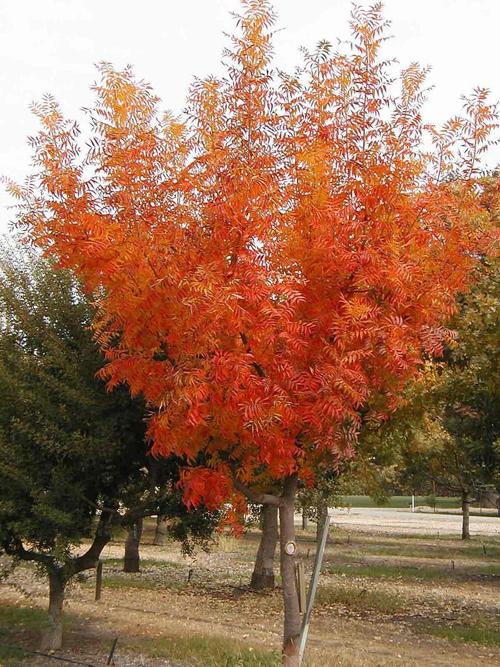
Q: I’m looking for a good tree that gives fall color. I’m trying to decide between a Texas red oak and a red push pistache. Is one a better tree for our desert climate? Which grows quicker and has better form? It would be planted about 20 feet from our home in Marana. Could you give me info about each tree so I could make a good choice?
A: The Texas red oak (Quercus buckleyi), aka the Texas hill country red oak, is a deciduous shade tree that may reach 30 feet in height and 60 feet in width under ideal circumstances. It has excellent fall color and makes a good specimen for our area. The downside might be the leaf litter and the acorns, depending on how you feel about either cleaning up after them or not. The red push pistache (Pistacia chinensis) is a hybrid deciduous tree that also has excellent fall color, maybe even better than the oak. Its growth is moderate and at maturity it typically reaches 40 feet tall by 35 feet wide. The leaflets are smaller and should be less troublesome than the oak leaves. The pistache should just fit your space if you plant it 20 feet away. The Texas red oak is typically a larger tree and would not fit your space as well.
Q: I have been buying firewood (mesquite and eucalyptus) to burn some and use some for woodcrafts like lathe-turned vases. It is common for the wood to be full of large round and oblong holes that are caused by some type of insect. Recently I was able to extract two almost whole grubs of some sort from a piece of mesquite. One “grub” is essentially round, and the other has a large head, sort of triangular, and a smaller round body. Can you tell me what these are and if they pose any danger to my house? Is there anything I can do to get rid of them?
Also, I cut some fresh mesquite last spring and left it in my garage to dry over the summer. It became riddled with small circular holes, apparently caused by some different insect. In this case the damage is pretty much limited to the early, or sap wood. Can you also give me some information about the insect that causes this other type of damage?
A: The two grubs are representatives of common wood-boring beetles from the Buprestidae and Cerambycidae families of insects. The round one is a larva of a long-horned beetle and the one with the large head is a larva of a metallic wood-boring beetle. Both of these insects are associated with dying or dead trees. Their galleries can be seen on sapwood, as you described, and the adult beetles are commonly seen emerging from firewood. They are not known to infest or reinfest dry wood so your home is safe. The small circular holes are from bark beetles, another species commonly associated with dying and dead trees in our area. In the forest, these three are examples of insects helping decompose trees into soil. Without them and the associated fungi and bacteria, we would be up to our eyeballs in timber and our soils would have even less organic matter than usual.
Q: Every year all of the lovely green leaves on my crabapple tree are cut into a half moon shape by leaf cutter bees. Is there any humane way to discourage this from happening? I know it does not kill the tree but it seems to severely affect its growth.
A: The short answer is no. Leaf cutter bees (Megachile species) are famous for making nice circles in our foliage. They may be found on a variety of trees and shrubs and their work can be seen across the U.S. The circular leaf pieces they remove are used to make a nest for their young. Usually, the damage they cause does not affect the growth of plants since most plants can tolerate some defoliation with any loss of vigor. It’s possible your tree could be suffering from another problem that is more trouble than the leaf cutter bees. Please let me know if you want to investigate that further. The other important thing leaf cutter bees do is pollinate our plants. As one of our native pollinators, it is important that we protect them from pesticides and habitat destruction. Being careful to not spray plants in bloom with insecticides is the first step. If you want to help provide habitat, there are opportunities to buy or make bee houses for them to use for their nest building.

