

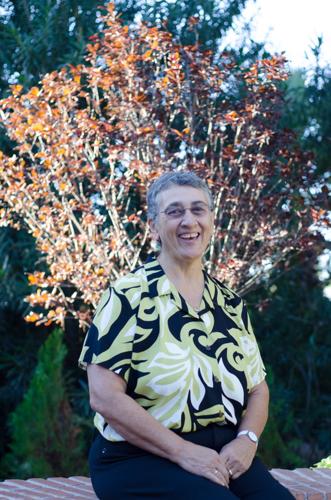
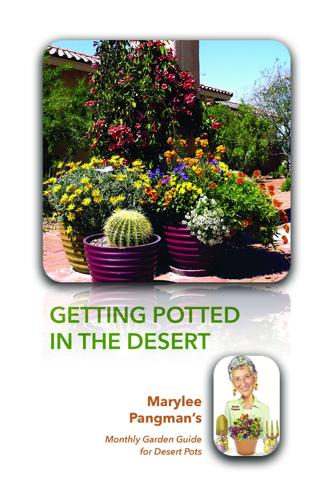
It was instant gratification that got Marylee Pangman hooked on container gardening.
Pangman loved it so much that she started a business, The Contained Gardener, that she ran for 14 years.
After she sold the business in 2012, she finally found time to fulfill requests for more information from dozens of students in her container gardening classes.
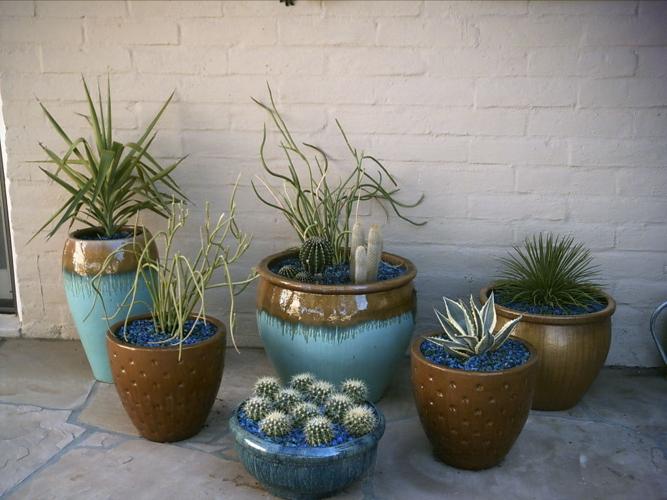
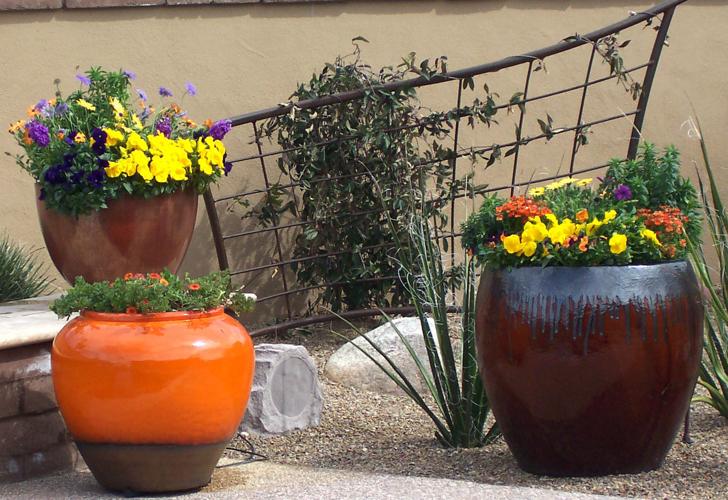
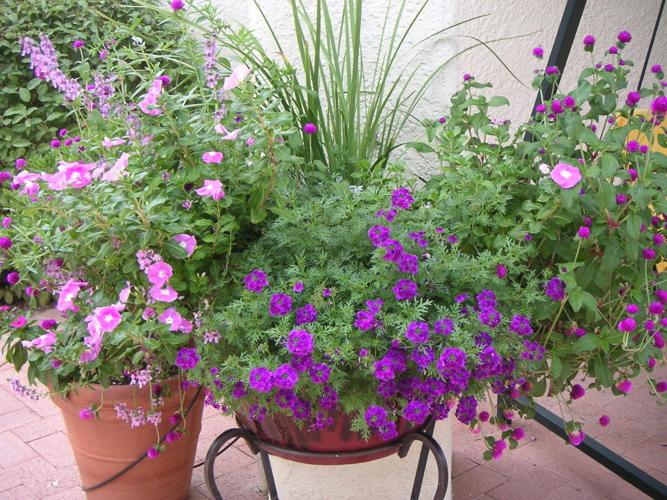
“Getting Potted in the Desert” is a month-by-month guide on how to plant and care for container gardens, including annuals, succulents, edibles and roses.
The spiral-bound paperback also includes basics on pot and plant selection, as well as irrigation and care.
“People have been waiting too long for (the book),” Pangman says. “I was teaching all these classes and people constantly would ask me, ‘Where could we find this information?’ What I teach is different than what is out there.”
What was different was that she taught people how to grow plants that aren’t native to the Sonoran Desert. Her classes often included people from other parts of the country used to non-native colorful flowers.
“How you can re-create something like that in the desert,” Pangman says of her old business and new book. “It’s a different kind of care.”
BECOMING A GARDENER
Pangman learned about gardening when she came to Tucson with her partner, Laura Schoenfeld, in 1996. They rented a house that had a backyard desert garden, which included lantana, Mexican primrose and bird of paradise. All those plants stop blooming in the winter.
“I thought, ‘We didn’t move to the desert to have nothing happening in our backyard in the winter,’” she recalls.
Pangman wasn’t a gardener in her youth in upstate New York—“I was more into mowing the lawn”—and the thought of tackling an in-ground garden, especially with soil full of concrete-like caliche, was unappealing.
“Instead, I got a couple of pots and because it was so easy and I got that immediate gratification, I was hooked,” she says. “If I can make pretty things in my backyard this way, let’s just do it.”
A short time later, the restless Pangman was trying to figure out a type of business she could start. One day, she and Schoenfeld were hanging around the pool at their home when Schoenfeld pointed to the landscape of potted plants and asked, “Do you think people would want you to do this for them?” Pangman says.
From the official opening in 1998, The Contained Garden grew with both residential and commercial clients looking for someone to design and maintain outdoor container gardens.
Pangman, who trained as a master gardener, had a steady list of clients, provided some consultation and taught classes.
With such a busy schedule of running the successful business, she simply couldn’t find the time to gather her knowledge in one place, although she made attempts through the years.
Once she sold the business to become a business coach, she found she also had a good chunk of time. “I decided enough is enough,” she says. “Let’s get this book done.”
Top 3 qUESTIONS
Pangman’s book was guided by the questions that popped up in her classes. The top three that she addresses:
1 What kind of pot should I use? While Pangman covers all types of pots in the book, she admits she’s partial to ceramic because the heavy, thick walls “help with insulation,” she says. She does not recommend plastic.
2 How much should I water? Pangman says, “95 percent of plant failure in Tucson is due to inappropriate watering,” and that includes too much as well as too little. The book has a watering guide section.
3 How do I keep critters out of my pots? The book lists plants that might deter rabbits, javelina and other animals from eating plants. One tip from the book: Try planting smelly specimens such as sage, artemesia and Dahlberg daisies.
The book details tasks for each month, including a roster of what to plant, a favorite seasonal plant and special issues.
There also is some advice on container garden design, fertilizing and pruning.
Above all, Pangman says she wants gardeners to understand the depth of gardening possibilities. “You can have beautiful gardens all year round,” she says. “It’s just a matter of what to plant, where to plant it and make sure it gets water and food.”

