

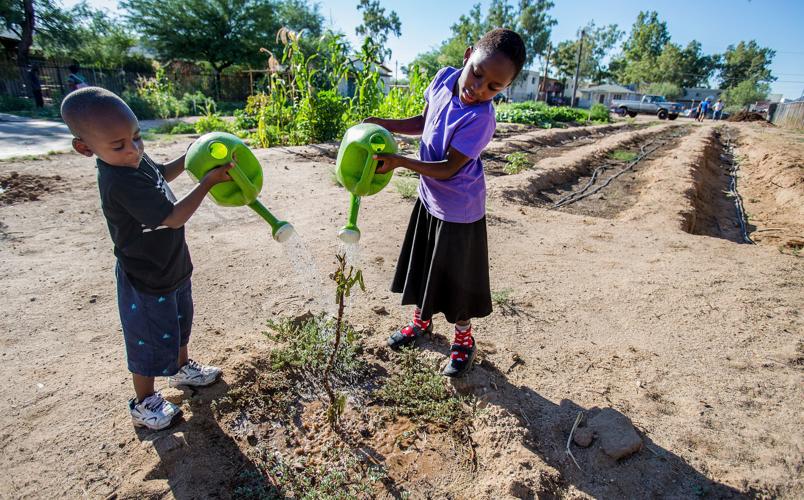
On a recent hot, dry day, garden plots next to the midtown Literacy Connects building were full of tomatoes, amaranth, corn, peppers, onions, squash, beans and sunflowers.
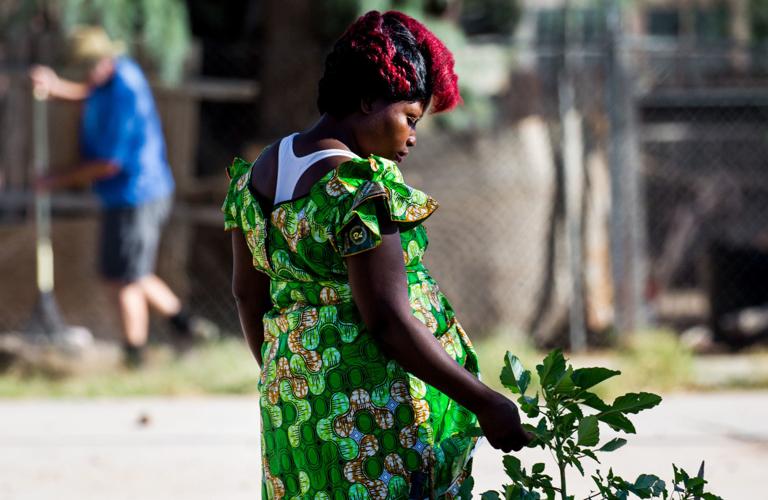
Louise Tatu and Liliane Ingabire were there to check on the progress of their assigned sections.
Tatu is cultivating peanuts and eggplant along with other summer plants, and Ingabire is nursing greens, cabbage and celery, all winter-season crops, and her summer plants.
They are among 25 refugee families who are working the new Literacy Garden, a joint project of Literacy Connects, the International Rescue Committee (IRC) and Habitat for Humanity.
Both women, who came to the United States from refugee camps in Tanzania, count on their plots to feed their families.
“I’m working in the garden to have organic, healthy food,” Ingabire, a native of Congo, says through an interpreter.
Josepha Ntakirutimana, an IRC assistant case worker and community health promoter, translated English and Swahili.
Tatu is taking an IRC-sponsored workshop that teaches refugees how to farm and sell produce at farmers markets.
“Then I will have income,” she says, that will help provide for herself, her husband and their nine children.
Ingabire, who was born in Rwanda but grew up in a Tanzanian refugee camp, is a single mother of three. She juggles gardening with working as a caregiver and taking classes. Having the food “is reducing our expenses,” she says.
The Literacy Garden helps fulfill one of the IRC’s aim to make its clients self-reliant. When it comes to gardening, many of the refugees are ahead of the game.
Tatu, for instance, worked on a family farm that sold produce to markets. Ingabire says many people at the refugee camp grow crops to supplement the flour they received in aid. “To survive, we were farming,” she says.
“They have the skills,” Katrina Martinez, IRC nutrition and food security program supervisor, says of refugee clients. “They’re tailoring it to the desert.”
And desert gardening, the refugees find out, is quite different from growing in the equatorial African countries they came from.
“Tucson is drier from the Serengeti,” Martinez explains. “Our clients come from rainy, moist areas. They’ve never seen such a hot, dry summer.”
Tatu and Ingabire confirm there are big differences in gardening in the two areas.
“We didn’t use irrigation as here,” says Ingabire. “Even the material we are using to cultivate here is very different. We have to use a hose.”
“In my country, we have much rain, and we are planting (all the) time,” adds Tatu.
Having the Literacy Garden offers possibilities to expand the self-sufficiency of IRC clients. In the future, IRC hopes to have a small farm, a greenhouse, a wash station and garden plots to support a total of 35 families.
“We’ve had years of need” for such an operation, says Martinez. “There are so few resources for beginning farmer training and (U.S. Department of Agriculture) certification.”
“What a special partnership this has been,” she says of the Literacy Garden project.
Literacy Connects invited IRC to create the community garden and pays for the water that’s used there.
“When we bought this land, there were four acres that go with the property,” says Betty Stauffer, Literacy Connects executive director. “We knew we weren’t going to use all of it.”
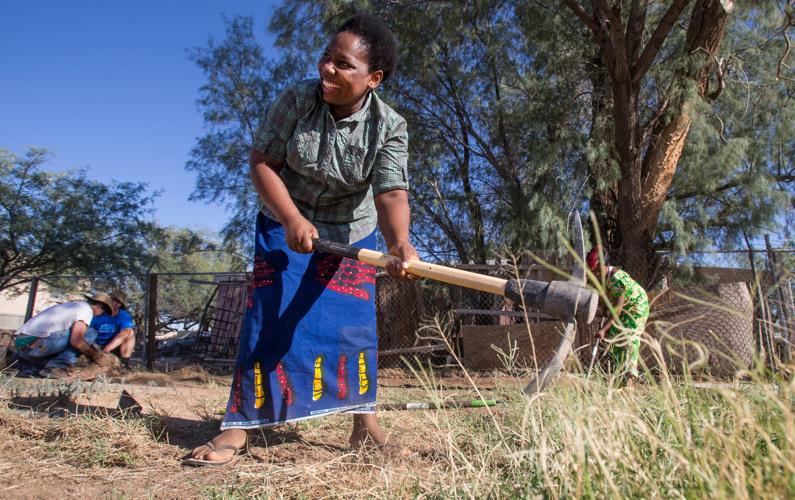
Volunteers from Habitat for Humanity dug the garden plots, installed irrigation and built a shed.
The IRC, which pays for seed, materials and equipment, involved clients right at the beginning.
“It was designed by the clients before we broke ground,” Martinez says. “They drew up the design. They were out there digging, pulling weeds, planting trees. It’s more of their garden.”
Organizations want to make it more of a community, too, with a focus on teaching English using gardening as a theme. Ingabire already demonstrates how that could work.
When she recently showed visitors what she’s growing in the garden, she spoke English.
“Sunflower. Cabbage. Beans, yellow. Tomato. Onion.”
When told that she speaks English well, she replies, “I try.”
Through the interpreter, she explains: “I know a little English. I used to help people with the little English I know.”
Martinez would love to have programs that teach English in and about the garden. For example, a tutor and the student would walk around the garden practicing English to identify things like “tomato” and “shovel.”
She’d also like to create backpacks with garden-themed books that refugee kids could bring home to read with their parents.
Because Literacy Connects also works to help adults learn English, it sees the garden as a perfect place to make that happen. It’s in a neighborhood where many refugees live, as well as residents whose native language isn’t English.
For instance, the garden could be used as a gathering spot for English-teaching projects like building bird feeders.
“The garden is just a wonderful way, an organic way to start connecting with the community and find out what their needs are with language development,” says Jennifer Stanowski, director for Literacy Connects’ English Language Acquisition for Adults Program. “I see millions of possibilities.”
“Even the material we are using to cultivate here is very different.
We have to use a hose. In my country, we have much rain,
and we are planting (all the) time.” Liliane Ingabire, Congo native who came to Tucson from a refugee camp in Tanzania

