


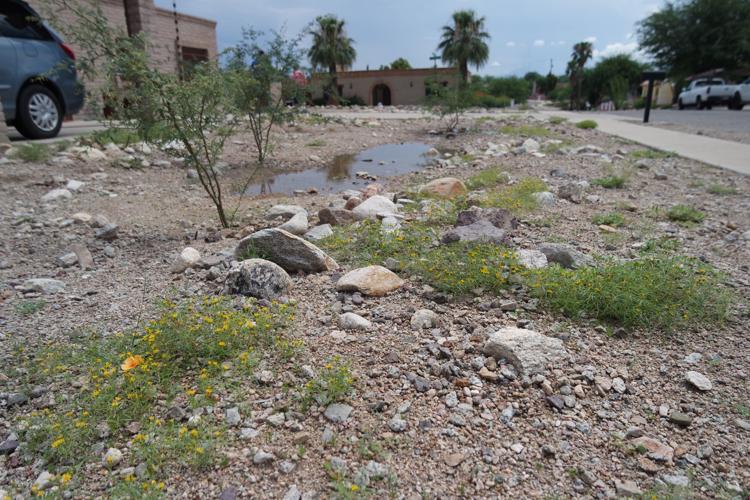
Two professional landscape designers want to test your patience. If you pass, you end up with a yard full of happy desert plants.
The challenge: You have to wait for at least a year to get something that looks like a landscape. That’s because the plants spring from seed.
Many folks want a ready-made landscape with mature plants, says Eli Nielsen, owner of Econsense Sustainable Landscape.
Sowing seeds instead can create a natural desert scene with plants that are growing in conditions they like.
“Direct seeding is a low-water and essentially a low-maintenance way of planting,” says Greg Corman, owner of Garden Insights Inc. “You let things come up where they will.”
You save money by buying seeds instead of mature or even young plants. You also save on water because you’re not irrigating to try to get a grown plant established in a new home. Instead, you’re watering sprouts growing in their ideal conditions.
As the landscape fills out with seed-sprouted specimens, you can easily adjust what plants will remain and what needs to be taken out or relocated.
It’s a lot easier — both physically and financially — to pull up a seedling that just isn’t in the right place, say, because there isn’t enough space for it to grow.
REGROWING A LANDSCAPE
Ann and Jim Goff are into their third spring since they decided to try Corman’s and Nielsen’s landscaping technique.
The retired couple lived in their west-side home from 1983 to 1996, when they temporarily moved out and rented the place. Four years later they moved back in with a big project ahead of them.
Their apricot and peach tree, the roses and Italian cypress and a lot of other plants had died while they were away.
But instead of replacing them, they decided to take a different path.
“We wanted to be really conscientious about the water,” says Ann Goff. “We didn’t want to be a water burden.”
Her research into rainwater harvesting led her to Corman and Nielsen and their ideas of seeding landscapes instead of planting them. She was intrigued. “They were promoting it as a low-maintenance approach,” she recalls.
It was easy for Ann to sell the idea to Jim. “I’m married to my best friend, and she’s very wise, and she’s rarely steered me wrong,” he says.
The process at the Goffs’ house went like this:
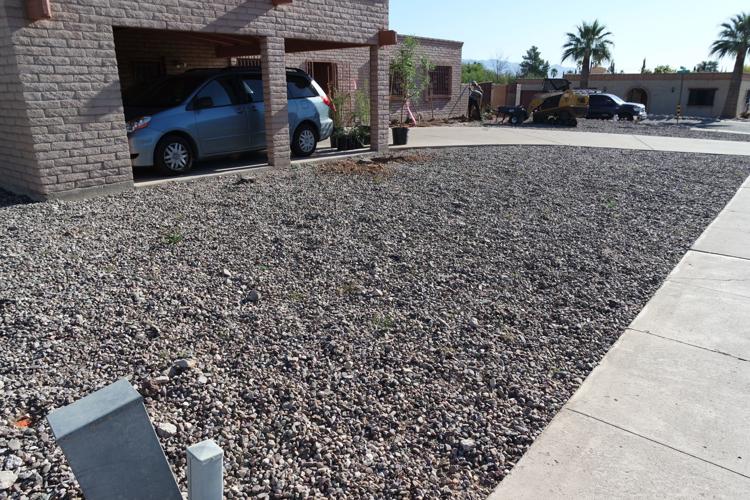
1. After the gravel groundcover was removed from the flat front yard, Nielsen’s company created earthworks meant to guide rainwater into, not away from, the property.
The idea is to slow water, move it to where plants will grow and allow it to soak into the ground.
2. A thin layer of amended soil was spread on places where seeds would likely grow.
3. Rock was placed on top of that thin layer, as well as along portions of the yard along the sidewalk. Seeds tend to take hold under rocks, which provide protection from animals and severe temperatures. The rocks also collect water that irrigate the seeds.
4. Three mesquite and one desert willow seedlings were planted to immediately anchor the landscape, Nielsen says. The rest of the landscape would be filled in over time.
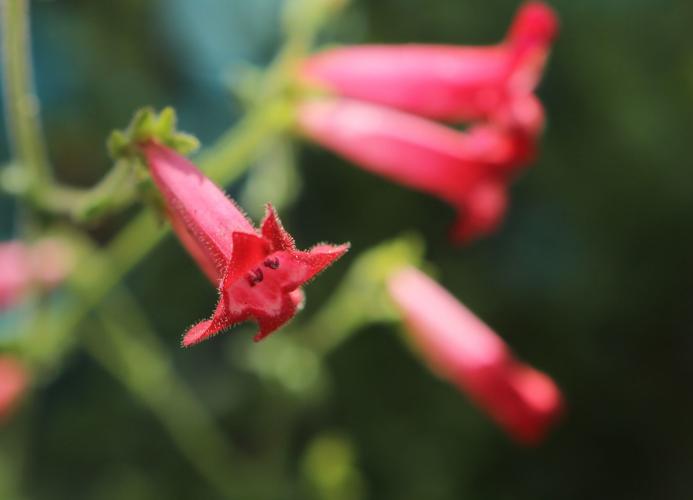
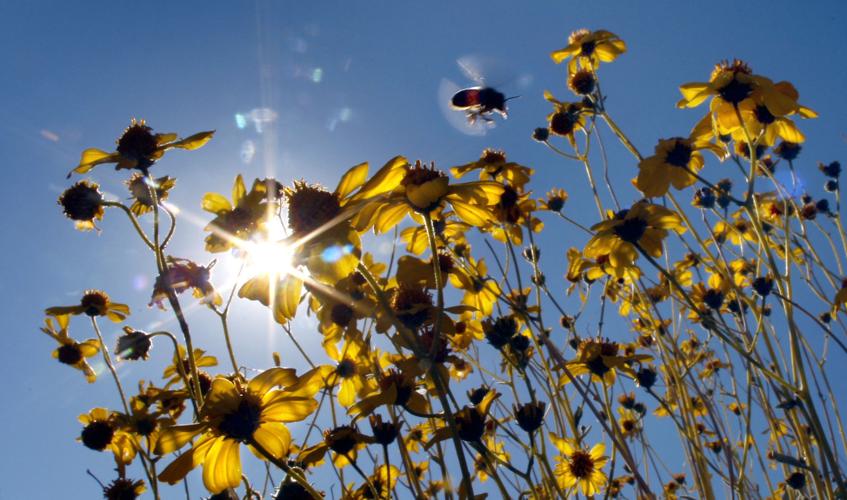
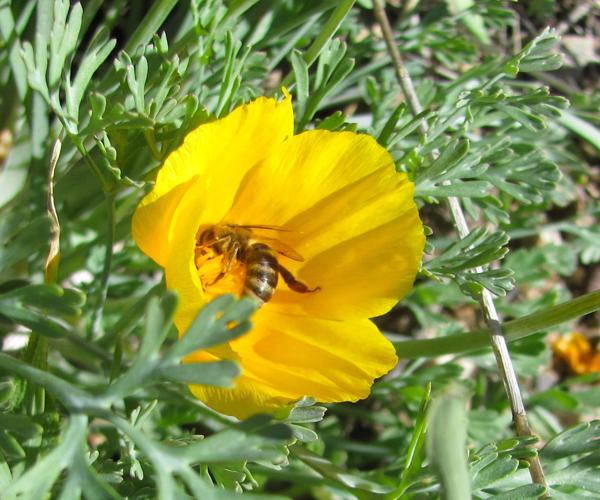
5. The Goffs, with Corman’s advice, spread a mix of seeds from Wildlands Restoration. It included several clumping grass species, penstemon, Mexican gold and Arizona summer poppies, globe mallow and several types of yellow-petal flowers such as Dyssodia pentachaeta, brittlebush and desert zinnia.
6. The couple checked out the growing progress.
“That’s been the most fun of this whole project,” says Ann, whose constant observations taught her how to identify plants and recognize their growth cycles.
As the Goffs waited for a landscape to spring up, neighbors felt sorry for them for having such a bare yard, Jim says. They wanted to help cover the yard with gravel, which the couple declined. Some gave them barrel cactus and prickly pear cuttings to grow.
Two years later the Goffs have many basketball-sized and 3-foot-high brittlebush plants full of yellow flowers. The dyssodia and dog weed also are coming up. As the season progresses, the couple expects a lush yard of wildflowers that attract birds, bees and butterflies.
And the same thing happens through every season. “We’ve never lacked for color year-round,” says Ann.
She loves to take stock of the yard, seeing what has popped up and what needs to be pulled out. It’s a practice she had to get used to.
“I watched it come up as a seedling,” she says of the plants. “They’re my babies. But I’ve hardened.”
She is constantly collecting seeds from her plants and deliberately sowing them in spots that she wants to fill in.
Jim says he likes the wildness of the yard. “We’re turning it back into the desert,” he says.
DIFFERENT MIXES
While the Goffs decided to focus on grasses, annuals and flowering bushes, Nielsen says any kind of seed mix can grow a landscape.
One homeowner he worked with used a seed mix that included ironwood, mesquite, yucca, prickly pear and agave, among other plants.
Nielsen admits he got pretty excited when a few months later he discovered that the mesquites were growing in a group sort of like a bosque, or woodland.
The homeowner wasn’t so keen on the idea of having so many mesquites, so she pulled out most of the seedlings. “That’s part of the editing process,” Nielsen says.
“When you just invested $50 in seed, it’s easy to pull things out,” he adds.
Ann finds many perks to this slow process of getting a landscape.
“I am learning so much about plants that it has become an adventure for me,” she says.
“My yard has gone from a stark, sterile plot of land to a garden that literally hums with life. This experiment is enriching my spirit as well as my mind. And it is teaching me patience.”

