

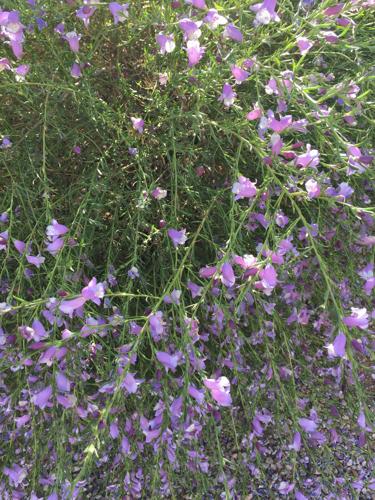
Q: I saw this plant while walking to work on campus. Can you tell me what it is?
A: The plant is called spotted emu bush (Eremophila divaricata). It’s an Australian native in the figwort or Scrophulariaceae family, which also includes the Texas rangers we see around these parts.
These shrubs do well in arid environments and seem to fair better with afternoon shade in our climate. Although they are desert-adapted plants, they do require some water.
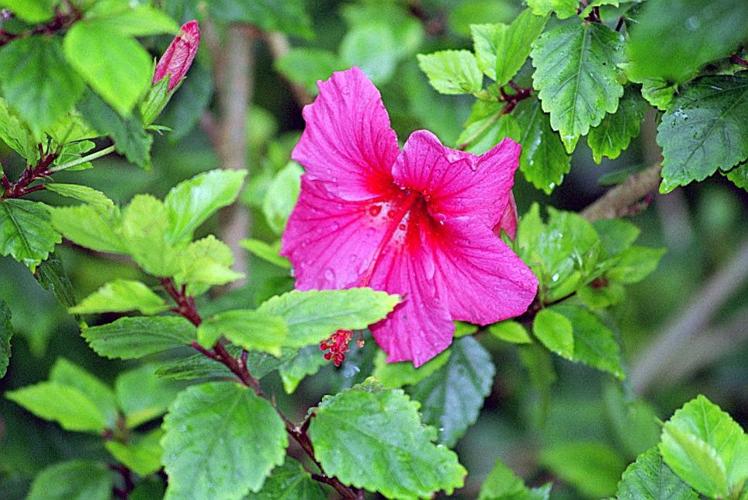
Q: I purchased a Hibiscus rosa-sinensis plant and I wonder if it can go in my front (open) patio. I don’t see many others around here in Green Valley, so I guess the javelina like them.
A: The hibiscus you purchased, sometimes called Chinese or Hawaiian hibiscus, is a tropical variety and would probably be best grown in a container in your neighborhood so that you can bring it indoors during the winter.
They don’t tolerate the temperatures we experience in the cool part of the year. The javelina would probably enjoy it as well, so maybe you maybe you can find an elevated place to put it out of reach or grow it indoors.
Q: How can I stop the infestation of Mexican primrose into my Bermuda lawn? Not knowing how invasive this plant can be, I placed several on a slope next to a grass area. Plants have now started growing in the grass.
A: Since Mexican primrose is a broadleaf plant, you can either pull it up as you see it or you can use a broadleaf herbicide to keep it out of your lawn area by spot treating where you see it coming up.
There are many broadleaf herbicides available and some are packaged with nonselective chemicals that also kill grass, like glyphosate.
It is important to read the label to make sure you are not also getting something that will kill your lawn and to make sure you understand the safety precautions for applying it.
Q: I feel like my ocotillos are blooming earlier this year and I wonder if I am imagining it. Is there a trend for this in the Tucson area?
A: There are some groups such as the National Phenology Network (usanpn.org) keeping track of such things as blooming times and other phenological events for a wide variety of plants and animals. The data they collect via the citizen- and professional-science program Nature’s Notebook (naturesnotebook.org) is an important research tool for those studying climate changes on a regional and national level.
That said, you are really the best judge for your particular plants. The reason for this is that we have microclimates, and there can even be slight differences in temperatures that affect plant growth within neighborhoods.
For example, people who live near a wash tend to experience colder temperatures because cold air runs downhill. If you’d like to get involved in a science experiment, you can keep track of the blooming of your plants and other changes such as leafing out, producing fruit, and dropping seeds.
Data like this is valuable for showing changes in seasonal temperatures locally and globally. Once you get in the habit of keeping data on specific plants year round, you will have valuable information that can help you decide what’s changing and what’s just a feeling that may be incorrect.

