

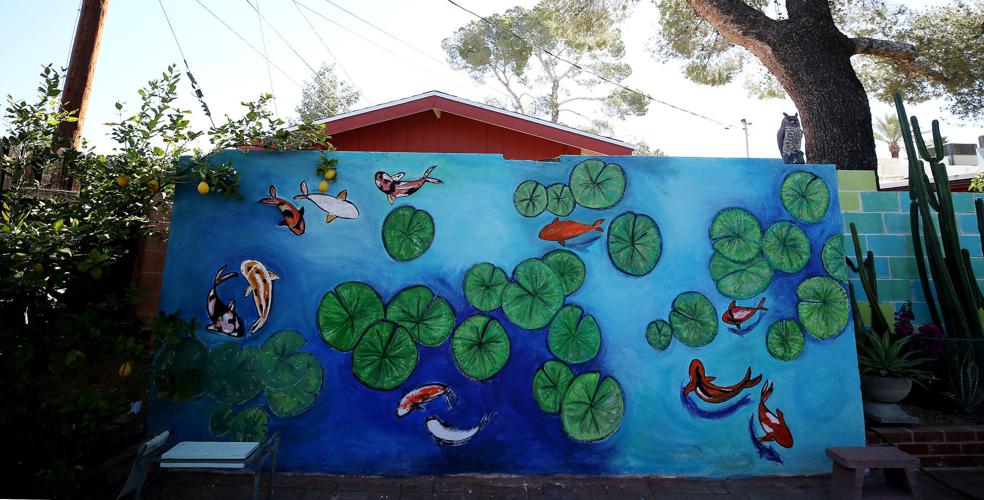
On a midtown Tucson street of mid-20th-century brick homes, Gael Cassidy’s house stands out.
Maybe because it’s painted cobalt and aqua blue. Or that there’s a big round peace sign hanging on the wall of the house and illuminated by solar power. Or it could be the bright yellow Adirondack chairs that draw the eye.
Cassidy wears her quirky sense of decor like a badge. “I’m the old lady hippie, that’s for sure,” she says with a smile.
Her pop-art color palette, the bird feeders from recycled dishware, imported garden statuary, artful mosiacs — oh, and plants — will be in full view during the annual tour of master gardener landscapes on Saturday, April 14.
When the retired airline employee moved into the 1954 home in 1986, she had a mid-century landscape to deal with. That included then-popular privet hedges, Japanese boxwood and juniper shrubs.
She launched her landscape redo after pulling the privet out with a chain tied to a Chevy Suburban.
In their place she’s put in barrel cactus, plumbago, small succulents, red Mexican bird of paradise, hollyhocks, queen’s wreath and columnar cactus such as silver torch.
The backyard continues the use of appropriate desert-adapted plants, including Indian fig prickly pear, octopus and desmettiana agave, and bottlebrush.
Cassidy, a master gardener for over two years, grows three citrus trees, onions, lemongrass and a variety of herbs. They do fine even though she says she’s not a very successful gardener of edible plants.
She also insists she’s not an artist, at least not a formally trained one. Yet her landscape is filled with mosaics she created from found objects, broken pottery and store-bought tile.
“Well, I went to Barcelona,” she says as she explains what got her started, “and I saw (Antoni) Gaudi’s work and said, ‘I could do that.’”
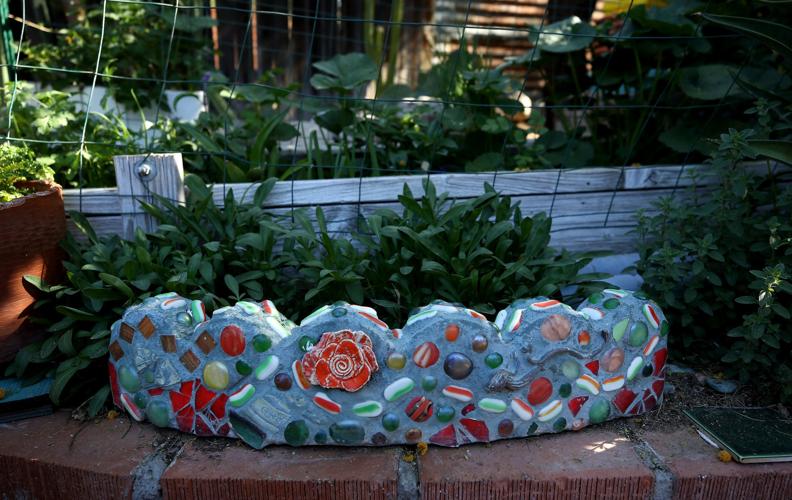
Self-taught, she started small with concrete steppingstones. Some mosaics depict hearts, plants, mermaids and fish, while others have geometric shapes or interesting color combinations.
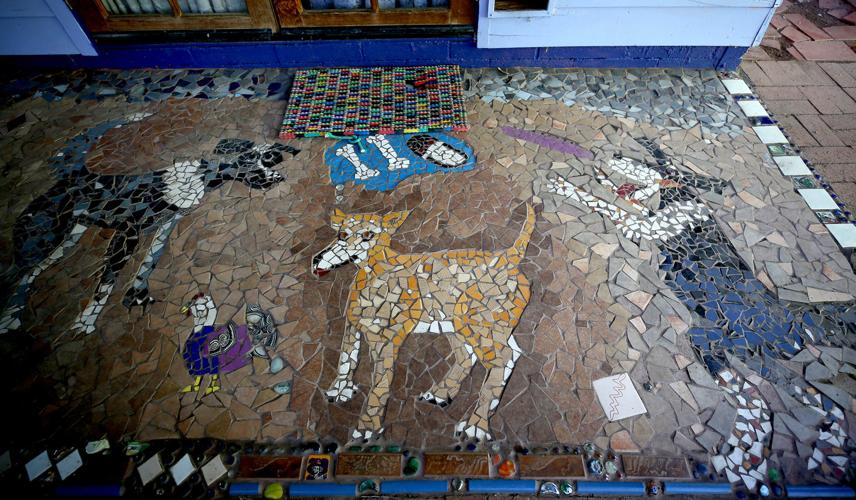
She’s covered scallop concrete edging and retaining wall blocks. The large mosaic underfoot in the patio depicts every pet that the family has had and the things those animals loved.
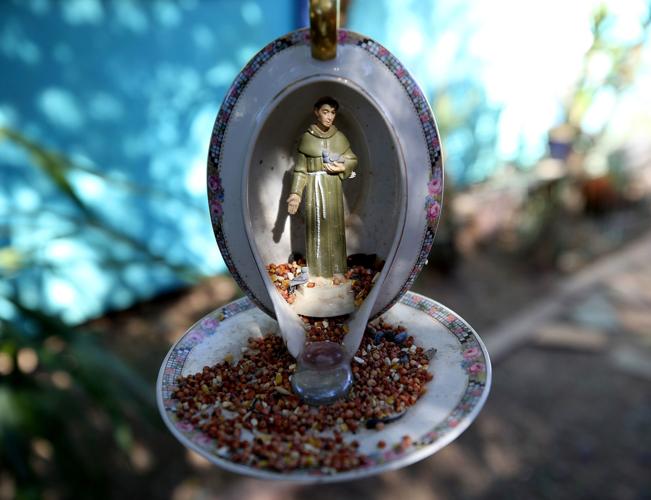
Cassidy’s artfulness extends to other garden features. She fashioned plates, a gravy boat, a sugar bowl, a juicer and other dishware — broken or no longer used — into seed-filled bird feeders that hang from an olive tree.
Paint also plays a big part in the backyard. She painted the backyard wall a combination of primary blue and lime green. They lighten and darken with the changing light.
A mural of koi in a pond, which she painted with the help of a friend, adds more of the vibrant color that Cassidy finds soothing. “You won’t see white and beige in my palette,” she says.
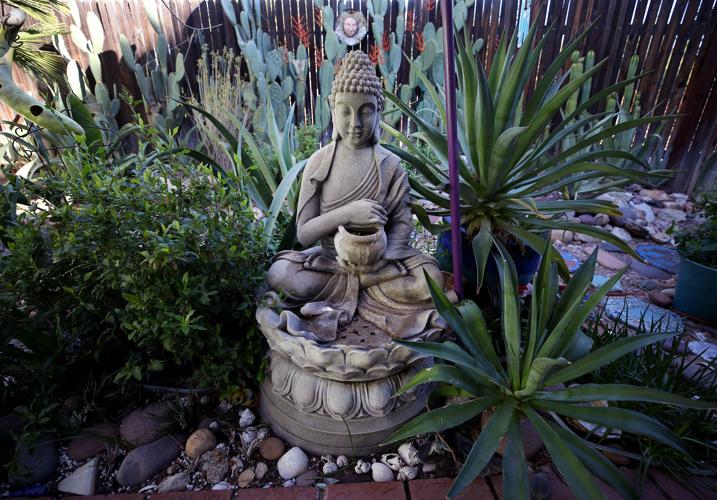
Statues of Buddha, St. Francis and Ganesha add focal points throughout the garden, and a fountain adds a calming water element.
Cassidy admits she was surprised when tour organizers asked to use her house a stop. “I always thought it would be weird to people,” she says. “It’s funky. I’m really surprised people like it.”
As part of the tour, fellow master gardeners will hold talks at her home on art in the garden and creating a lush garden in a small space.
Each home stop similarly will have talks. Here’s a rundown of the other places.
- An overgrown 4-acre property was transformed into a cactus garden shaded by native tree species. Most of the plants were selected to attract bees, hummingbirds and butterflies. Talks will cover garden design basics and revegetating with rescued plants.
- Chickens are the stars of a stop that combines native and desert-adapted trees with citrus trees and edible gardens. Captured rainwater and recycled gray water help irrigate thirsty trees. Master gardeners will discuss rainwater and gray-water harvesting and raising chickens in an urban garden.
- A 1926 home that was purchased by the current owners 20 years ago has an eclectic garden that shows decades of their landscape memories. They’ve also provided the food, shelter, nesting areas and water that attract animals and which earned them a wildlife habitat certification from the National Wildlife Federation. Visitors attending the talks can learn about creating a certified habitat and gardening in the shade.

