

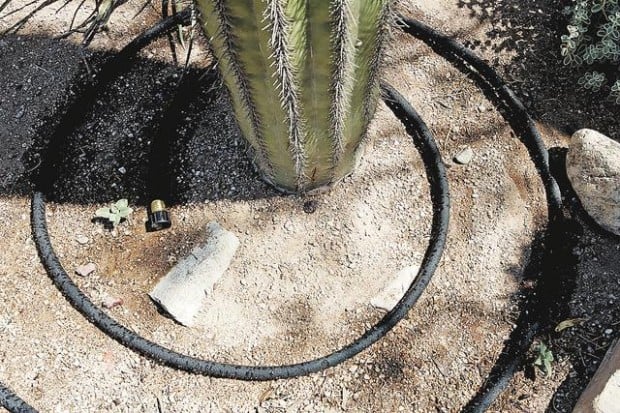
Few pieces of gardening equipment are as simple and as useful as the soaker hose.
It's amazing that recycled rubber tires can be worked into a hose that has become the ideal portable irrigation system for desert landscapes.
A soaker hose's rough black tubing weeps water out its entire length at a slow enough rate to allow the water to be absorbed by our desert soils. Available in 20-, 50- and 100-foot lengths, it can be snaked through planting beds or spiraled around trees to provide temporary watering for plants not on irrigation systems or to supply supplemental irrigation for plants with too few drip emitters.
The manufacturer recommends spacing between soaker hoses based on soil type. On sandy soils the hose should be 1 to 1.5 feet apart. On loam soils, hose spacing should be 1.5 to 2 feet apart. And on clay soils spacing should be 2 to 3 feet apart. If you have a heavy soil, which is hard to dig, then use the 2 to 3 feet spacing as you wind or spiral the hosing in and around the plants to be watered.
The manufacturer also indicates that the hose should be operated at low pressure and flow — 10 to 30 pounds per square inch (PSI). However, this requires the addition of a pressure regulator at the supply end of the hose. Rather than attaching a pressure regulator, I suggest just barely opening the hose bib to obtain the smallest amount of water flow through the hose. Although not scientific, my tests have indicated that by just opening the hose bib slightly, the flow rate of water out the hose is about .6 gallons per foot-of-hose per hour. So, a 50 foot soaker hose would apply about 30 gallons of water per hour. Comparing this to the output of one gallon drip emitters on standard 3-foot spacings, the soaker hose applies double the amount of water over the same given time.
The time needed to water with a soaker hose will depend in great part on the type of plants being watered. Trees require the longest soaking since their roots can extend down 3 feet. Small garden plants and ground covers need the shortest soaking since their roots extend down only 12 to 18 inches. The object is to allow the water to penetrate down to the rooting depth.
When laying out the hose over the area to be watered, remember to watch spacing. When watering trees, start the soaker hose a few feet from the trunk. Spiral the hose out several feet beyond the edge of the branches. This will allow watering of a substantial portion of the roots. When watering shrub or ground cover beds, snake the hose through the area, extending the hose just a foot or so beyond the outermost branches.
Turn the hose on and allow the water to run 30 to 60 minutes, then check the depth of wetting. You can do this by using a metal soil probe. A 3-foot piece of metal re-bar or a thick wooden dowel will work. The rod can be pushed through moist soil, but stops when dry soil is encountered. Measure the depth of wetting and adjust the watering time of the soaker hose accordingly. It may take several hours to properly water a tree.
A final suggestion. Rather than run your soaker hose for a continuous time period, try running it in cycles — one hour on and one hour off until the desired depth of wetting is reached. This will further slow the rate of application and increase absorption.
● John P. Begeman is the urban horticulture agent for the University of Arizona-Pima County Cooperative Extension. If you have questions, call 626-5161 to reach a master gardener.

