

Save your poinsettia; revive frost-damaged plants; control insects
- Updated
Answers to your gardening questions from an expert.

- By Peter L. Warren Special to the Arizona Daily Star
- Updated
Question: I am trying to find out what kind of plants I can plant in my garden that will help ward off insects.
Answer: Despite a large amount of misinformation published on this topic, there are no plants that can be used to repel insects effectively. There are, however, plants that can be planted together to reap other benefits. Flowering plants can be used to attract beneficial insects that help manage pests. Mostly these helpful plants are flowering plants that supply nectar and pollen to the predators and parasites that prey on pest insects. The nice thing is most any flowering plants can be effective in this way so you can choose ones that you like and that do well in your area. One plant feature that works well is flowers that face up and form a cup or sorts that can hold rainwater since water can be scarce. Another idea is planting varieties that are more attractive to pests and can be used as trap crops to lure the pests away from a desirable crop. The grower then has the option to spray the trap crop with the pests on it or simply let them eat it. Also, some plants act as nurse plants for more sensitive species by shading them. We often see saguaro cacti growing this way naturally in the desert.
Peter L. Warren is the urban horticulture agent for the Pima County Cooperative Extension and the University of Arizona. Questions may be emailed to tucsongardensage@gmail.com

- By Peter L. Warren Special to the Arizona Daily Star
- Updated
Poinsettias thrive on bright natural daylight: at least six hours daily is recommended. Placement near a sunny window is ideal, but avoid locations where hot afternoon sun may shine directly on, and fade colorful bracts.
To prolong the bright red of the bracts, temperatures ideally should not exceed 70 degrees during the day, or fall below 65 degrees at night. Avoid placing poinsettias near drafts, fluctuating air currents, excess heat and dry air from appliances, fireplaces or ventilating ducts. Poinsettias are sensitive to cold temperatures and outside placement during the winter months is not recommended when temperatures are below 55 degrees Leaf drop will occur if poinsettias are exposed to temperatures below 50 degrees
Poinsettias do best with moist soil so water when the soil surface feels dry to the touch. Like other container plants, the best indication of a thorough watering is water begins to seep through the drain holes at the bottom of the pot. Don't leave them sitting in water or they may suffer from root rot. It is not necessary to fertilize your poinsettias during the holiday season, however, beyond the holidays you should apply a balanced, all-purpose household plant fertilizer to promote new growth.
Poinsettias can be grown year round for lush green foliage.
March or April: When the bracts age and turn to a muddy green, cut the stems back to about eight inches in height. After you cut the plant back, it will probably look rather stark, with bare branches and bluntly cut woody stems.
By the end of May, you should see new growth. Keep the plants near a sunny window.
Around July 4: Cut branches back again about half their length to encourage bushy plants. You may place your poinsettias outdoors in indirect sun when night temperatures are warmer. Continue to water the plants regularly during the growing period. Fertilize every two to three weeks throughout the spring, summer and fall months with a complete, indoor plant fertilizer.
The poinsettia is a plant that requires a long period of darkness and is termed a "short day" (long night) plant. Short-day plants form flowers only when day length is less than about 12 hours. Many spring and fall flowering plants are short day plants, including chrysanthemums, poinsettias and Christmas cactus. If these are exposed to more than 12 hours of light per day, bloom formation does not occur.
November or December: Poinsettias will naturally bloom depending upon the flowering response time of the particular cultivar. This can be tricky to do outside of a controlled greenhouse environment, because any stray artificial light could delay or halt the flowering of the plants.
To make this work, the plants must be kept in complete darkness for 14 continuous hours each night beginning Oct. 1. This can be done by moving the plants to a dark room, or placing a large box over them. During this period, the plants require six to eight hours of bright sunlight and night temperatures between 60 and 70 degrees. This regimen must continue for about eight to 10 weeks for the plants to develop colorful bracts for the holiday season.
If this seems like too much effort, you can always support the horticulture industry by purchasing another poinsettia.
Peter L. Warren is the urban horticulture agent for the Pima County Cooperative Extension and the University of Arizona. Questions may be emailed to tucsongardensage@gmail.com

- By Peter L. Warren Special to the Arizona Daily Star
- Updated
- By Peter L. Warren Special to the Arizona Daily Star
- Updated
Question: Is there a list of fruit trees that grow in Tucson? Specifically, I am interested in peaches, apricots, cherries (sweet and sour) and apples? If they need a pollinator, which varieties do best together?
Answer: The main limiting factor to successfully growing fruit trees in Tucson is the lack of cold weather. Fruit trees require a certain amount of chilling hours to produce fruit, and we do not consistently get enough cold weather to meet the requirements for many fruit trees you may have seen or heard about in other parts of the country. Fortunately, there is a good selection of fruit trees that do fine here, and as long as you stick with these, you can have many years of harvesting your homegrown fruit. From your list of interests, you can find varieties of peaches, apricots and apples that grow well here. We don’t have cherries, but you can substitute figs, pears, persimmons, plums, quince, grapes, kiwi, blackberries, strawberries and pomegranates. Here is a link to our publication on fruits and nuts that includes much of what you need to know about these varieties. You will notice that the ones that do well in the low desert of Tucson are marked. There is a link to the pdf version that has a nice chart showing when they are harvested and if they require cross-pollination. Go to ag.arizona.edu/pubs/garden/az1269
Peter L. Warren is the urban horticulture agent for the Pima County Cooperative Extension and the University of Arizona. Questions may be emailed to tucsongardensage@gmail.com

- By Peter L. Warren Special to the Arizona Daily Star
- Updated
Question: Thanks to our climate, I’m doing a postmortem for last season’s garden and planning seed starting for next season pretty much simultaneously. About tomatillos: I’ve had rotten luck. I’ve had single plants, mixed varieties, started seeds, bought plants from reputable local nurseries and have tried to appropriately manage watering and soil nitrogen. Tomatoes have done just fine. Tomatillos? I’ve had rotten luck.
Answer: Now is an excellent time to revisit and evaluate your gardening practices in 2015. In theory, growing tomatillos should be easy although they are as sensitive to the heat as tomatoes and there are a few insects to watch for so you don’t lose your crop. Shade cloth can help protect them once the spring heat kicks in and checking for insects once a week should be sufficient to manage pests before they get out of control. Here are some basic guidelines for growing tomatillos. Please let me know if you are already doing all these things.
Tomatillos should be planted in full sun with well-drained soil. Jan. 15 to Feb. 15 is the ideal planting time, although you can wait until March if you are using transplants. Drip irrigation is ideal and should provide an inch of water per week. Multiple plants are required for pollination.

- By Peter L. Warren Special to the Arizona Daily Star
- Updated
Question: Thanks to our climate, I’m doing a postmortem for last season’s garden and planning seed starting for next season pretty much simultaneously. About tomatillos: I’ve had rotten luck. I’ve had single plants, mixed varieties, started seeds, bought plants from reputable local nurseries and have tried to appropriately manage watering and soil nitrogen. Tomatoes have done just fine. Tomatillos? I’ve had rotten luck.
Answer: Now is an excellent time to revisit and evaluate your gardening practices in 2015. In theory, growing tomatillos should be easy although they are as sensitive to the heat as tomatoes and there are a few insects to watch for so you don’t lose your crop. Shade cloth can help protect them once the spring heat kicks in and checking for insects once a week should be sufficient to manage pests before they get out of control. Here are some basic guidelines for growing tomatillos. Please let me know if you are already doing all these things.
Tomatillos should be planted in full sun with well-drained soil. Jan. 15 to Feb. 15 is the ideal planting time, although you can wait until March if you are using transplants. Drip irrigation is ideal and should provide an inch of water per week. Multiple plants are required for pollination.
Question: Is it too late for my bougainvilleas? I was out of town during the recent night freezes in Tucson, and I now have two bougainvilleas that are half frozen (they look great where the branches were protected by my awning). What do I do with the dead half? Pinch off the flowers and leaves? Prune it back? Just leave it alone?
Answer: Since you still have live parts it’s not too late to cover them in case we get more frosts. They will likely come back from this damage. The dead parts will protect the living parts somewhat in case we have more frosty temperatures so leave the dead parts on the plant until the spring when the danger of frost has passed.
Peter L. Warren is the urban horticulture agent for the Pima County Cooperative Extension and the University of Arizona. Questions may be emailed to tucsongardensage@gmail.com

- By Peter L. Warren Special to the Arizona Daily Star
- Updated
Question: I live here in Tucson at Villa Catalina condos at Sixth Street and Country Club Road. We have a small rose garden with some beautiful flowers. My problem is some of our larger flowers don’t fully open. I get a very large ball, very tight, but will not open. Then there are flowers next to them, and they open nicely. Any ideas?
Answer: There are a couple possible answers to this problem. If the rose buds that don’t open appear unhealthy, possibly with a browning on the edges, there are known diseases and insects that can affect them. If the buds appear to be healthy, a more likely problem is environmental stress. According to local rose expert and master gardener volunteer, Lauren Kettenbach, this time of year that is a common problem. Before Thanksgiving there was some pretty cold weather, and then it got warm again. So it could be weather-related, and it’s also very late in the season to have any blooms at all. I would not worry unless there is a problem with the spring bloom.
Peter L. Warren is the urban horticulture agent for the Pima County Cooperative Extension and the University of Arizona. Questions may be emailed to tucsongardensage@gmail.com
- By Peter L. Warren Special to the Arizona Daily Star
- Updated
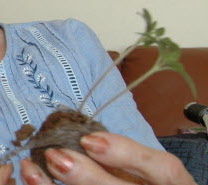
Question: We live in the Tanque Verde area. In the spring I planted a tomato seedling in very good soil in the planter next to the house on the patio. It grew quite tall and produced tomatoes. I missed the weather forecast for our first frost, and the leaves wilted. Since then I’ve hung frost cloth from the eaves every evening, which traps the heat from the house. Last week when it was 26 on the patio it was 40 inside the frost cloth. Since it was wilted I cut the plant down, intending to uproot it, but noticed new green shoots coming from the bottom. Any hope for the plant, or should I start over in the spring?
Answer: As you saw, even if the temperatures are below freezing for a short time, some plants will die back above the soil and still be alive below ground. It is best to cover frost-sensitive plants when possible. In many cases, protecting plants with frost cloth can make the difference between survival and starting over. Your tomato could be fine since you are seeing new growth now. Time will tell for your plant and for many others. Patience is a virtue when determining how much damage your plants suffered. Some plants will not show new life until mid-spring.
Peter L. Warren is the urban horticulture agent for the Pima County Cooperative Extension and the University of Arizona. Questions may be emailed to tucsongardensage@gmail.com
- Peter L. Warren Special to the Arizona Daily Star
- Updated
Q: Can you tell me if this tree is a cedar of Lebanon?
A: It looks like a deodar cedar (Cedrus deodara) from a distance. Cedar of Lebanon (Cedrus libani) branches usually form level layers in a mature tree. The deodar doesn’t usually look as layered and the branches and the leader tend to droop at the ends.
To be sure, you can count the needles in a cluster and you can measure them. The cedar of Lebanon has clusters of 15 to 45 whereas the deodar cedar has clusters of 20 to 30 so there is some overlap but if you can find some with greater than 30 needles that is a good clue.
Of the three true cedar trees in the genus Cedrus, the longest needles belong to the deodar cedar. If most needles exceed 2ƒ centimeters is likely a deodar cedar.
Peter L. Warren is the urban horticulture agent for Pima County Cooperative Extension and the University of Arizona. Questions may be emailed to tucsongardensage@gmail.com

- By Peter L. Warren Special to the Arizona Daily Star
- Updated
Q: Today I spoke with two lovely ladies at the Oro Valley Farmers market. I asked about this flower that grows wild in my yard. When I first saw it I thought it was a form of dandelion, but it has a gorgeous iridescent white bloom that opens at dusk. The hawk moths love it. The seedpods are plentiful right now, all dried up at the base of the plant. I’m including some pictures to help identify it. One woman showed me a photo of a birdcage primrose, however I’m thinking it is just an evening primrose.
A: There are a few species of primrose so it’s easy to get confused. I checked with our friends at the University of Arizona Herbarium and they think it is Oenothera caespitosa, commonly known as tufted evening primrose and fragrant evening primrose. This low-growing perennial is found throughout the West in sunny, dry, infertile, rocky, well-drained soils. It requires little water, which makes it a good choice for xeriscape gardens. Moderate watering will keep it blooming all summer.
Peter L. Warren is the urban horticulture agent for Pima County Cooperative Extension and the University of Arizona. Questions may be emailed to tucsongardensage@gmail.com

- By Peter L. Warren Special to the Arizona Daily Star
- Updated
Q: Do you have any info that would help our HOA organize its response to its fountain grass infestation? Also, are there any fountain grass variations that local nurseries sell that are sterile and won’t spread?
A: Fountaingrass (Pennisetum setaceum) is a fast growing, attractive, perennial, fire-adapted bunch grass and in our ideal environment can reach several feet tall and wide. It does just fine in dry environments although some rain helps. Unfortunately, it invades desert areas and readily outcompetes native species.
There are some varieties that are purported to be sterile but research shows they’re not 100 percent sterile and that’s a deal breaker considering it is invasive. Since it is a noxious weed in dry areas like ours I recommend removing it when possible, spraying with herbicides when necessary, and not planting it again. As is sometimes the case with invasive plants, humans are guilty of planting this species before we knew it was invasive. When it was first introduced, it was thought to be just another pretty grass for medians and landscapes.
Peter L. Warren is the urban horticulture agent for Pima County Cooperative Extension and the University of Arizona. Questions may be emailed to tucsongardensage@gmail.com

- By Peter L. Warren Special to the Arizona Daily Star
- Updated
Question: I found this insect on my gas grill today. Is this the kissing bug I have been reading about?
Answer: What you are seeing is the giant agave bug (Acanthocephala thomasi). Kissing bugs (Triatoma species) are smaller and don’t have the bright orange feet and orange tips on the antennae. Also, the kissing bugs feed primarily on mammals, such as pack rats and humans, whereas the bug you found feeds on plants. Recently, there was a flurry of news reports in other parts of the country on the kissing bugs and the associated Chagas disease they can transmit. These stories then spread through social media, gathering some misinformation as they went. So I understand why you are concerned. Despite the media hype, this was not actually new information.
Kissing bugs are more common in the Southwest. However, the risk of Chagas disease transmission in Arizona is very low, according to University of Arizona Cooperative Extension Specialist Dawn Gouge. UA researchers found a high rate of infection (about 40 percent) of kissing bugs in southern Arizona by the protozoan Trypanosoma cruzi that causes the Chagas disease infection. However, the kissing bugs in Arizona differ from those in areas where Chagas disease is a health problem and are not as effective in transmitting the disease to humans. The reason has to do with the timing of blood feeding and defecating. Our local species fly then poop as opposed to poop then fly. The protozoa are passed in feces, not during blood feeding, so by waiting to defecate until after they fly from where they eat, their behavior greatly reduces chances for transmission.
Peter L. Warren is the urban horticulture agent for Pima County Cooperative Extension and the University of Arizona. Questions may be emailed to tucsongardensage@gmail.com
- By Peter L. Warren Special to the Arizona Daily Star
- Updated
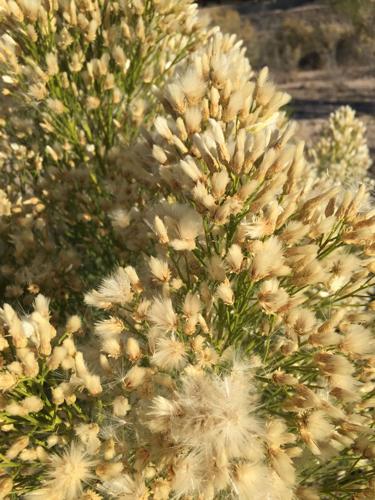
Question: I have a desert broom plant in my yard that has turned into a tree. I really like it but it is now blooming and is sending cottony stuff all over the yard. My neighbor said it is a weed and a nuisance and I should cut it down. Is there any way I can keep it from blooming?
Answer: Desert broom (Baccharis sarothroides) is a native plant and very common in the Southwest. It is often considered a weed because of its ability to colonize open spaces quickly. My predecessor at the University of Arizona Cooperative Extension, George Brookbank, was a proponent of this plant as a good native shrub for landscape use, so not everyone sees this plant as a weed. There is no way to prevent it from blooming, but you could prune off the flowers before they go to seed and start taking flight. That way you could still enjoy the plant to some extent and hopefully appease your neighbor.
Peter L. Warren is the urban horticulture agent for Pima County Cooperative Extension and the University of Arizona. Questions may be emailed to tucsongardensage@gmail.com

- By Peter L. Warren Special to the Arizona Daily Star
- Updated
Question: Our HOA has declared war on buffelgrass: a good thing. But rather than remove it, they are having intense commercial spraying of glyphosate using concentrations higher than the typical herbicide available to homeowners. I cannot find information (from scientific sources such as .edu) about the immediate or long-term toxicity of the spray on cactus or our desert trees. Do you know of any research showing what it may do?
Answer: According to our University of Arizona Cooperative Extension Weed Specialist, Bill McCloskey, direct spraying of cacti with glyphosate repeatedly will probably kill most cactus species but they can withstand incidental spray contact (i.e., the whole plant is not sprayed) intermittently and can survive a single direct spraying. Generally, we recommend spraying grass-specific herbicides for grass control (e.g., fluaziflop, sethoxydim or clethodim on bermuda grass) to avoid injuring the cacti. Unfortunately, this class of herbicides doesn’t work well on buffelgrass, but maybe repeated spraying would eventually do it. Manual removal of buffelgrass would be effective in this case but understandably hard around cacti.
Peter L. Warren is the urban horticulture agent for Pima County Cooperative Extension and the University of Arizona. Questions may be emailed to tucsongardensage@gmail.com

- By Peter L. Warren Special to the Arizona Daily Star
- Updated
Question: I occasionally run across a dead branch on some of my mesquite trees. The dead branch sticks out like a sore thumb, and on closer inspection, there is a ring around the branch etched into the bark. The foliage in front of the ring is dead, but behind everything appears fine. First, do you know what causes this? Second, should I be concerned. And third, should I be preventing this and how? Right now, all I do is prune the branch out.
Answer: The ring etched in the bark is the work of the mesquite twig girdler (Oncideres rhodosticta). This beetle is in the family Cerambycidae that are commonly referred to as long-horned beetles due to their long antennae. The adults aren’t commonly seen on the trees although they are attracted to lights at night if you want to find them. The female chews a ring in the stem and deposits her eggs further out on the stem. The eggs hatch in the stem and the larvae feed on the dying wood in the stem caused by the girdle cutting off nutrients to the end of the branch. The larvae will overwinter in the wood and adults will emerge in the spring. Research has shown the damage has no affect on the health of mesquite trees and it is simply nature’s way of pruning. So the good news is you don’t have to do anything to prevent these beetles from chewing on your trees.
Peter L. Warren is the urban horticulture agent for Pima County Cooperative Extension and the University of Arizona. Questions may be emailed to tucsongardensage@gmail.com

- By Peter L. Warren Special to the Arizona Daily Star
- Updated
Q: We are snowbirds here November through March. Much of our landscape was redone the last week of March and we departed April 3. Now we have just returned and I see our 5-gallon emus (red valentine shrubs) have bit the dust and a couple red barrels are dying. These plants should have been sturdy enough for their western exposure site. Our new sprinkler system is one year old and works fine. Would you guess that these plants should not have been planted so late in the spring before we left right away? Perhaps they needed two to three daily waterings on hot summer days but no one was here? Our gardener/landscaper didn’t indicate that there should be any problems and he knew we are here just part time and he set the sprinklers.
We both chose the plants together and he knew we were leaving immediately after he installed the landscape. He wasn’t able to schedule our work sooner and I think maybe the job shouldn’t have been done after late January to allow the plants to settle in before the heat hit.
A: The last week of March and into April we were seeing temperatures in the high 80s and low 90s. If your irrigation was working properly and delivering the right amount of water then you might have been OK, although western sun exposure is a tough place to get started when it gets hot.
Drip irrigation is the preferred method rather than a sprinkler and the recommended amount for the summer season is once every 14 days to a depth of 12 to 18 inches for the barrel cacti and 24 to 36 inches for the emu shrubs. The barrels (Ferocactus species) are certainly desert plants and the emu (Eremophila maculata) is from Australia and a good desert adapted plant so their chance of survival in your area is good.
You are asking the right questions and if you are planning to try again, I recommend planting earlier, maybe now, so they can get established before the summer and make sure to adjust your irrigation to fit the needs of the plants.
Peter L. Warren is the urban horticulture agent for the Pima County Cooperative Extension and the University of Arizona. Questions may be emailed to tucsongardensage@gmail.com

- By Peter L. Warren Special to the Arizona Daily Star
- Updated
Q: When is the correct time to prune roses in the Tucson area? And do you prune them like we do in the Midwest, i.e. cut back near the ground?
Answer: The pruning of roses is recommended twice per year in Tucson. The first pruning can be done in late January to a height of 15 inches or so. This time remove all dead wood, crossing branches, and small leaves. Seal the fresh pruning cuts with Elmer’s glue to prevent insects from invading the newly cut branches, fertilize, and then water.
In mid-September a lighter pruning is recommended. This time remove one third of the plant along with any diseased or dead wood but leave any leaflets. Seal fresh cuts with Elmer’s Glue, fertilize, and water.
The Pima County Master Gardeners teach classes on roses and other things at some of the public libraries in case you’re interested. Check your library schedules or call the Extension Office for more information,626-5161.
Peter L. Warren is the urban horticulture agent for the Pima County Cooperative Extension and the University of Arizona. Questions may be emailed to tucsongardensage@gmail.com

- By Peter L. Warren Special to the Arizona Daily Star
- Updated
Q: I am writing to inquire about recommendations for a nontoxic approach to controlling citrus leafminer on a young lime tree I am growing in a large pot. I do not recall having this pest in the past and have had limes, grapefruit and lemons for many years. This new lime tree I planted about a year ago is now infested on all the new leaves and I am wondering if there might be a nontoxic method to reduce or eliminate them. I have looked up information on the web but the recommendations seem to be relatively toxic and I would prefer to avoid those if possible.
A: Because your lime tree is young, insecticides are generally recommended to prevent these insects from slowing the growth of the tree. That said, you could let your tree tough it out since there are natural enemies that prey on the citrus leafminer and the leaves they damage are still effective food producers for the tree.
Other things you can do to manage the situation include avoiding pruning except for water sprouts and branches broken by wind, et cetera, and only fertilizing outside of the normal flights of the adults. The adults are most often seen in the summer and fall months. Both pruning and fertilizing promote the new growth that is most attractive to these insects.
Peter L. Warren is the urban horticulture agent for the Pima County Cooperative Extension and the University of Arizona. Questions may be emailed to tucsongardensage@gmail.com

- By Peter L. Warren Special to the Arizona Daily Star
- Updated
Q: I’ve never seen a bug like this one found in my garage. It had eyes and would move quickly when I put my finger in front of it.
A: This is a solpugid. It is a member of the arachnid class in the phylum of arthropods and related to spiders and scorpions but distinct enough to warrant their own order. Their habitat is the desert and they are predators of other arthropods and have a reputation for being fast; their top speed is reportedly around 10mph. They have no venom, are harmless to humans, and do a good bit of pest management for us while we sleep. All things considered, they are good to have around.
Peter L. Warren is the urban horticulture agent for the Pima County Cooperative Extension and the University of Arizona. Questions may be emailed to tucsongardensage@gmail.com

- By Peter L. Warren Special to the Arizona Daily Star
- Updated
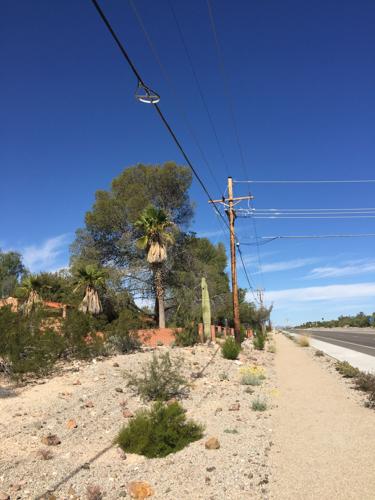
Question: I have a palm tree the city wants me to trim. I don’t want to spend the money to have someone else do it. I don’t want to climb a 20-foot ladder with a chainsaw. And I like the way this tree looks. Can you help me by saying something about how this form is considered by many people to be attractive and is a common landscape practice?
Answer: It is a common practice to leave a full skirt on palm trees and you can find others in the city just like yours. Most palm trees with a full skirt are a bit taller and as long as the bottom 10 feet of the tree is bare and the dead fronds are away from anything that might catch fire, everything is deemed okay. Some people find the natural form of these trees with a full skirt to be attractive and others like to see them well pruned. Unfortunately for you, the city requires the latter when the skirt hangs low like yours does. The hazards of palm skirts and the risks are mostly fire and having it fall on someone and crush them.
Peter L. Warren is the urban horticulture agent for the Pima County Cooperative Extension and the University of Arizona. Questions may be emailed to tucsongardensage@gmail.com
- By Peter L. Warren Special to the Arizona Daily Star
- Updated
Question: I found a patch of Aleppo pine that is dying on the west side of La Canada. The road was recently widened (3 years ago) and this whole group fronts close to the road. Could the die-off be due to road widening?
Answer: Yes, the trees could be suffering from the road widening. Construction would likely damage the roots on that side of the tree and typically damage such as this shows up above ground a few years later. It would be difficult to protect such large trees in a road-widening because their roots likely extend two to three times the width of the crown. In a different construction situation the property owner could ask for a protective zone to be fenced off around the tree to help more of the root system to survive. Typically when we see trees that have been attacked by pine engraver beetles, the color of the needles ranges from straw to reddish colors.
Peter L. Warren is the urban horticulture agent for the Pima County Cooperative Extension and the University of Arizona. Questions may be emailed to plwarren@cals.arizona.edu

- By Peter L. Warren Special to the Arizona Daily Star
- Updated
Q: I’m looking for a good tree that gives fall color. I’m trying to decide between a Texas red oak and a red push pistache. Is one a better tree for our desert climate? Which grows quicker and has better form? It would be planted about 20 feet from our home in Marana. Could you give me info about each tree so I could make a good choice?
A: The Texas red oak (Quercus buckleyi), aka the Texas hill country red oak, is a deciduous shade tree that may reach 30 feet in height and 60 feet in width under ideal circumstances. It has excellent fall color and makes a good specimen for our area. The downside might be the leaf litter and the acorns, depending on how you feel about either cleaning up after them or not. The red push pistache (Pistacia chinensis) is a hybrid deciduous tree that also has excellent fall color, maybe even better than the oak. Its growth is moderate and at maturity it typically reaches 40 feet tall by 35 feet wide. The leaflets are smaller and should be less troublesome than the oak leaves. The pistache should just fit your space if you plant it 20 feet away. The Texas red oak is typically a larger tree and would not fit your space as well.
Peter L. Warren is the urban horticulture agent for the Pima County Cooperative Extension and the University of Arizona. Email him at csongardensage@gmail.com
- By Peter L. Warren Special to the Arizona Daily Star
- Updated
Q: I have been buying firewood (mesquite and eucalyptus) to burn some and use some for woodcrafts like lathe-turned vases. It is common for the wood to be full of large round and oblong holes that are caused by some type of insect. Recently I was able to extract two almost whole grubs of some sort from a piece of mesquite. One “grub” is essentially round, and the other has a large head, sort of triangular, and a smaller round body. Can you tell me what these are and if they pose any danger to my house? Is there anything I can do to get rid of them?
Also, I cut some fresh mesquite last spring and left it in my garage to dry over the summer. It became riddled with small circular holes, apparently caused by some different insect. In this case the damage is pretty much limited to the early, or sap wood. Can you also give me some information about the insect that causes this other type of damage?
A: The two grubs are representatives of common wood-boring beetles from the Buprestidae and Cerambycidae families of insects. The round one is a larva of a long-horned beetle and the one with the large head is a larva of a metallic wood-boring beetle. Both of these insects are associated with dying or dead trees. Their galleries can be seen on sapwood, as you described, and the adult beetles are commonly seen emerging from firewood. They are not known to infest or reinfest dry wood so your home is safe. The small circular holes are from bark beetles, another species commonly associated with dying and dead trees in our area. In the forest, these three are examples of insects helping decompose trees into soil. Without them and the associated fungi and bacteria, we would be up to our eyeballs in timber and our soils would have even less organic matter than usual.
Peter L. Warren is the urban horticulture agent for the Pima County Cooperative Extension and the University of Arizona. Email him at csongardensage@gmail.com
- By Peter L. Warren Special to the Arizona Daily Star
- Updated
Q: I have been buying firewood (mesquite and eucalyptus) to burn some and use some for woodcrafts like lathe-turned vases. It is common for the wood to be full of large round and oblong holes that are caused by some type of insect. Recently I was able to extract two almost whole grubs of some sort from a piece of mesquite. One “grub” is essentially round, and the other has a large head, sort of triangular, and a smaller round body. Can you tell me what these are and if they pose any danger to my house? Is there anything I can do to get rid of them?
Also, I cut some fresh mesquite last spring and left it in my garage to dry over the summer. It became riddled with small circular holes, apparently caused by some different insect. In this case the damage is pretty much limited to the early, or sap wood. Can you also give me some information about the insect that causes this other type of damage?
A: The two grubs are representatives of common wood-boring beetles from the Buprestidae and Cerambycidae families of insects. The round one is a larva of a long-horned beetle and the one with the large head is a larva of a metallic wood-boring beetle. Both of these insects are associated with dying or dead trees. Their galleries can be seen on sapwood, as you described, and the adult beetles are commonly seen emerging from firewood. They are not known to infest or reinfest dry wood so your home is safe. The small circular holes are from bark beetles, another species commonly associated with dying and dead trees in our area. In the forest, these three are examples of insects helping decompose trees into soil. Without them and the associated fungi and bacteria, we would be up to our eyeballs in timber and our soils would have even less organic matter than usual.
Peter L. Warren is the urban horticulture agent for the Pima County Cooperative Extension and the University of Arizona. Email him at csongardensage@gmail.com
- By Peter L. Warren Special to the Arizona Daily Star
- Updated
Question: I occasionally run across a dead branch on some of my mesquite trees. The dead branch sticks out like a sore thumb, and on closer inspection, there is a ring around the branch etched into the bark. The foliage in front of the ring is dead, but behind everything appears fine. First, do you know what causes this? Second, should I be concerned. And third, should I be preventing this and how? Right now, all I do is prune the branch out.
Answer: The ring etched in the bark is the work of the mesquite twig girdler (Oncideres rhodosticta). This beetle is in the family Cerambycidae that are commonly referred to as long-horned beetles due to their long antennae. The adults aren’t commonly seen on the trees although they are attracted to lights at night if you want to find them. The female chews a ring in the stem and deposits her eggs further out on the stem. The eggs hatch in the stem and the larvae feed on the dying wood in the stem caused by the girdle cutting off nutrients to the end of the branch. The larvae will overwinter in the wood and adults will emerge in the spring. Research has shown the damage has no affect on the health of mesquite trees and it is simply nature’s way of pruning. So the good news is you don’t have to do anything to prevent these beetles from chewing on your trees.
Peter L. Warren is the urban horticulture agent for Pima County Cooperative Extension and the University of Arizona. Questions may be emailed to tucsongardensage@gmail.com
- By Peter L. Warren Special to the Arizona Daily Star
Question: I am trying to find out what kind of plants I can plant in my garden that will help ward off insects.
Answer: Despite a large amount of misinformation published on this topic, there are no plants that can be used to repel insects effectively. There are, however, plants that can be planted together to reap other benefits. Flowering plants can be used to attract beneficial insects that help manage pests. Mostly these helpful plants are flowering plants that supply nectar and pollen to the predators and parasites that prey on pest insects. The nice thing is most any flowering plants can be effective in this way so you can choose ones that you like and that do well in your area. One plant feature that works well is flowers that face up and form a cup or sorts that can hold rainwater since water can be scarce. Another idea is planting varieties that are more attractive to pests and can be used as trap crops to lure the pests away from a desirable crop. The grower then has the option to spray the trap crop with the pests on it or simply let them eat it. Also, some plants act as nurse plants for more sensitive species by shading them. We often see saguaro cacti growing this way naturally in the desert.
Peter L. Warren is the urban horticulture agent for the Pima County Cooperative Extension and the University of Arizona. Questions may be emailed to tucsongardensage@gmail.com
- By Peter L. Warren Special to the Arizona Daily Star
Poinsettias thrive on bright natural daylight: at least six hours daily is recommended. Placement near a sunny window is ideal, but avoid locations where hot afternoon sun may shine directly on, and fade colorful bracts.
To prolong the bright red of the bracts, temperatures ideally should not exceed 70 degrees during the day, or fall below 65 degrees at night. Avoid placing poinsettias near drafts, fluctuating air currents, excess heat and dry air from appliances, fireplaces or ventilating ducts. Poinsettias are sensitive to cold temperatures and outside placement during the winter months is not recommended when temperatures are below 55 degrees Leaf drop will occur if poinsettias are exposed to temperatures below 50 degrees
Poinsettias do best with moist soil so water when the soil surface feels dry to the touch. Like other container plants, the best indication of a thorough watering is water begins to seep through the drain holes at the bottom of the pot. Don't leave them sitting in water or they may suffer from root rot. It is not necessary to fertilize your poinsettias during the holiday season, however, beyond the holidays you should apply a balanced, all-purpose household plant fertilizer to promote new growth.
Poinsettias can be grown year round for lush green foliage.
March or April: When the bracts age and turn to a muddy green, cut the stems back to about eight inches in height. After you cut the plant back, it will probably look rather stark, with bare branches and bluntly cut woody stems.
By the end of May, you should see new growth. Keep the plants near a sunny window.
Around July 4: Cut branches back again about half their length to encourage bushy plants. You may place your poinsettias outdoors in indirect sun when night temperatures are warmer. Continue to water the plants regularly during the growing period. Fertilize every two to three weeks throughout the spring, summer and fall months with a complete, indoor plant fertilizer.
The poinsettia is a plant that requires a long period of darkness and is termed a "short day" (long night) plant. Short-day plants form flowers only when day length is less than about 12 hours. Many spring and fall flowering plants are short day plants, including chrysanthemums, poinsettias and Christmas cactus. If these are exposed to more than 12 hours of light per day, bloom formation does not occur.
November or December: Poinsettias will naturally bloom depending upon the flowering response time of the particular cultivar. This can be tricky to do outside of a controlled greenhouse environment, because any stray artificial light could delay or halt the flowering of the plants.
To make this work, the plants must be kept in complete darkness for 14 continuous hours each night beginning Oct. 1. This can be done by moving the plants to a dark room, or placing a large box over them. During this period, the plants require six to eight hours of bright sunlight and night temperatures between 60 and 70 degrees. This regimen must continue for about eight to 10 weeks for the plants to develop colorful bracts for the holiday season.
If this seems like too much effort, you can always support the horticulture industry by purchasing another poinsettia.
Peter L. Warren is the urban horticulture agent for the Pima County Cooperative Extension and the University of Arizona. Questions may be emailed to tucsongardensage@gmail.com
- By Peter L. Warren Special to the Arizona Daily Star
Question: Is there a list of fruit trees that grow in Tucson? Specifically, I am interested in peaches, apricots, cherries (sweet and sour) and apples? If they need a pollinator, which varieties do best together?
Answer: The main limiting factor to successfully growing fruit trees in Tucson is the lack of cold weather. Fruit trees require a certain amount of chilling hours to produce fruit, and we do not consistently get enough cold weather to meet the requirements for many fruit trees you may have seen or heard about in other parts of the country. Fortunately, there is a good selection of fruit trees that do fine here, and as long as you stick with these, you can have many years of harvesting your homegrown fruit. From your list of interests, you can find varieties of peaches, apricots and apples that grow well here. We don’t have cherries, but you can substitute figs, pears, persimmons, plums, quince, grapes, kiwi, blackberries, strawberries and pomegranates. Here is a link to our publication on fruits and nuts that includes much of what you need to know about these varieties. You will notice that the ones that do well in the low desert of Tucson are marked. There is a link to the pdf version that has a nice chart showing when they are harvested and if they require cross-pollination. Go to ag.arizona.edu/pubs/garden/az1269
Peter L. Warren is the urban horticulture agent for the Pima County Cooperative Extension and the University of Arizona. Questions may be emailed to tucsongardensage@gmail.com
- By Peter L. Warren Special to the Arizona Daily Star
Question: Thanks to our climate, I’m doing a postmortem for last season’s garden and planning seed starting for next season pretty much simultaneously. About tomatillos: I’ve had rotten luck. I’ve had single plants, mixed varieties, started seeds, bought plants from reputable local nurseries and have tried to appropriately manage watering and soil nitrogen. Tomatoes have done just fine. Tomatillos? I’ve had rotten luck.
Answer: Now is an excellent time to revisit and evaluate your gardening practices in 2015. In theory, growing tomatillos should be easy although they are as sensitive to the heat as tomatoes and there are a few insects to watch for so you don’t lose your crop. Shade cloth can help protect them once the spring heat kicks in and checking for insects once a week should be sufficient to manage pests before they get out of control. Here are some basic guidelines for growing tomatillos. Please let me know if you are already doing all these things.
Tomatillos should be planted in full sun with well-drained soil. Jan. 15 to Feb. 15 is the ideal planting time, although you can wait until March if you are using transplants. Drip irrigation is ideal and should provide an inch of water per week. Multiple plants are required for pollination.
- By Peter L. Warren Special to the Arizona Daily Star
Question: Thanks to our climate, I’m doing a postmortem for last season’s garden and planning seed starting for next season pretty much simultaneously. About tomatillos: I’ve had rotten luck. I’ve had single plants, mixed varieties, started seeds, bought plants from reputable local nurseries and have tried to appropriately manage watering and soil nitrogen. Tomatoes have done just fine. Tomatillos? I’ve had rotten luck.
Answer: Now is an excellent time to revisit and evaluate your gardening practices in 2015. In theory, growing tomatillos should be easy although they are as sensitive to the heat as tomatoes and there are a few insects to watch for so you don’t lose your crop. Shade cloth can help protect them once the spring heat kicks in and checking for insects once a week should be sufficient to manage pests before they get out of control. Here are some basic guidelines for growing tomatillos. Please let me know if you are already doing all these things.
Tomatillos should be planted in full sun with well-drained soil. Jan. 15 to Feb. 15 is the ideal planting time, although you can wait until March if you are using transplants. Drip irrigation is ideal and should provide an inch of water per week. Multiple plants are required for pollination.
Question: Is it too late for my bougainvilleas? I was out of town during the recent night freezes in Tucson, and I now have two bougainvilleas that are half frozen (they look great where the branches were protected by my awning). What do I do with the dead half? Pinch off the flowers and leaves? Prune it back? Just leave it alone?
Answer: Since you still have live parts it’s not too late to cover them in case we get more frosts. They will likely come back from this damage. The dead parts will protect the living parts somewhat in case we have more frosty temperatures so leave the dead parts on the plant until the spring when the danger of frost has passed.
Peter L. Warren is the urban horticulture agent for the Pima County Cooperative Extension and the University of Arizona. Questions may be emailed to tucsongardensage@gmail.com
- By Peter L. Warren Special to the Arizona Daily Star
Question: I live here in Tucson at Villa Catalina condos at Sixth Street and Country Club Road. We have a small rose garden with some beautiful flowers. My problem is some of our larger flowers don’t fully open. I get a very large ball, very tight, but will not open. Then there are flowers next to them, and they open nicely. Any ideas?
Answer: There are a couple possible answers to this problem. If the rose buds that don’t open appear unhealthy, possibly with a browning on the edges, there are known diseases and insects that can affect them. If the buds appear to be healthy, a more likely problem is environmental stress. According to local rose expert and master gardener volunteer, Lauren Kettenbach, this time of year that is a common problem. Before Thanksgiving there was some pretty cold weather, and then it got warm again. So it could be weather-related, and it’s also very late in the season to have any blooms at all. I would not worry unless there is a problem with the spring bloom.
Peter L. Warren is the urban horticulture agent for the Pima County Cooperative Extension and the University of Arizona. Questions may be emailed to tucsongardensage@gmail.com
- By Peter L. Warren Special to the Arizona Daily Star
Question: We live in the Tanque Verde area. In the spring I planted a tomato seedling in very good soil in the planter next to the house on the patio. It grew quite tall and produced tomatoes. I missed the weather forecast for our first frost, and the leaves wilted. Since then I’ve hung frost cloth from the eaves every evening, which traps the heat from the house. Last week when it was 26 on the patio it was 40 inside the frost cloth. Since it was wilted I cut the plant down, intending to uproot it, but noticed new green shoots coming from the bottom. Any hope for the plant, or should I start over in the spring?
Answer: As you saw, even if the temperatures are below freezing for a short time, some plants will die back above the soil and still be alive below ground. It is best to cover frost-sensitive plants when possible. In many cases, protecting plants with frost cloth can make the difference between survival and starting over. Your tomato could be fine since you are seeing new growth now. Time will tell for your plant and for many others. Patience is a virtue when determining how much damage your plants suffered. Some plants will not show new life until mid-spring.
Peter L. Warren is the urban horticulture agent for the Pima County Cooperative Extension and the University of Arizona. Questions may be emailed to tucsongardensage@gmail.com
- Peter L. Warren Special to the Arizona Daily Star
Q: Can you tell me if this tree is a cedar of Lebanon?
A: It looks like a deodar cedar (Cedrus deodara) from a distance. Cedar of Lebanon (Cedrus libani) branches usually form level layers in a mature tree. The deodar doesn’t usually look as layered and the branches and the leader tend to droop at the ends.
To be sure, you can count the needles in a cluster and you can measure them. The cedar of Lebanon has clusters of 15 to 45 whereas the deodar cedar has clusters of 20 to 30 so there is some overlap but if you can find some with greater than 30 needles that is a good clue.
Of the three true cedar trees in the genus Cedrus, the longest needles belong to the deodar cedar. If most needles exceed 2ƒ centimeters is likely a deodar cedar.
Peter L. Warren is the urban horticulture agent for Pima County Cooperative Extension and the University of Arizona. Questions may be emailed to tucsongardensage@gmail.com
- By Peter L. Warren Special to the Arizona Daily Star
Q: Today I spoke with two lovely ladies at the Oro Valley Farmers market. I asked about this flower that grows wild in my yard. When I first saw it I thought it was a form of dandelion, but it has a gorgeous iridescent white bloom that opens at dusk. The hawk moths love it. The seedpods are plentiful right now, all dried up at the base of the plant. I’m including some pictures to help identify it. One woman showed me a photo of a birdcage primrose, however I’m thinking it is just an evening primrose.
A: There are a few species of primrose so it’s easy to get confused. I checked with our friends at the University of Arizona Herbarium and they think it is Oenothera caespitosa, commonly known as tufted evening primrose and fragrant evening primrose. This low-growing perennial is found throughout the West in sunny, dry, infertile, rocky, well-drained soils. It requires little water, which makes it a good choice for xeriscape gardens. Moderate watering will keep it blooming all summer.
Peter L. Warren is the urban horticulture agent for Pima County Cooperative Extension and the University of Arizona. Questions may be emailed to tucsongardensage@gmail.com
- By Peter L. Warren Special to the Arizona Daily Star
Q: Do you have any info that would help our HOA organize its response to its fountain grass infestation? Also, are there any fountain grass variations that local nurseries sell that are sterile and won’t spread?
A: Fountaingrass (Pennisetum setaceum) is a fast growing, attractive, perennial, fire-adapted bunch grass and in our ideal environment can reach several feet tall and wide. It does just fine in dry environments although some rain helps. Unfortunately, it invades desert areas and readily outcompetes native species.
There are some varieties that are purported to be sterile but research shows they’re not 100 percent sterile and that’s a deal breaker considering it is invasive. Since it is a noxious weed in dry areas like ours I recommend removing it when possible, spraying with herbicides when necessary, and not planting it again. As is sometimes the case with invasive plants, humans are guilty of planting this species before we knew it was invasive. When it was first introduced, it was thought to be just another pretty grass for medians and landscapes.
Peter L. Warren is the urban horticulture agent for Pima County Cooperative Extension and the University of Arizona. Questions may be emailed to tucsongardensage@gmail.com
- By Peter L. Warren Special to the Arizona Daily Star
Question: I found this insect on my gas grill today. Is this the kissing bug I have been reading about?
Answer: What you are seeing is the giant agave bug (Acanthocephala thomasi). Kissing bugs (Triatoma species) are smaller and don’t have the bright orange feet and orange tips on the antennae. Also, the kissing bugs feed primarily on mammals, such as pack rats and humans, whereas the bug you found feeds on plants. Recently, there was a flurry of news reports in other parts of the country on the kissing bugs and the associated Chagas disease they can transmit. These stories then spread through social media, gathering some misinformation as they went. So I understand why you are concerned. Despite the media hype, this was not actually new information.
Kissing bugs are more common in the Southwest. However, the risk of Chagas disease transmission in Arizona is very low, according to University of Arizona Cooperative Extension Specialist Dawn Gouge. UA researchers found a high rate of infection (about 40 percent) of kissing bugs in southern Arizona by the protozoan Trypanosoma cruzi that causes the Chagas disease infection. However, the kissing bugs in Arizona differ from those in areas where Chagas disease is a health problem and are not as effective in transmitting the disease to humans. The reason has to do with the timing of blood feeding and defecating. Our local species fly then poop as opposed to poop then fly. The protozoa are passed in feces, not during blood feeding, so by waiting to defecate until after they fly from where they eat, their behavior greatly reduces chances for transmission.
Peter L. Warren is the urban horticulture agent for Pima County Cooperative Extension and the University of Arizona. Questions may be emailed to tucsongardensage@gmail.com
- By Peter L. Warren Special to the Arizona Daily Star
Question: I have a desert broom plant in my yard that has turned into a tree. I really like it but it is now blooming and is sending cottony stuff all over the yard. My neighbor said it is a weed and a nuisance and I should cut it down. Is there any way I can keep it from blooming?
Answer: Desert broom (Baccharis sarothroides) is a native plant and very common in the Southwest. It is often considered a weed because of its ability to colonize open spaces quickly. My predecessor at the University of Arizona Cooperative Extension, George Brookbank, was a proponent of this plant as a good native shrub for landscape use, so not everyone sees this plant as a weed. There is no way to prevent it from blooming, but you could prune off the flowers before they go to seed and start taking flight. That way you could still enjoy the plant to some extent and hopefully appease your neighbor.
Peter L. Warren is the urban horticulture agent for Pima County Cooperative Extension and the University of Arizona. Questions may be emailed to tucsongardensage@gmail.com
- By Peter L. Warren Special to the Arizona Daily Star
Question: Our HOA has declared war on buffelgrass: a good thing. But rather than remove it, they are having intense commercial spraying of glyphosate using concentrations higher than the typical herbicide available to homeowners. I cannot find information (from scientific sources such as .edu) about the immediate or long-term toxicity of the spray on cactus or our desert trees. Do you know of any research showing what it may do?
Answer: According to our University of Arizona Cooperative Extension Weed Specialist, Bill McCloskey, direct spraying of cacti with glyphosate repeatedly will probably kill most cactus species but they can withstand incidental spray contact (i.e., the whole plant is not sprayed) intermittently and can survive a single direct spraying. Generally, we recommend spraying grass-specific herbicides for grass control (e.g., fluaziflop, sethoxydim or clethodim on bermuda grass) to avoid injuring the cacti. Unfortunately, this class of herbicides doesn’t work well on buffelgrass, but maybe repeated spraying would eventually do it. Manual removal of buffelgrass would be effective in this case but understandably hard around cacti.
Peter L. Warren is the urban horticulture agent for Pima County Cooperative Extension and the University of Arizona. Questions may be emailed to tucsongardensage@gmail.com
- By Peter L. Warren Special to the Arizona Daily Star
Question: I occasionally run across a dead branch on some of my mesquite trees. The dead branch sticks out like a sore thumb, and on closer inspection, there is a ring around the branch etched into the bark. The foliage in front of the ring is dead, but behind everything appears fine. First, do you know what causes this? Second, should I be concerned. And third, should I be preventing this and how? Right now, all I do is prune the branch out.
Answer: The ring etched in the bark is the work of the mesquite twig girdler (Oncideres rhodosticta). This beetle is in the family Cerambycidae that are commonly referred to as long-horned beetles due to their long antennae. The adults aren’t commonly seen on the trees although they are attracted to lights at night if you want to find them. The female chews a ring in the stem and deposits her eggs further out on the stem. The eggs hatch in the stem and the larvae feed on the dying wood in the stem caused by the girdle cutting off nutrients to the end of the branch. The larvae will overwinter in the wood and adults will emerge in the spring. Research has shown the damage has no affect on the health of mesquite trees and it is simply nature’s way of pruning. So the good news is you don’t have to do anything to prevent these beetles from chewing on your trees.
Peter L. Warren is the urban horticulture agent for Pima County Cooperative Extension and the University of Arizona. Questions may be emailed to tucsongardensage@gmail.com
- By Peter L. Warren Special to the Arizona Daily Star
Q: We are snowbirds here November through March. Much of our landscape was redone the last week of March and we departed April 3. Now we have just returned and I see our 5-gallon emus (red valentine shrubs) have bit the dust and a couple red barrels are dying. These plants should have been sturdy enough for their western exposure site. Our new sprinkler system is one year old and works fine. Would you guess that these plants should not have been planted so late in the spring before we left right away? Perhaps they needed two to three daily waterings on hot summer days but no one was here? Our gardener/landscaper didn’t indicate that there should be any problems and he knew we are here just part time and he set the sprinklers.
We both chose the plants together and he knew we were leaving immediately after he installed the landscape. He wasn’t able to schedule our work sooner and I think maybe the job shouldn’t have been done after late January to allow the plants to settle in before the heat hit.
A: The last week of March and into April we were seeing temperatures in the high 80s and low 90s. If your irrigation was working properly and delivering the right amount of water then you might have been OK, although western sun exposure is a tough place to get started when it gets hot.
Drip irrigation is the preferred method rather than a sprinkler and the recommended amount for the summer season is once every 14 days to a depth of 12 to 18 inches for the barrel cacti and 24 to 36 inches for the emu shrubs. The barrels (Ferocactus species) are certainly desert plants and the emu (Eremophila maculata) is from Australia and a good desert adapted plant so their chance of survival in your area is good.
You are asking the right questions and if you are planning to try again, I recommend planting earlier, maybe now, so they can get established before the summer and make sure to adjust your irrigation to fit the needs of the plants.
Peter L. Warren is the urban horticulture agent for the Pima County Cooperative Extension and the University of Arizona. Questions may be emailed to tucsongardensage@gmail.com
- By Peter L. Warren Special to the Arizona Daily Star
Q: When is the correct time to prune roses in the Tucson area? And do you prune them like we do in the Midwest, i.e. cut back near the ground?
Answer: The pruning of roses is recommended twice per year in Tucson. The first pruning can be done in late January to a height of 15 inches or so. This time remove all dead wood, crossing branches, and small leaves. Seal the fresh pruning cuts with Elmer’s glue to prevent insects from invading the newly cut branches, fertilize, and then water.
In mid-September a lighter pruning is recommended. This time remove one third of the plant along with any diseased or dead wood but leave any leaflets. Seal fresh cuts with Elmer’s Glue, fertilize, and water.
The Pima County Master Gardeners teach classes on roses and other things at some of the public libraries in case you’re interested. Check your library schedules or call the Extension Office for more information,626-5161.
Peter L. Warren is the urban horticulture agent for the Pima County Cooperative Extension and the University of Arizona. Questions may be emailed to tucsongardensage@gmail.com
- By Peter L. Warren Special to the Arizona Daily Star
Q: I am writing to inquire about recommendations for a nontoxic approach to controlling citrus leafminer on a young lime tree I am growing in a large pot. I do not recall having this pest in the past and have had limes, grapefruit and lemons for many years. This new lime tree I planted about a year ago is now infested on all the new leaves and I am wondering if there might be a nontoxic method to reduce or eliminate them. I have looked up information on the web but the recommendations seem to be relatively toxic and I would prefer to avoid those if possible.
A: Because your lime tree is young, insecticides are generally recommended to prevent these insects from slowing the growth of the tree. That said, you could let your tree tough it out since there are natural enemies that prey on the citrus leafminer and the leaves they damage are still effective food producers for the tree.
Other things you can do to manage the situation include avoiding pruning except for water sprouts and branches broken by wind, et cetera, and only fertilizing outside of the normal flights of the adults. The adults are most often seen in the summer and fall months. Both pruning and fertilizing promote the new growth that is most attractive to these insects.
Peter L. Warren is the urban horticulture agent for the Pima County Cooperative Extension and the University of Arizona. Questions may be emailed to tucsongardensage@gmail.com
- By Peter L. Warren Special to the Arizona Daily Star
Q: I’ve never seen a bug like this one found in my garage. It had eyes and would move quickly when I put my finger in front of it.
A: This is a solpugid. It is a member of the arachnid class in the phylum of arthropods and related to spiders and scorpions but distinct enough to warrant their own order. Their habitat is the desert and they are predators of other arthropods and have a reputation for being fast; their top speed is reportedly around 10mph. They have no venom, are harmless to humans, and do a good bit of pest management for us while we sleep. All things considered, they are good to have around.
Peter L. Warren is the urban horticulture agent for the Pima County Cooperative Extension and the University of Arizona. Questions may be emailed to tucsongardensage@gmail.com
- By Peter L. Warren Special to the Arizona Daily Star
Question: I have a palm tree the city wants me to trim. I don’t want to spend the money to have someone else do it. I don’t want to climb a 20-foot ladder with a chainsaw. And I like the way this tree looks. Can you help me by saying something about how this form is considered by many people to be attractive and is a common landscape practice?
Answer: It is a common practice to leave a full skirt on palm trees and you can find others in the city just like yours. Most palm trees with a full skirt are a bit taller and as long as the bottom 10 feet of the tree is bare and the dead fronds are away from anything that might catch fire, everything is deemed okay. Some people find the natural form of these trees with a full skirt to be attractive and others like to see them well pruned. Unfortunately for you, the city requires the latter when the skirt hangs low like yours does. The hazards of palm skirts and the risks are mostly fire and having it fall on someone and crush them.
Peter L. Warren is the urban horticulture agent for the Pima County Cooperative Extension and the University of Arizona. Questions may be emailed to tucsongardensage@gmail.com
- By Peter L. Warren Special to the Arizona Daily Star
Question: I found a patch of Aleppo pine that is dying on the west side of La Canada. The road was recently widened (3 years ago) and this whole group fronts close to the road. Could the die-off be due to road widening?
Answer: Yes, the trees could be suffering from the road widening. Construction would likely damage the roots on that side of the tree and typically damage such as this shows up above ground a few years later. It would be difficult to protect such large trees in a road-widening because their roots likely extend two to three times the width of the crown. In a different construction situation the property owner could ask for a protective zone to be fenced off around the tree to help more of the root system to survive. Typically when we see trees that have been attacked by pine engraver beetles, the color of the needles ranges from straw to reddish colors.
Peter L. Warren is the urban horticulture agent for the Pima County Cooperative Extension and the University of Arizona. Questions may be emailed to plwarren@cals.arizona.edu
- By Peter L. Warren Special to the Arizona Daily Star
Q: I’m looking for a good tree that gives fall color. I’m trying to decide between a Texas red oak and a red push pistache. Is one a better tree for our desert climate? Which grows quicker and has better form? It would be planted about 20 feet from our home in Marana. Could you give me info about each tree so I could make a good choice?
A: The Texas red oak (Quercus buckleyi), aka the Texas hill country red oak, is a deciduous shade tree that may reach 30 feet in height and 60 feet in width under ideal circumstances. It has excellent fall color and makes a good specimen for our area. The downside might be the leaf litter and the acorns, depending on how you feel about either cleaning up after them or not. The red push pistache (Pistacia chinensis) is a hybrid deciduous tree that also has excellent fall color, maybe even better than the oak. Its growth is moderate and at maturity it typically reaches 40 feet tall by 35 feet wide. The leaflets are smaller and should be less troublesome than the oak leaves. The pistache should just fit your space if you plant it 20 feet away. The Texas red oak is typically a larger tree and would not fit your space as well.
Peter L. Warren is the urban horticulture agent for the Pima County Cooperative Extension and the University of Arizona. Email him at csongardensage@gmail.com
- By Peter L. Warren Special to the Arizona Daily Star
Q: I have been buying firewood (mesquite and eucalyptus) to burn some and use some for woodcrafts like lathe-turned vases. It is common for the wood to be full of large round and oblong holes that are caused by some type of insect. Recently I was able to extract two almost whole grubs of some sort from a piece of mesquite. One “grub” is essentially round, and the other has a large head, sort of triangular, and a smaller round body. Can you tell me what these are and if they pose any danger to my house? Is there anything I can do to get rid of them?
Also, I cut some fresh mesquite last spring and left it in my garage to dry over the summer. It became riddled with small circular holes, apparently caused by some different insect. In this case the damage is pretty much limited to the early, or sap wood. Can you also give me some information about the insect that causes this other type of damage?
A: The two grubs are representatives of common wood-boring beetles from the Buprestidae and Cerambycidae families of insects. The round one is a larva of a long-horned beetle and the one with the large head is a larva of a metallic wood-boring beetle. Both of these insects are associated with dying or dead trees. Their galleries can be seen on sapwood, as you described, and the adult beetles are commonly seen emerging from firewood. They are not known to infest or reinfest dry wood so your home is safe. The small circular holes are from bark beetles, another species commonly associated with dying and dead trees in our area. In the forest, these three are examples of insects helping decompose trees into soil. Without them and the associated fungi and bacteria, we would be up to our eyeballs in timber and our soils would have even less organic matter than usual.
Peter L. Warren is the urban horticulture agent for the Pima County Cooperative Extension and the University of Arizona. Email him at csongardensage@gmail.com
- By Peter L. Warren Special to the Arizona Daily Star
Q: I have been buying firewood (mesquite and eucalyptus) to burn some and use some for woodcrafts like lathe-turned vases. It is common for the wood to be full of large round and oblong holes that are caused by some type of insect. Recently I was able to extract two almost whole grubs of some sort from a piece of mesquite. One “grub” is essentially round, and the other has a large head, sort of triangular, and a smaller round body. Can you tell me what these are and if they pose any danger to my house? Is there anything I can do to get rid of them?
Also, I cut some fresh mesquite last spring and left it in my garage to dry over the summer. It became riddled with small circular holes, apparently caused by some different insect. In this case the damage is pretty much limited to the early, or sap wood. Can you also give me some information about the insect that causes this other type of damage?
A: The two grubs are representatives of common wood-boring beetles from the Buprestidae and Cerambycidae families of insects. The round one is a larva of a long-horned beetle and the one with the large head is a larva of a metallic wood-boring beetle. Both of these insects are associated with dying or dead trees. Their galleries can be seen on sapwood, as you described, and the adult beetles are commonly seen emerging from firewood. They are not known to infest or reinfest dry wood so your home is safe. The small circular holes are from bark beetles, another species commonly associated with dying and dead trees in our area. In the forest, these three are examples of insects helping decompose trees into soil. Without them and the associated fungi and bacteria, we would be up to our eyeballs in timber and our soils would have even less organic matter than usual.
Peter L. Warren is the urban horticulture agent for the Pima County Cooperative Extension and the University of Arizona. Email him at csongardensage@gmail.com
- By Peter L. Warren Special to the Arizona Daily Star
Question: I occasionally run across a dead branch on some of my mesquite trees. The dead branch sticks out like a sore thumb, and on closer inspection, there is a ring around the branch etched into the bark. The foliage in front of the ring is dead, but behind everything appears fine. First, do you know what causes this? Second, should I be concerned. And third, should I be preventing this and how? Right now, all I do is prune the branch out.
Answer: The ring etched in the bark is the work of the mesquite twig girdler (Oncideres rhodosticta). This beetle is in the family Cerambycidae that are commonly referred to as long-horned beetles due to their long antennae. The adults aren’t commonly seen on the trees although they are attracted to lights at night if you want to find them. The female chews a ring in the stem and deposits her eggs further out on the stem. The eggs hatch in the stem and the larvae feed on the dying wood in the stem caused by the girdle cutting off nutrients to the end of the branch. The larvae will overwinter in the wood and adults will emerge in the spring. Research has shown the damage has no affect on the health of mesquite trees and it is simply nature’s way of pruning. So the good news is you don’t have to do anything to prevent these beetles from chewing on your trees.
Peter L. Warren is the urban horticulture agent for Pima County Cooperative Extension and the University of Arizona. Questions may be emailed to tucsongardensage@gmail.com
Tags


View this profile on Instagram#ThisIsTucson 🌵 (@this_is_tucson) • Instagram photos and videos
Most viewed stories
-
Surprise! Wildflower season is starting early. Here's where to find the best blooms 🌼
-
Jamie vs. Sonoran dogs: Follow me as I take on Visit Tucson's Sonoran Dog Trail 🌭
-
43 events you won't want to miss, February 20-22! 🤠🐎
-
Over 60 fun events happening in Tucson in February 💖🐎
-
Conservation park for endangered animal could open south of Tucson
-
A new chapter: Crossroads Restaurant is back open after fire
-
Transplant Pizza, Mosaic Brewing and Marana Serial Grillers close their doors