


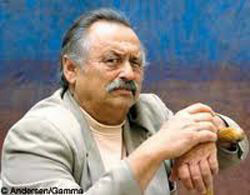

Authors Chuck Bowden and Jim Harrison were a lot more than close friends. They walked, drank, smoked, hiked, and endlessly talked politics, writing and nature together. Beyond that, Bowden spent the last six summers of his life resting, writing, birdwatching and cogitating on Harrison’s spread along Sonoita Creek outside the town of Patagonia while Harrison and his wife fled to Montana to escape the heat.
Harrison, now 77, is scheduled to talk about Bowden’s literary legacy at a March 15 panel discussion at the Tucson Festival of Books. Like Bowden, Harrison is intensely prolific, having written more than 30 books, mostly poetry collections and novels, including his just-released “The Big Seven.” Both men’s work have been compared to Hemingway’s. Both have, or in Bowden’s case had, a taste for wine, cigarettes and the outdoors. Both possess an innate tendency to speak their minds with no compromise.
An Outside Magazine writer described Harrison back in 2011 as “seeming less like a man to me than a force of nature with a Pancho Villa mustache.” Here, the forceful Harrison remembers a friend of 20 years.
Q. How did you meet him?
A. I met him at Doug Peacock’s house (Peacock, the real-life role model for George Hayduke’s character in Edward Abbey’s “The Monkey Wrench Gang,” is an author and naturalist). It was well before we moved to Patagonia from Michigan. Peacock lived on the west side of town, off Ina Road. I was friends for years with Peacock, who showed up at my house in Michigan once and we just hit it off. When I got out here we started doing a lot of camping together. (Peacock now lives only four months of the year in the Tucson area and the rest of the time in Montana.)
Abbey was there, and he and Chuck argued at each other all the time, usually about matters most people don’t care about. My first impression of Chuck was that he was very, sort of abrasive, but I found that to not really be true. That was just his manner, as you know.
Q. What do you mean?
A. All of us disagree with everyone, which I enjoy. So much of our culture, when people don’t ever disagree, sometimes we’re so boring. Chuck would really let go.
Later, after I moved out here, I’d go over to his house where he and Mary Martha (Mary Martha Miles, Bowden’s partner for more than a decade in the 1990s and 2000s) lived. We would have a drink, eat lunch and walk with the dog. We became good friends pretty, pretty fast. We had so many of the same interests — literature to the desert to having a drink now and then.
Q. What was it you liked about him?
A. His way above-board curiosity, his intense curiosity, his willingness to talk about what everybody apparently thinks is too raw or difficult to talk much about. I mean the border and so on. I don’t see anything wrong with an open border myself. In general, Mexicans have been a tremendous boon for America.
Q. How would you rank him in the pantheon of writers, Southwestern and otherwise?
A. He ranks way up there. I was disappointed that in his death, he got all this talk that really should have come to him when he was alive. Quite often that happens — sometimes the only way to make an extra buck is to die. There’s a sad, abrupt popularity in dying.
Q. Your view of his writing.
A. I thought he wrote beautifully and vividly. You were always sort of spellbound when you read anything of Chuck’s. At least I was and I’m spoiled. He had a curious interest in poetry. I’m a poet, too, and for some reason he started reading poetry and he was pretty interested in the subject — suddenly one day he started asking me why I bother writing poetry …
He certainly had this all abiding interest in everything, which you don’t find to be true of people or writers in general. They are often bored at everything but themselves.
Q. Do you have a favorite book of his?
A. Not specifically. I just concentrate on all the border stuff. I don’t know that he was very optimistic along those ways (about the border). How can people comprehend 5,000 murders in one year in a not very big city (Juarez, the subject of much of Bowden’s early Mexico reportage)? We lost so many people. The cartels were offering jobs with benefits, which is ironic.
Q. So he was pessimistic about the border.
A. I think he was pessimistic about everything. I would say that the healthiest people I know are hopeless about everything. He was certainly full of subdued rancor about everything. We used to have a talk about the point of how do you spend billions on Afghanistan, and not a lot on Mexico?
Q. How did he come to spend summers at your place?
A. He liked it down here. We were gone in the summer and we don’t rent it. He would come here and go to Nogales and buy 10,000 tripe and feed the ravens. Then he put a dozen hummingbird feeders out here and had 1,000 hummingbirds.
It’s sort of a unique property — a number of acres on the creek, which flows the year around and draws a lot of wildlife, including mountain lions. They killed a big deer in front of us last year. There are grasslands, woods, the creek and a lot of willows and cottonwoods. A riparian thicket.
Q. He always had a thing for birds and there are a lot of birds down there.
A. This area is such a good flyway for every species. There’s an awful lot of warblers — he saw six in one willow bush once. My mother was such a good birdwatcher. She was here and saw 119 species in one weekend from the patio.
Q. Did you two talk much about the environment (Bowden’s most-reported-on topic until he started on the border and Mexico)?
A. We talked constantly about the environment. We were both habitual walkers. The dog required me to take a habitual walk every morning. Interesting, Chuck was sort of a modern Thoreau. He’d say, ‘Please, don’t bullshit me’ right from the start. You would wonder if anyone could have a lower view of politics than Chuck.
When he and I were down here at the same time, we’d walk on my property. My property — I’m encircled by the Circle Z Ranch property. I have a deeded right to walk all the Circle Z land. That whole stretch of woods from there down to the conservancy property (the Nature Conservancy’s Patagonia-Sonoita Creek Preserve) is luscious. We would walk an hour or so, then go have a drink. Something about walking frees your mind.
Q. What do you hope that people who come to your panel will take away from it?
A. I don’t know if I’d expect people to get anything, except a curiosity about Chuck and his work.

