

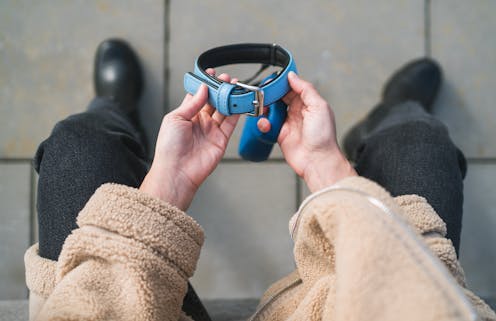
 People are often taken aback by the intensity of pet grief Soloviova Liudmyla/Shutterstock
Many pet owners know that our connections with animals can be on an emotional par with those we share with other humans — and scientific research backs this up.
The key ingredients of human attachment are experiencing the other person as a dependable source of comfort, seeking them out when distressed, feeling enjoyment in their presence and missing them when apart. Researchers have identified these as features of our relationships with pets too.
But there are complexities. Some groups of people are more likely to develop intimate bonds with their pets. This includes isolated older people, people who have lost trust in humans, and people who rely on assistance animals.
Researchers have also found our connections with our fluffy, scaled and feathered friends come with a price, in that we grieve the loss of our pets. But some aspects of pet grief are unique.
Euthanasia
For many people, pet death may be the only experience they have of grief connected to euthanasia. Guilt or doubt over a decision to euthanize a cherished companion animal can complicate grief. For example, research has found that disagreements within families about whether it is (or was) right to put a pet to sleep can be particularly challenging.
But euthanasia also gives people a chance to prepare for a beloved animal’s passing. There is a chance to say goodbye and plan final moments to express love and respect such as a favorite meal, a night in together or a last goodbye.
There are stark differences in people’s responses to pet euthanasia. Israeli research found that in the aftermath of euthanized pet death, 83% of people feel certain they made the right decision. They believed they had granted their animal companion a more honorable death that minimized suffering.
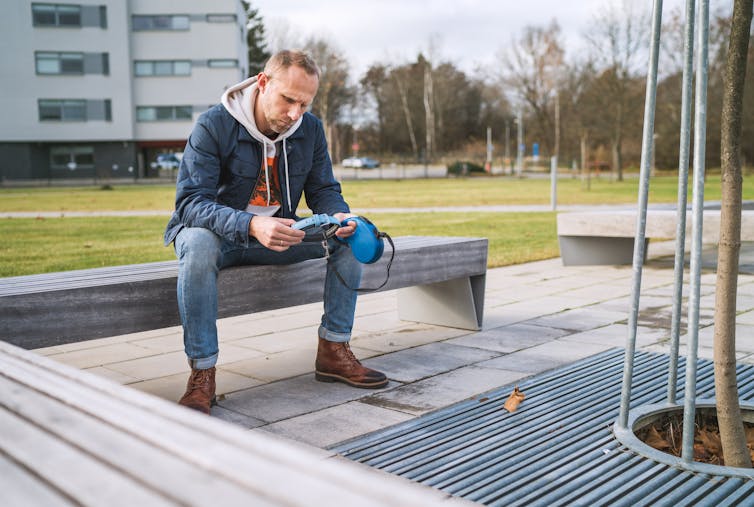 Pet grief can make people turn inwards. Soloviova Liudmyla/Shutterstock
However, a Canadian study found 16% of participants in their study whose pets were euthanized “felt like murderers”. And American research has shown how nuanced the decision can be as 41% of participants in a study felt guilty and 4% experienced suicidal feelings after they consented to their animal being euthanized. Cultural beliefs, the nature and intensity of their relationship, attachment styles and personality influence people’s experience of pet euthanasia.
Disenfranchised grief
This type of loss is still less acceptable socially. This is called disenfranchised grief, which refers to losses that society doesn’t fully appreciate or ignores. This makes it harder to mourn, at least in public.
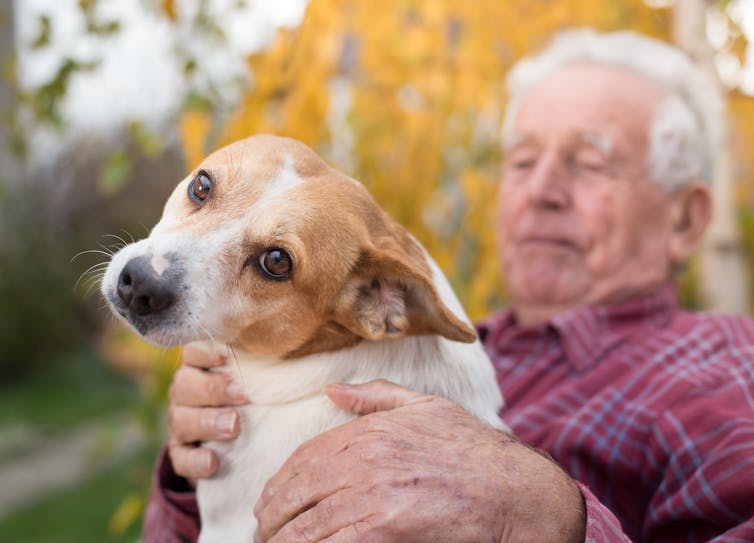 Older people are often more isolated which makes their pets an important source of comfort. Budimir Jevtic/Shutterstock
Psychologists Robert Neiymeyer and John Jordan said disenfranchised grief is a result of an empathy failure. People deny their own pet grief because a part of them feels it is shameful. This isn’t just about keeping a stiff upper lip in the office or at the pub. People may feel pet grief is unacceptable to certain members of their family, or to the family more generally.
And at a wider level, there may be a mismatch between the depth of pet grief and social expectations around animal death. For example, some people may react with contempt if someone misses work or takes leave to mourn a pet.
Research suggests that when people are in anguish over the loss of a pet, disenfranchised grief makes it more difficult for them to find solace, post-traumatic growth and healing. Disenfranchised grief seems to restrain emotional expression in a way that makes it harder to process.
Our relationships to our pets can be as meaningful as those we share with each other. Losing our pets is no less painful, and our grief reflects that. There are dimensions of pet grief we need to recognize as unique. If we can accept pet death as a type of bereavement, we can lessen people’s suffering. We’re only human, after all.
Sam Carr does not work for, consult, own shares in or receive funding from any company or organization that would benefit from this article, and has disclosed no relevant affiliations beyond their academic appointment.
This article is republished from The Conversation under a Creative Commons license.
Photos: Ukrainians fleeing war can't leave pets behind
Russia Ukraine War Pets Photo Gallery
Updated
A woman holds a dog while crossing the Irpin River on an improvised path under a bridge as people flee the town of Irpin, Ukraine, Saturday, March 5, 2022. (AP Photo/Vadim Ghirda)
Russia Ukraine War Pets Photo Gallery
Updated
A refugee who fled the Russian invasion from neighboring Ukraine comforts her dog as they sit in a ballroom converted into a makeshift refugee shelter at a 4-star hotel & spa, in Suceava, Romania, Friday, March 4, 2022.(AP Photo/Andreea Alexandru)
Russia Ukraine War Pets Photo Gallery
Updated
A puppy peers his head from a pet carrier after his owner fled the conflict from neighboring Ukraine at the Romanian-Ukrainian border, in Siret, Romania, Sunday, Feb. 27, 2022. (AP Photo/Andreea Alexandru)
Russia Ukraine War Pets Photo Gallery
Updated
A Ukrainian girl pets her cat in her coat inside Lviv railway station, Monday, Feb. 28, 2022, in Lviv, west Ukraine. (AP Photo/Bernat Armangue)
Russia Ukraine War Pets Photo Gallery
Updated
Julia Lazarets plays with her cat Gabriel, after fleeing Ukraine and arriving at the train station in Przemysl, Poland, Tuesday, March 8, 2022. (AP Photo/Daniel Cole)
Russia Ukraine War Pets Photo Gallery
Updated
Katya holds her two dogs after fleeing from Ukraine, at the border crossing in Medyka, Poland, Wednesday, March 9, 2022. (AP Photo/Visar Kryeziu)
Russia Ukraine War Pets Photo Gallery
Updated
A refugee holding her dog sits by the side of the road approaching the border with Poland in Shehyni, Ukraine, Sunday, March 6, 2022. (AP Photo/Daniel Cole)
Russia Ukraine War Pets Photo Gallery
Updated
Ukrainian servicemen help a woman carrying a small dog across the Irpin River on an improvised path while assisting people fleeing the town of Irpin, Ukraine, Saturday, March 5, 2022. (AP Photo/Vadim Ghirda)
Russia Ukraine War Pets Photo Gallery
Updated
A refugee holding a small dog gives a sip of tea to a toddler after fleeing the conflict from neighboring Ukraine, as they sit in a bus at the Romanian-Ukrainian border, in Siret, Romania, Friday, March 4, 2022. (AP Photo/Andreea Alexandru)
Russia Ukraine War Pets Photo Gallery
Updated
A girl comforts a cat before the departure of a Lviv-bound train in Kyiv, Ukraine, Thursday, March 3, 2022. (AP Photo/Vadim Ghirda)
Russia Ukraine War Pets Photo Gallery
Updated
A Ukrainian girl and her cat wait at the platform inside Lviv railway station, Sunday, Feb. 27, 2022, in Lviv, west Ukraine. (AP Photo/Bernat Armangue)
Russia Ukraine War Pets Photo Gallery
Updated
A refugee who fled the Russian invasion from neighboring Ukraine comforts his dog as they sit in a ballroom converted into a makeshift refugee shelter at a 4-star hotel & spa, in Suceava, Romania, Friday, March 4, 2022. (AP Photo/Andreea Alexandru)
Russia Ukraine War Pets Photo Gallery
Updated
A dog named Josephine licks a Ukrainian woman reunited with her sister after crossing the border from Ukraine at the Romanian-Ukrainian border, in Siret, Romania, Friday, Feb. 25, 2022. (AP Photo/Andreea Alexandru)
Russia Ukraine War Pets Photo Gallery
Updated
A refugee fleeing the conflict from neighboring Ukraine wipes away tears after seeing a relative at the Romanian-Ukrainian border, in Siret, Romania, Monday, March 7, 2022. (AP Photo/Andreea Alexandru)
Russia Ukraine War Pets Photo Gallery
Updated
A woman from neighboring Ukraine sits with her dog at a train station that was turned into an accommodation center in Przemysl, Poland, on Thursday, Feb. 24, 2022. (AP Photo/Petr David Josek)
Russia Ukraine War Pets Photo Gallery
Updated
A couple talks after people rushed to board a Lviv-bound train in Kyiv, Ukraine, Monday, Feb. 28, 2022. (AP Photo/Vadim Ghirda)
APTOPIX Russia Ukraine War
Updated
Antonina, 84 years old, sits in a wheelchair after being evacuated along with her 12 dogs from Irpin, at a triage point in Kyiv, Ukraine, Friday, March 11, 2022. A large scale evacuation operation of residents of a satellite area of capital Kyiv continued Friday, with more and more people deciding to leave areas now under Russian control.(AP Photo/Vadim Ghirda)

