

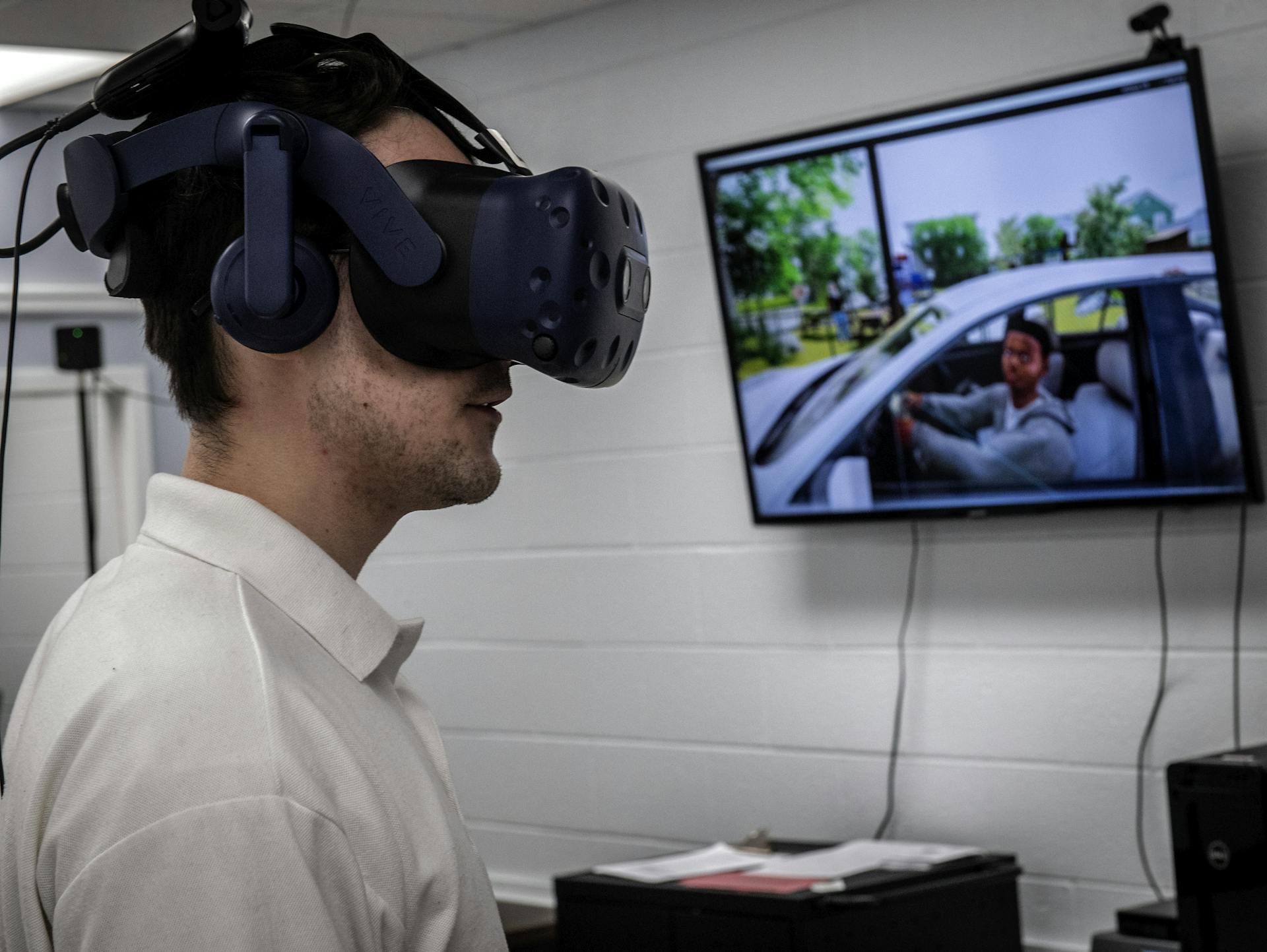
 A student wears virtual reality goggles and headphones as part of a digital learning experience. Bill O'Leary/The Washington Post via Getty Images
More and more colleges are becoming “metaversities,” taking their physical campuses into a virtual online world, often called the “metaverse.” One initiative has 10 U.S. universities and colleges working with Meta, the parent company of Facebook, and virtual reality company VictoryXR to create 3D online replicas – sometimes called “digital twins” – of their campuses that are updated live as people and items move through the real-world spaces.
Some classes are already happening in the metaverse. And VictoryXR says that by 2023, it plans to build and operate 100 digital twin campuses, which allow for a group setting with live instructors and real-time class interactions.
One metaversity builder, New Mexico State University, says it wants to offer degrees in which students can take all their classes in virtual reality, beginning in 2027.
There are many benefits to taking college classes in the metaverse, such as 3D visual learning, more realistic interactivity and easier access for faraway students. But there are also potential problems. My recent research has focused on ethical, social and practical aspects of the metaverse and risks such as privacy violations and security breaches. I see five challenges:
1. Significant costs and time
The metaverse provides a low-cost learning alternative in some settings. For instance, building a cadaver laboratory costs several million dollars and requires a lot of space and maintenance. A virtual cadaver lab has made scientific learning affordable at Fisk University.
However, licenses for virtual reality content, construction of digital twin campuses, virtual reality headsets and other investment expenses do add costs for universities.
A metaverse course license can cost universities at least $20,000, and could go as high as $100,000 for a digital twin campus. VictoryXR also charges a yearly subscription fee of $200 per student to access its metaverse.
Additional costs are incurred for virtual reality headsets. While Meta is providing a limited number of its virtual reality headsets – the Meta Quest 2 – for free for metaversities launched by Meta and VictoryXR, that’s only a few of what may be needed. The low-end 128GB version of the Meta Quest 2 headset costs $399.99. Managing and maintaining a large number of headsets, including keeping them fully charged, involves additional operational costs and time.
Colleges also need to spend significant time and resources to provide training to faculty to deliver metaverse courses. Even more time will be required to deliver metaverse courses, many of which will need all-new digital materials.
Most educators don’t have the capability to create their own metaverse teaching materials, which can involve merging videos, still images and audio with text and interactivity elements into an immersive online experience.
2. Data privacy, security and safety concerns
Business models of companies developing metaverse technologies rely on collecting users’ detailed personal data. For instance, people who want to use Meta’s Oculus Quest 2 virtual reality headsets must have Facebook accounts.
The headsets can collect highly personal and sensitive data such as location, students’ physical features and movements, and voice recordings. Meta has not promised to keep that data private or to limit access that advertisers might have to it.
Meta is also working on a high-end virtual reality headset called Project Cambria, with more advanced capabilities. Sensors in the device will allow a virtual avatar to maintain eye contact and make facial expressions that mirror the user’s eye movements and face. That data information can help advertisers measure users’ attention and target them with personalized advertising.
Professors and students may not freely participate in class discussions if they know that all their moves, their speech and even their facial expressions are being watched by the university as well as a big technology company.
The virtual environment and its equipment can also collect a wide range of user data, such as physical movement, heart rate, pupil size, eye openness and even signals of emotions.
Cyberattacks in the metaverse could even cause physical harm. Metaverse interfaces provide input directly into users’ senses, so they effectively trick the user’s brain into believing the user is in a different environment. People who attack virtual reality systems can influence the activities of immersed users, even inducing them to physically move into dangerous locations, such as to the top of a staircase.
The metaverse can also expose students to inappropriate content. For instance, Roblox has launched Roblox Education to bring 3D, interactive, virtual environments into physical and online classrooms. Roblox says it has strong protections to keep everyone safe, but no protections are perfect, and its metaverse involves user-generated content and a chat feature, which could be infiltrated by predators or people posting pornography or other illegal material.
A Stanford University class took students on an exploration of world-merging virtual and physical elements.
3. Lack of rural access to advanced infrastructure
Many metaverse applications such as 3D videos are bandwidth-intensive. They require high-speed data networks to handle all of the information flowing between sensors and users across the virtual and physical space.
Many users, especially in rural areas, lack the infrastructure to support the streaming of high-quality metaverse content. For instance, 97% of the population living in urban areas in the U.S. has access to a high-speed connection, compared to 65% in rural areas and 60% in tribal lands.
4. Adapting challenges to a new environment
Building and launching a metaversity requires drastic changes in a school’s approach to teaching and learning. For instance, metaverse students aren’t just recipients of content but active participants in virtual reality games and other activities.
The combination of advanced technologies such as immersive game-based learning and virtual reality with artificial intelligence can create personalized learning experiences that are not in real time but still experienced through the metaverse. Automatic systems that tailor the content and pace of learning to the ability and interest of the student can make learning in the metaverse less structured, with fewer set rules.
Those differences require significant modifications in assessment and monitoring processes, such as quizzes and tests. Traditional measures such as multiple choice questions are inappropriate to assess individualized and unstructured learning experiences offered by the metaverse.
5. Amplifying biases
Gender, racial and ideological biases are common in textbooks of history, science and other subjects, which influence how students understand certain events and topics. In some cases, those biases prevent the achievement of justice and other goals, such as gender equality.
Biases’ effects can be even more powerful in rich media environments. Films are more powerful at molding students’ views than textbooks. Metaverse content has the potential to be even more influential.
To maximize the benefits of the metaverse for teaching and learning, universities – and their students – will have to wrestle with protecting users’ privacy, training teachers and the level of national investment in broadband networks.
___
Nir Kshetri does not work for, consult, own shares in or receive funding from any company or organization that would benefit from this article, and has disclosed no relevant affiliations beyond their academic appointment.
___

What shopping in the metaverse might look like
What shopping in the metaverse might look like
Updated
Imagine our world, then picture it fully digital. For many, it looks like the metaverse, an immersive virtual space where we can log on to meet friends, shop, work in virtual offices, and even buy virtual real estate. Offering an estimated $800 billion market opportunity, the metaverse is eyed by online game creators, social networks, and various tech leaders who are looking for the next game-changing technology platform.
Although social media companies see it as a way to capitalize on revenue, building the metaverse is not exactly cheap. Facebook’s parent company, Meta, lost more than $10 billion in 2021 alone just to work on building its own vision of the metaverse. Such losses prove that companies like Meta are investing astronomical amounts of money to discover their next growth stage.
In the metaverse, making purchases is possible through crypto wallets. They are made to keep your cryptocurrency safe and easily accessible by storing your private keys. You’d be able to receive, spend, and send out cryptocurrencies such as Bitcoin and Ethereum. There are various forms of crypto wallets, whether it’s a USB stick or a mobile app that makes it similar to shopping online.
To look at this emerging world, Wicked Reports compiled a list from news reports and expert predictions exploring the ways that people may shop for different types of real and virtual goods in the metaverse Some of these options are already available to try today, others are in the early phases of development. But the metaverse is coming, and here is how it may affect your buying habits.

Food
Updated
Both grocery shopping and dining out are ingrained in our everyday lives, and both are also possible in the metaverse. Recently, a video circulated on Twitter of how Walmart envisions shopping in the metaverse. Although it was created in 2017, current metaverse demos still appear to be similar. So moving our meals to the metaverse is not exactly something new, at least in the minds of grocery chain executives.
Grocery shopping in the metaverse may also help with staff shortages, supply and demand, and optimizing buying experiences. The first food order in the metaverse happened in March 2021 through Decentraland, one of the most popular virtual platforms to buy land and digital assets.
Clothes and accessories
Updated
Fashion in the metaverse will look a little different than strolling to our closets to pick out our daily outfits. Using digital garments “worn” through augmented reality, you’ll outfit digital avatars and possibly make them into non-fungible tokens, or NFTs, to trade and collect. With NFTs (basically non-replicable units of data that can be stored, traded, or purchased) rising in popularity, fashion brands have jumped on board. RTFKT studios, which is a Nike company, has created sneaker designs in the virtual realm, making them collectible in the metaverse.
As we inch closer to the metaverse, avatars and clothing continue to hold relevance. In June 2021, Decentraland allowed users to make and sell clothing for their avatars to wear on the site. Some users made a mint almost instantly: User Hiroto Kai sold $20,000 of digital kimonos in three weeks. This goes to show that virtual possessions generate sales and that the metaverse will leverage the clothing industry to help brands and individual designers grow a new form of revenue. Luxury brands will also be accessible in the metaverse, as Gucci, Balenciaga, and Fendi have already created digital collections for gaming avatars.
Digital real estate
Updated
Real estate in the metaverse will allow us to invest in property within the digital realm, and it has already gained a lot of traction. Can you believe that someone paid $450,000 to live next to Snoop Dogg in the metaverse?
Those that got into digital real estate early have already seen massive returns. In 2021, the average price for a plot of land on Decentraland was under $1,000. Today, it sits at about $13,000. Digital homes, lots, and land are all being bought today because they are assumed to rise in value going forward.
Art
Updated
Art has already paved its way into the metaverse, with NFTs rising in popularity. What appear to be digital pieces of art are cryptographic tokens existing on a blockchain, and they cannot be replicated. These emerging digital tokens have assisted up-and-coming artists—like college student Jazmine Boykins, who trades under the virtual name BLACKSNEAKERS and managed to draw in more than $60,000 in a six-month period—to profit from their work tremendously.
The virtual art market overall is flat-out booming; online tracker Nonfungible.com estimated that the NFT market reached $15 billion in 2021. In the metaverse, NFTs may be used in art galleries, virtual marketplaces, and auctions.
Virtual goods
Updated
Virtual goods are already transitioning into the metaverse. Meta is currently testing ways for creators to make money within its Horizon Worlds social metaverse platform, with the hope they’ll be able to monetize virtual items and effects. Platforms such as Roblox—which is estimated to have more than 220 million monthly players and up to 22 million players on any given day—and Red Room currently allow creators to sell items that they make.
Elsewhere in the metaverse, virtual beer has become a big topic. Head of global innovation at AB InBev Lindsey McInerney believes that there is a spot for beer drinkers in the metaverse, which also presents a revenue opportunity. And she would know, as AB InBev owns bestselling macro-breweries Budweiser and Corona, as well as a deep bullpen of craft and micro-brew labels. Heineken, however, doesn’t feel the same after launching a virtual beer in an attempt to mock the metaverse.
This story originally appeared on Wicked Reports and was produced and distributed in partnership with Stacker Studio.

