

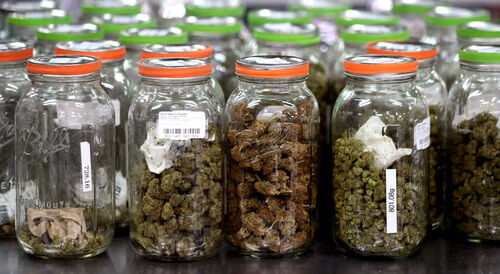

The room inside the Arizona Department of Health Services Offices in Phoenix was filled Friday with department dignitaries, media and representatives of applicants seeking one of 26 “social equity” licenses needed to operate a recreational marijuana dispensary in the state.
There was no bingo wheel, no cage spinning full of of ping pong balls or applications. Instead, a computer processed nearly 1,300 application numbers and selected the 26 winners within a few moments. Online, hundreds of candidates for Arizona’s Social Equity Dispensary Program waited anxiously to see who was lucky enough to win one of lucrative 26 issued licenses.
Though the name and number on the application of the winners is now known, who the individuals or companies are behind the applications was not immediately known.
Most of the applicants that were selected were listed as Limited Liability Companies registered in the Phoenix area. Three winning applicants had Pima County addresses on their LLC filings with the Arizona Corporation Commission: Higher Than High I, Joint Junkies I, and Juicy Joint I. (See box for names of those selected)
The story behind how the state’s social equity program came to be is complicated. Where it goes from here is anyone’s guess, but the exclusive recreational nature of the licenses and zoning decisions by cities like Tucson could shape the cannabis market for years to come.
How Social Equity came to be
Social equity licenses were passed as part of Prop. 207 in 2020 which legalized adult-use recreational marijuana usage. According to the statute, they are to be issued to “people from communities disproportionately impacted by the enforcement of previous marijuana laws.”
However, due to the exclusively recreational nature of the licenses and special zoning exceptions that could run the clock out on licensees’ time to open retail locations, new licensees might be entering the toughest portion yet in what has been an onerous and expensive process.
That could mean some winners are forced to forfeit their licenses (even though they could also transfer, or essentially sell, the license for a potential profit of $10 to $20 million). And some cities, like Tucson, could become unattractive to potential operators.
The first issue for social equity licensees is that the new licenses are only for recreational adult-use and don’t include an accompanying medical dispensary license.
That becomes important to cities, like Tucson and Flagstaff, who decided to proactively put a moratorium on exclusively recreational dispensaries after the passage of Prop. 207.
While Prop. 207 allowed for already established medical dispensaries to apply for dual-licenses and, after a 60-day process, begin selling to recreational customers and medical patients alike, it made no such provision to allow social equity licensees to apply for an accompanying medical license.
Sam Richard, executive director of the Arizona Dispensary Association — one of the main entities responsible for crafting Prop. 207 along with the state health department — explained the reason for the new licenses being exclusively recreational.
“Prop. 207 didn’t amend the Arizona Medical Marijuana act at all, so the reason why the currently established medical licenses can be kind of co-located is because they already existed,” he said. “The only new licenses Prop. 207 created were adult-use, recreational licenses.”
Both Richard and Jon Udell, the director of politics for the Arizona branch of the marijuana advocacy group NORML, noted that there are potential legislative fixes for this seeming discrepancy.
But Udell pointed out that a bill that included language to help fix the problem had been dead for some time.
“Right now there just isn’t really a realistic path forward,” for any comprehensive fix, he said.
New zoning
An even more recent move last week Tucson’s City Council to subject potential social equity licensees to a special exception zoning process could be a game changer for both the city and state, according to Berekk Blackwell, COO of Zoned Properties, a real estate services company that specializes in the cannabis industry.
“The news out of Tucson, or I guess the rhetoric that was used, was very surprising,” Blackwell said. “I think it was a really, really strong statement and it’s going to be really interesting to see if any of the other localities in the state of Arizona follow suit.”
Blackwell was referring to a unanimous decision during the last Tucson City Council meeting, where the council moved to create a special exception zoning process for social equity licensees. The zoning process will take six months to complete and will go before mayor and council for approval.
That move is not good in Blackwell’s eyes, or the eyes of some potential social equity dispensary operators. First, as stipulated by Prop. 207, social equity licensees must have the retail portion of their operation up and running within 18 months. That clock started April 8.
“If you aren’t able to start that process for another six months, you might be in a situation where you actually can’t look at Tucson as an option anymore,” he said.
That 18-month window was written into the law to ensure new retail dispensary locations opened and to prevent licensees from sitting on the license, something that happened when medical licenses were first issues nearly a decade ago, according to Richard.
One social equity applicant, Ariana Munoz — who between herself and her mother had four applications in the pool of nearly 1,300 — solidified Blackwell’s point about Tucson’s new zoning rule.
“Due to the zoning specifically in the city of Tucson, unless they do an emergency hearing to rush the process, I probably will not look into that city because I wouldn’t get anything really going for six months,” Munoz said.
Although Munoz did not win one of the coveted 26 licenses, she said she believes others like her will look at Tucson the same way due to the special exception process.
This six-month special exception process can’t be rushed, according to Tucson Councilman Steve Kozachik, not necessarily because of any state law or statute, but because of precedence.
“If we ease it up for one, then we’re pretty much on the hook to ease it up for everybody who participates in that process,” he said. “I don’t think we can cherry pick the equity licenses and say, ‘You get a streamlined path through the special exception process. If we do that for them, then TEP is going to ask for the same thing.”
Kozachik insisted the special exception process wouldn’t restrict potential dispensary operators and will in fact open up more appropriate and “better” spaces for dispensaries to locate. He also said he believed that even with a six-month wait, the potential market share in Tucson would be too great a pull for operators to resist.
“I don’t think it’s as onerous as people are making it out to be,” he said, adding that he believes large dispensary conglomerates, or MSOs (short for multi-state operators) are the driving force behind many social equity licensees.
“So tacking on another, you know, pick your period of time — three months or whatever — it’s not going to break their bank.”
Differences in philosophy
According to Demitri Downing, CEO and founder of the Marijuana Industry Trade Association, Kozachik’s understanding of who applied for social equity licenses is incomplete.
Downing called the idea of social equity programs “nebulous,” and countered Kozachik’s argument that only those with money applied.
“Half of the applicants are normal people who scratched together $4,000 and are hoping to win the lottery,” he said. “The other half are normal people who own 51% of enterprises that were paid for by existing dispensary, MSOs, intelligent people, investors, but they’re still half owned by them.”
While a significant number of applicants were either backed financially or in some other way by already established dispensary operators or other big cannabis corporations, Downing believes that now that the state has issued the licenses, it’s up to cities and other jurisdictions to decide on time, place and manner of where a social equity dispensary can go.
He sees Tucson’s special exception zoning as not just a bad idea, but one that could be disastrous for future potential dispensary operators and consumers. And he doesn’t think the city should be in the game of deciding just who is truly benefiting off social equity licenses.
“It’s just wrong,” he said. “First of all, it’s none of the city of Tucson’s business, it’s the state’s business to decide eligibility. Tucson’s there to regulate time, place and manner. But they’re confused.”
For his part, Kozachik said he sees the special exception zoning process as a way to open up more areas of eligible real estate within the city for dispensaries to operate.
He also disagreed with Downing, asserting the mayor and council do play a role when it comes to social equity licenses.
“Is it the city’s role by statute? No. But but nothing prevents us from seeing holes in the statute, the state statute, and pointing to them and indicating to the state government that you’re not achieving the goals that the voters voted for,” he said.

