



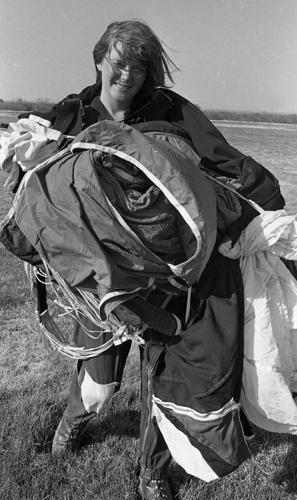

The Morgue Lady has long thought anyone who straps on a parachute and jumps out of a perfectly functioning plane might not be perfectly functioning themselves.
However, she appreciates that other feel differently, and as long as they aren't pushing unwilling victims out of the plane, to each his ─ or her ─ own.
in 1968, a Star reporter talked to several women who enjoyed parachuting and were taking part in the U.S. National Parachuting Championships at Marana Air Park.
From the Arizona Daily Star, July 4, 1968:
Women Parachutists Fall Out For Competition
By VIRGINIA LEE HODGE
Star Women's Editor
One's a computer programmer, another a medical research technician. There are a couple of teachers, a secretary, a telephone operator. But they all have one thing in common: on weekends, holidays and vacations they go up and jump out of airplanes.
They're all girls, average age 24, here for the U. S. National Parachuting Championships this week at Marana Air Park. Five of the 21 will make up the women's half of the U. S. Parachute Team for world competition in Austria this August.
Martha Huddleston, a medical research technician from Dallas, has been jumping for seven years and averages 300 jumps a year. "But I've made about 200 jumps in the past two months," she said. Why? To get better than the Russians. "The Russians are devastating in accuracy," she added.
In accuracy competition, the parachutist comes out of the plane at an altitude of about 2400 feet, and aims at a 4-inch disc set in a circle of gravel. ("It was a 6-inch disc last year," Martha noted.) You score by what hits first ─ heel, toe or seat of the pants.
The other part of competition is style ─ starting at 6600 feet up, the chutist does a series of turns and tumbles before opening the parachute and drifting to the ground.
"Susie is a natural at style," Martha said, nodding toward Susan Joerns, a thin (100 pounds) girl from Houston who works as a computer programmer. "There's only one man in the country who beat her last year. If she'd train as hard as some people, she'd probably be the best in the world," Martha bragged on Susan's behalf, "but for her, practice is a bore." Susan has logged more than 600 jumps in her seven years at the sport.
For some of the girls, jumping is a togetherness thing. Their husbands are in it too.
Donna Conners from Denver met her husband while jumping. She pointed out that one of the side benefits of the sport is pictures: "He loves to take pictures and I just love to pose." All this while falling through the sky.
Barbara Roquemore from Santa Monica started jumping with her husband after their sixth wedding anniversary. They tumbled out of the plane together on that first jump and Barbara knew right away that she was cut out for competitive jumping ─ alone. Her husband goes in for relative work, that is, jumping with a group and doing tricks and formations together before opening the chutes. (Today at Marana Air Park, a team of relative workers will attempt a 15-man star formation from 15,000 feet up, during the morning events.)
"It takes different personalities to do relative and competitive jumping," Barbara says. She likes the discipline of competitive work, yet she enjoys the aloneness, the freedom ─ you have just yourself to work with. It's more challenging, she thinks. "That's why we do things like quitting our jobs and working at it." Every year Barbara quits her job as a telephone operator. Then every year she begs it back.
Fun jumping is the third way to parachute ─ "That's jumping just for the heck of it," Annie Zurcher from Portland, Ore., explained. Lots of competitive jumpers and relative workers start out that way then get caught up in the urge to do something more definite.
The best way to learn any kind of jumping, the girls agreed, is simply to jump. That and swapping jump stories at the end of the day, are the best ways to pick up skills. Since it's a fairly new sport, there aren't many texts on the subject.
Laura MacKenzie from Fairfield, Conn., enthusiastically endorses fun jumping and relative work. Unlike Barbara, Laura likes company. "If just two of you come out of the plane, that's all you need. You can do cross, passes and tumbles drift apart then come back together," she said. "And what girl doesn't like a kiss pass?" she added with a shrug.
Laura thinks that the West Coast has it all over the East for jumping. In the east it's harder to keep at it because of the weather. Martha Huddleston doesn't let weather interfere ─ she's jumped into snow at Dallas.
Out at Marana, watching parachutists drift down out of the sky, it's easy to see why these girls are so gung ho about the sport.
The view from the ground is one thing, but the view from the top, when someone falls out of the plane ahead of you, is supposed to be the really unbeatable vantage point.
We'll just take their word for it.

