


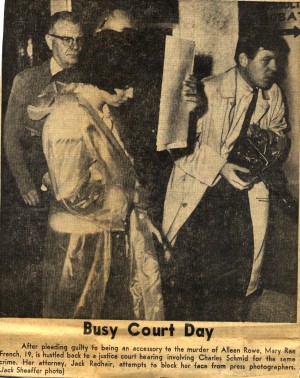
After pleading guilty to being an accessory to the murder of Alleen Rowe, Mary Rae French, 19, is hustled back to a Justice Court hearing involving Charles Schmid for the same crime. Her attorney, Jack Redhair, attempts to block her face from press photographers.
The Schmid case was sensational enough to put Tucson in the public eye. Time magazine did an article on the case, which was summarized in the Arizona Daily Star on Nov. 24, 1965.
Time Gives Full Treatment To Schmid Case
Magazine Tells Of 'Image Building'
Charles H. Schmid, facing charges of murder in the deaths of three Tucson teenaged girls, is described in this week's Time magazine as a swinger who "always had wheels, money, tall tales and an inexhaustible supply of available girls' phone numbers."
The news magazine article also said Schmid went to bizarre lengths to build his image.
"He added 3 in. to his meager (5 ft. 3 in.) frame by stuffing rags and folded tin cans into his black leather boots. He dyed his hair raven black, wore pancake makeup, pale cream lipstick and mascara," the magazine said.
Time also reported that Schmid's supply of cash was from a generous weekly dole from his mother. "Schmid bragged to the boys," the story said, "that it (the money) came from smuggling cars into Mexico, to the girls that it came from women whom he taught '100 ways to make love.'"
Schmid landed in jail after Richard Bruns, 19, turned informer and told police Schmid had taken him into the desert and shown him the bodies of Gretchen and Wendy Fritz and boasted he had killed them.
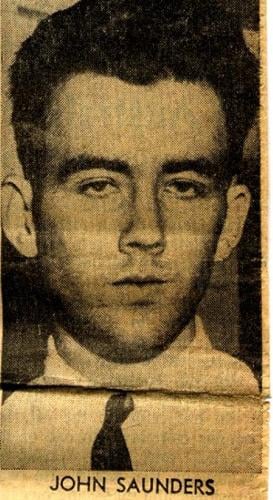
Bruns also told police that Schmid had shown him a grave in another desert location in June of 1964, shortly after Alleen Rowe, 15, disappeared from her home. Acting on the Bruns story, police also rounded up John Saunders, 19, and Mary Rae French, also 19.
Time says that according to their statements, Schmid, who was dating Mary French, and Saunders were at Mary's house the night of May 31, 1964, when Schmid idly wondered if they could kill someone and get away with it. He suggested Alleen, a bright pretty student who had once stood Saunders up for a date; the others agreed.
Mary French, the Time story says, persuaded the girl to go for a drive with them. She was taken about five miles into the desert, where Schmid and Saunders walked her down to a dry stream bed and hit her on the head with rocks until she died.
Time also hints at a curtain of silent conspiracy. It said:
"Almost as fantastic as the murders themselves was the disclosure that at least 30 teenagers, all friends of Schmid's, had apparently heard him brag about the crimes — and said nothing. Confided one 16-year-old coed at Tucson's Palo Verde High School: 'A lot of people knew, but it was already too late. Telling would just have made it tough on everyone.'"
The next day, the Star ran the news that John Saunders and Mary French pleaded guilty for their parts in the crimes.
From the Star, Nov. 25, 1965:
Suddenly and unexpectedly, two teenagers yesterday admitted their guilt in the slaying of 15-year-old Alleen Rowe.
John Robert Saunders, 19, pleaded guilty to first-degree murder charges and Mary Rae French, 19, pleaded guilty to two lesser charges in connection with the murder of Miss Rowe.
Saunders entered the plea before Judge Collins, Miss French appeared before Judge Robert O. Roylston. They will be sentenced Dec. 20.
County Atty. Norman E. Green told both judges that Miss French and Saunders had agreed to testify for the state at the preliminary hearing and trial for Charles Howard Schmid Jr., 23, who is charged with murder in the death of Miss Rowe.
"They wish to speak the full truth for the state in the Schmid case and will also be witnesses in the Fritz case. I hope you will take this into consideration," said Green.
Green dropped the bombshell during a preliminary hearing in Justice Court in which Schmid, of E. Adams St., is charged with murder stemming from the deaths of Gretchen Fritz, 17, and Wendy Fritz, 13.
Saunders and the French girl were brought to the courtroom with their attorneys, W. Edward Morgan and Jack Redhair, about 2:30 p.m.
Green then read amended criminal complaints charging Saunders with first-degree murder and Miss French with being an accessory to murder and compounding and concealing the crime of murder.
In behalf of their clients, Morgan and Redhair then waived a preliminary hearing in Justice Court and the two were taken immediately to Superior Court where they entered pleas of guilty.
Morgan and Redhair stipulated to a statement by Green that Saunders and Miss French will testify against Schmid in the Rowe case as well as in connection with the death of the Fritz sisters.
Schmid's attorney, William Tinney reacted to Green's surprise by saying:
"It's obvious that somebody made a deal. This has been going on since Nov. 10." Tinney's reference to Nov. 10 was the day when the skeletons of the Fritz girls were found in the desert area north of the city. Schmid was charged with two counts of murder the same day.
Green refused to comment further on the reasons for the amended complaints against Saunders and Miss French and the sudden decision that the pair would plead guilty on the Rowe case and testify against Schmid for the state.
He did say that Saunders could get "life or death" for first-degree murder and said Miss French could be sentenced to up to five years in prison on each of the two counts with which she is charged.
Although the county attorney would not say so, it was apparent that the key reason for the sudden action is to give the prosecution more teeth in the case against Schmid in the Rowe case.
The Morgue Lady is surprised that it was considered so unexpected that Saunders and French should plead guilty. Many of the details reported so far had come from French. Wouldn't it have been hard for her to tell such a story and then claim complete innocence?
It is important to note that under Arizona law at that time, if Saunders was sentenced to life, he could be eligible for parole in about seven or eight years, according to the Star article. Second-degree murder carried a minimum sentence of 10 years.
Saunders' attorney figured he would fare better with the guilty plea for first-degree murder because he could get out earlier. The attorney probably thought it unlikely he would be sentenced to death since he agreed to testify against Schmid.
Next: A surprise witness, and complaints about muzzling the press.

