


If you work Downtown, you have it all set up. You know where to park because your building has a lot, you rent a space or have an account at a parking garage. Maybe you take the bus or streetcar.
If you don't work Downtown and suddenly have an appointment, one of the questions you may ask is, "Where's the best place to park?" Let's just say it'll cost you.
Fifty years ago, parking was an issue as well. It has probably been an issue as long as there have been cars in Tucson. One might wonder if tickets were given to horse-drawn buggies found double-parked back in the day.
From the Arizona Daily Star, Sunday, Oct. 13, 1968:
Parking Comedy Enacted Daily By Tucsonans
By KEN BURTON
Parking in downtown is a paradox of comedy and frustration.
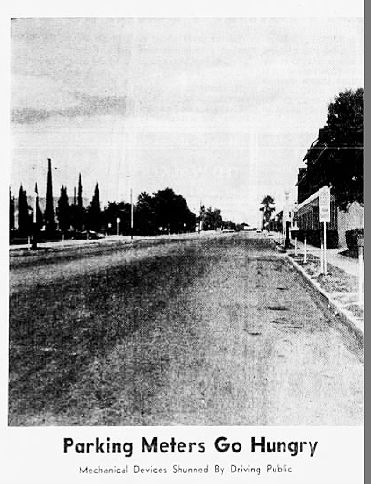
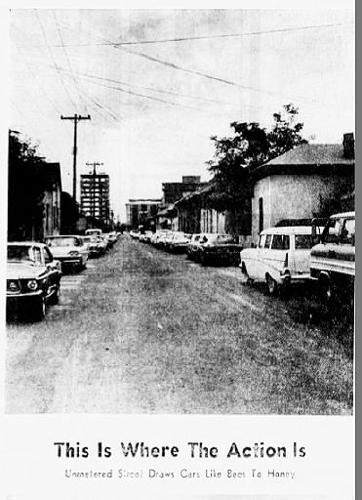
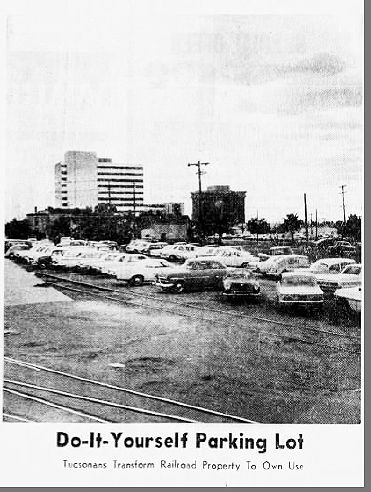
The comedy is in rows of empty parking meters, in "wildcat" parking lots and in bumper-to-bumper parking on streets without meters.
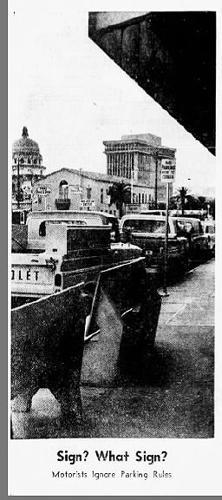
The frustration is in watching government vehicles park next to a "No Parking" sign without being ticketed, or driving by a row of civilian cars all illegally parked and all without a yellow ticket tucked under their windshield wiper.
One Wednesday, beginning at 1:30 p.m., an Arizona Daily Star photographer snapped the random photographs published on this page.
Among the conclusions that may be drawn from this sampling are:
1. If there is no parking lot there, Tucsonans will make one.
2. Motorists prefer to park close to where they work ─ at all costs.
3. Parking meters are not popular.
Near the intersection of 9th Ave. and Franklin St., a triangular piece of railroad property is now a parking lot. The owners have not planned it that way. There are no signs, no fences and, best of all, no fees.
In front of the Justice Courts building at 112 E. Pennington St., two Pima County vehicles and a private car were parked comfortably under two signs: "Loading Zone. Sheriff Only." and "No Parking Any Time." The county cars were not from the Sheriff's Office. None of the three bore tickets.
More than two blocks off Court Ave., an old and narrow side street not far from City Hall, was jammed bumper-to-bumper with cars and trucks.
And yet on E. 13th St., only a stone's throw from the heart of town, two full blocks ─ lined with parking meters ─ stood empty at mid-day.
Other areas not far from the downtown business district ─ many studded with "No Parking" signs of one variation or another, draw automobiles like a free lot.
Capt. Clarence Dupnik, acting chief of police in the absence of Chief Bernard L. Garmire, acknowledged that the parking situation is not as good as he would like it to be.
He said that the department would like to ticket all violators, but a manpower shortage prevents them from doing so. "We enforce as many as we can," said Dupnik, adding: "It's getting to be quite a bad situation."
One motorist said he didn't care a lot about parking tickets. He said a space in a private lot downtown cost $40 a year, so if he were ticketed 39 times in a two-hour parking zone, "I'd still be ahead."
The logic is shaky, but it illustrates the thinking of the motorist.
And the game goes on.

