

After a two-day trial, a Pima County judge cleared a dozen defendants of most charges stemming from a 2013 protest where they stopped two buses carrying border crossers heading to federal court.
“The charges that we are facing right now really are quite insignificant in the broader story of what happened on Oct. 11 and how we came to be charged,” Sarah Launius, an immigrant-rights activist and one of the defendants, said later.
“For us to not simply accept a plea, but to come into court with the opportunity to be able to share some of the experiences we have had with friends, family members, neighbors who have been put through Operation Streamline, was important,” she said.
Operation Streamline is a mass prosecution program for immigration defendants.
Each defendant faced between four and seven misdemeanor charges. Another defendant took a plea and one other person rescheduled.
Pima County Justice Court Judge Susan Bacal dismissed four charges: disorderly conduct, hindering prosecution, obstruction of government operations and criminal trespassing.
She found the defendants not guilty of resisting arrest and will decide by April 13 on the obstructing a highway and public nuisance charges.
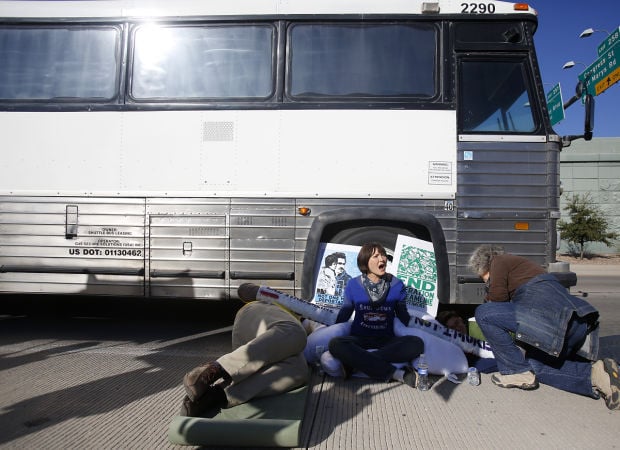
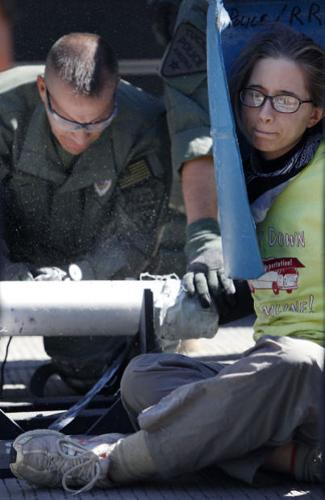
On Oct. 11, 2013, about 20 activists were arrested after they linked themselves together with plastic piping to block the federal courthouse parking lot and stopped two buses with 61 detainees headed to federal court to be criminally prosecuted as a group for immigration offenses.
Last year, six of those who blocked the driveway to the federal courthouse were found guilty. They were charged with disorderly conduct on federal property and failure to follow the direction of a federal police officer. They are appealing.
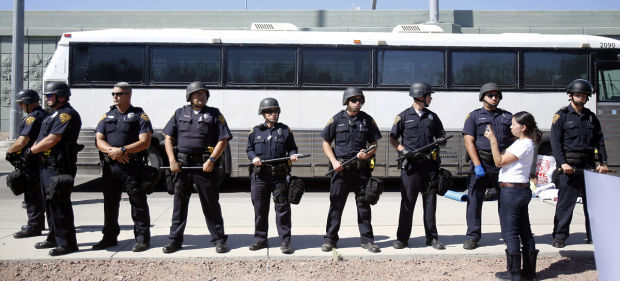
In this week’s trial, the state brought in 10 witnesses, including Tucson Police Department officers and the two bus drivers, to describe the scene that morning on the frontage road near downtown: Two buses with people chaining themselves to the tires, protesters chanting around them and a road blocked for several hours.
In closing, Rebecca Mueller, deputy Pima County attorney, said even though the protesters’ actions had only blocked one lane, TPD had to block the entire road to ensure everyone’s safety.
Police had also repeatedly asked them to clear the scene, she said, and they didn’t.
Their behavior turned a 20-minute drive from the Border Patrol station on Golf Links at Swan to the federal courthouse into a five-hour ordeal, she said.
“Everyone has a right to protest,” Mueller said in closing, “but it has to be in a lawful manner.”
What happened that day, said Margo Cowan, the defendants’ attorney, is about something much greater than an inconvenience.
“Our obligation as Americans is to hold our government accountable,” she said.
Paula McPheeters, one of the defendants and a retired public school teacher, said for her it was a responsibility.
Through her 25 years as a teacher she always asked herself how she could advance justice in her community, she said.
“I’ve realized I’m never neutral,” she said. “I’m either, through inaction, siding with the powerful, or through inaction, siding with the powerless.”

