

EWA BEACH, Hawaii — Brian Keaulana is the quintessential Native Hawaiian waterman, well-known in Hawaii and beyond for his deep understanding of the ocean, gifted with surfing and lifeguarding skills passed down from his big-wave rider father.
Now, as one of the islands’ standard-bearers of surfing, Keaulana wants to further boost the sport in his homeland by building an artificial wave pool just down the road from the beach — a spot where competitive surfers could always be guaranteed the perfect breaks that are sometimes elusive in nature.
The bold proposal has made waves in Hawaii, particularly among some Native Hawaiians, and raised questions about how a modern-day sport followed by millions worldwide fits into the cultural legacy of islanders who have been riding waves for millennia.

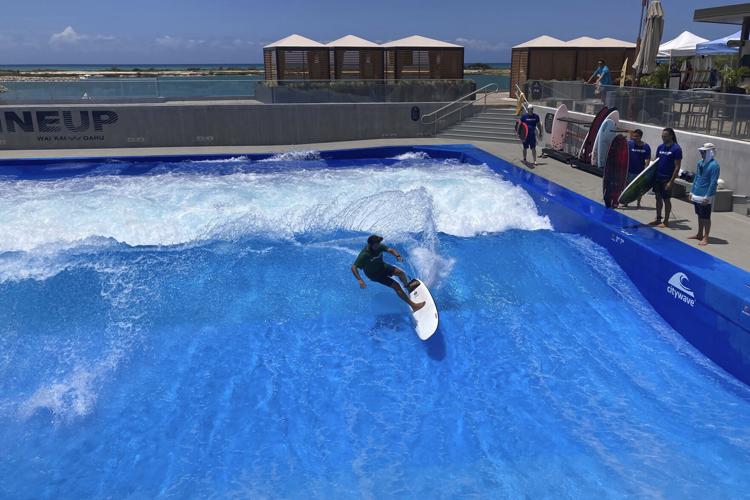
Ikaika Kaulukukui surfs in a wave pool May 9 in Ewa Beach, Hawaii.
The project has landed in court and reflects the unease some Native Hawaiians feel about the commercialization of what long has been a cultural touchstone.
“They’re profiting off a cultural practice by controlling it by making these wave pools, which are going to destroy the actual beach that is nearby,” said Healani Sonoda-Pale, a plaintiff in a civil case seeking to stop the wave pool. “I cannot speak for other Hawaiians. All I can I say is as a Hawaiian … it goes against my culture.”
Surfer and writer Mindy Pennybacker said the controversy highlights a struggle over how to balance tradition with a booming sport.
In researching her book, “Surfing Sisterhood Hawai’i: Women Reclaiming the Waves,” she learned of creative ways Hawaiians compensated when there was no surf, including finding standing river waves or sledding down hillsides.
She also sees how wave pools help athletes improve, noting a World Surf League championship tour competition over Memorial Day weekend at a California wave pool developed by pro surfer Kelly Slater.

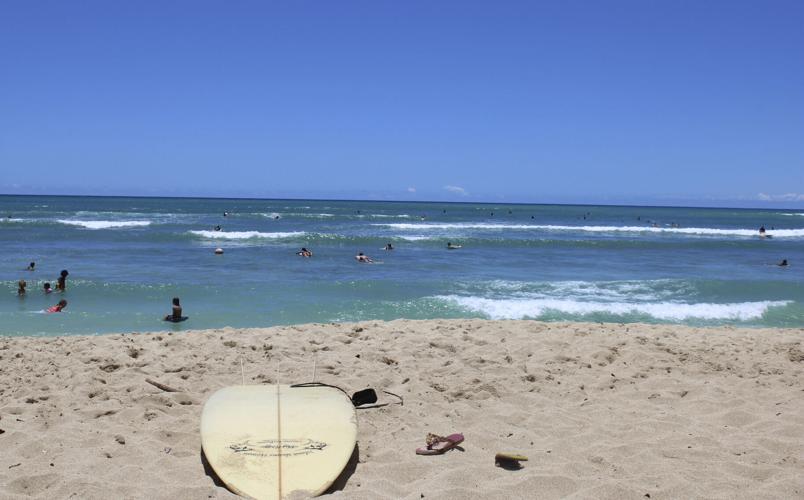
A surfboard lies on the sand May 12 on the sand at a beach known as White Plains in Ewa Beach, Hawaii.
“The beauty of surfing, and the frustration of surfing at the recreational and competitive level, remains the unpredictability and how surfers have to have the reflexes to deal with changing conditions,” she said.
The lawsuit — filed in state environmental court by a group of Hawaiians and residents near the proposed site — alleges the 7 million-gallon artificial pool would damage nearshore limu, or seaweed, and desecrate iwi kupuna, or ancient Hawaiian remains.
Bidding to halt the project, the lawsuit challenges the Hawaii Community Development Authority’s approval and finding that it will have no significant environmental impacts.
The development authority and the state attorney general’s office declined to comment on the lawsuit, which seeks a new environmental review. A hearing is set for July and it’s not clear when a judge might rule.
Sonoda-Pale pointed out that the artificial lagoon would be 2 miles from a beach called White Plains, long a popular surf spot.
A wave pool recently opened nearby and opponents say another one is unnecessary and a waste of water. But Keaulana remains committed, noting ocean conditions aren’t always ideal for learning how to surf or save lives.

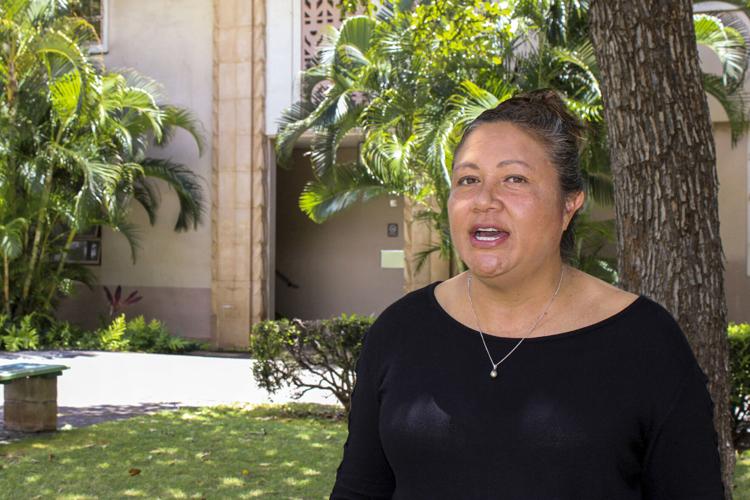
Healani Sonoda-Pale discusses her opposition to plans for another surf park May 8 in Honolulu.
One recent afternoon, no one was surfing at Makaha beach in west Oahu, where Keaulana grew up. Conditions were too calm despite Makaha’s world-famous reputation for its ferocious shore break.
“The ocean is the greatest treasure that we have,” he said, but “it can be flat. It can be big. It can be dirty. It can have, you know, sharks here and there.”
He worries Hawaii’s Olympic surfing hopefuls are at a disadvantage to competitors who can easily train at one of several surf parks worldwide. A wave pool allows for more time on a surfboard in an hour than most surfers get in the ocean in a week, he said.
“You see these surfers going to these surf parks and catching wave after wave and they are honing their skills and then they go into the ocean when there’s a swell,” he said. “Boom. They’re already primed and ready.”

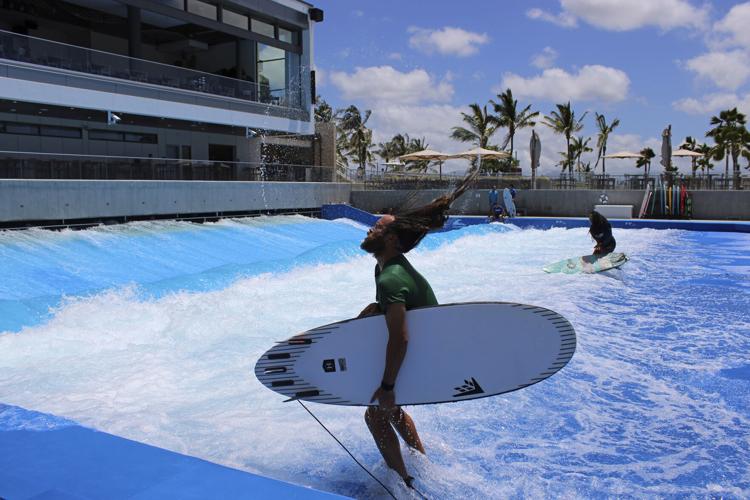
Ikaika Kaulukukui flips his hair after emerging from surfing at a wave pool May 9 in Ewa Beach, Hawaii.
Using the latest technology, the facility would simulate ideal conditions needed to keep top surfers competitive and serve as a “life-saving lab” for teaching safety skills in a controlled setting, he said.
Keaulana said he’s hopeful differences can be worked out with hooponopono, a traditional, culture-based form of mediation. Project opponents say they are open to such a meeting.
“I’m more disappointed in myself. I felt — and we felt — that we’ve pretty much tried to do everything possible,” Keaulana said of concerns about the project. “I just feel to be Hawaiian is to meet up and work your differences and problems out.”
Rare red sprites captured over Hawaii, and more of today's top videos
A camera perched atop Mauna Kea in Hawaii captured a rare sighting of red sprites hovering above a distant thunderstorm, watch as a dog is rescued from earthquake rubble in Turkey, and more of today's top videos.

Rescuers in Turkey saved the life of a dog that was trapped underneath rubbles after the deadly quakes that struck Turkey and Syria. Veuer’s M…

Amid the efforts to rescue any remaining survivors, communities in Turkey and Syria hit by Monday's earthquakes are also dealing with the chal…

It wasn’t just Kim Jong Un’s nuclear missiles on display that caught the world’s attention, it was his daughter.

Drug-sniffing squirrels are the new addition to a police brigade in the southwestern Chinese city of Chongqing. Veuer’s Chloe Hurst has the story!

The Chinese balloon shot down off the South Carolina coast was part of a large surveillance program that China has been conducting for “severa…

Engineers at the University of Colorado at Boulder have developed a helpful new stick for people who are blind or visually impaired - one that…

The first UN aid convoy has made its way through the only open humanitarian corridor to reach Syria's rebel-held northwest, bringing much-need…

With incessant fighting in the city of Bakhmut in eastern Ukraine still ongoing, exhausted Ukrainian soldiers have turned to taking refuge in …

