




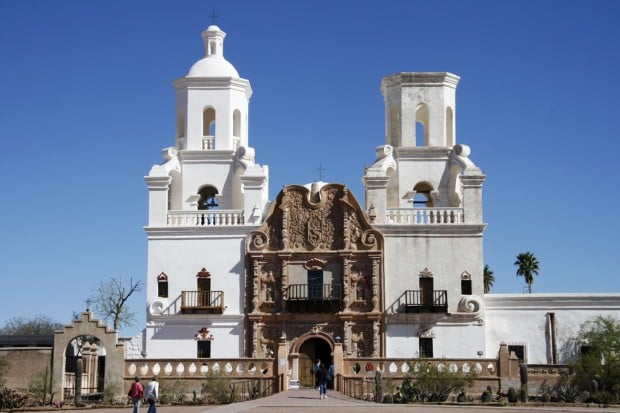
It’s a surprise that San Xavier Mission is here at all. After all, why build a church this elaborate in a small village at the north end of nowhere? No other mission in Southern Arizona or northern Sonora is this highly decorated, this expensive, this lovely.
A part of the answer may lie in its very location on the edge of the Spanish Empire. A contemporary document states that San Xavier was built as a beacon of faith to attract the yet-unconverted nations to the north and east. But no permanent missions were started to the north, and the church remains as a unique monument.
That it remains is due to the efforts of a lot of people over two centuries. In the early 1800s, the departing Franciscans left the church in the care of the O'odham villagers. It is due to their vigilance that we have inherited a complete church. During the 1850s, San Xavier with its permanent water source was a resting and refitting stop on the southern route to California. If anyone wanted to get into the church, they had to get the key from the appropriate villager. And that is probably the reason why none of the statues made the long walk to California.
Beginning around 1900, a series of stabilization and building projects began on San Xavier, The great gateway to the north of the church was built, the Lourdes Grotto on Grotto Hill was constructed, and much of the church was re-plastered, reinforced, and repainted. Much of this latter work, done with the best intentions and most modern materials available at the time, has had to be redone. For instance, much of the roof and the domes were covered with a thick layer of cement – which added unnecessary weight and served to trap moisture inside the walls and ceiling.
Then in the 1990s all the high-tech materials were removed from the exterior, damaged bricks were replaced, and the whole building was covered with lime plaster with prickly pear juice added as a water repellent. Low-tech solutions for a low-tech building.
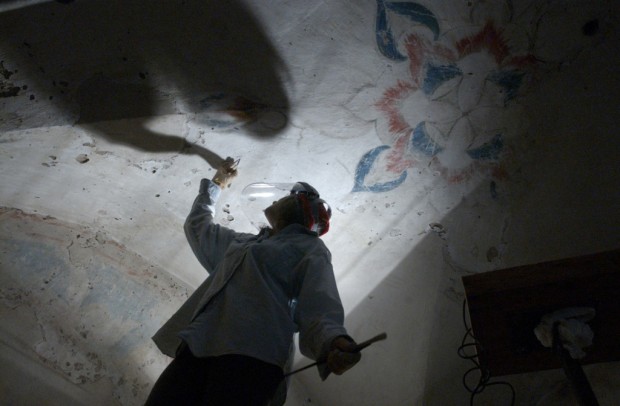
The entire interior was painstakingly cleaned for the first time since 1797. How do you clean a dirty 200-year-old mural? Sounds simple. You hold a piece of rice paper over the bit you're working on, and pat the paper with a damp sponge. The dirt goes into solution and rises to the surface, and when you remove the paper, the dirt comes off.
Of course, it helps to know what you are doing, and this job was tackled by an international team of experts, some of whom were on the advisory committee for the work on the Sistine Chapel.
NEXT: FAQs and Legends about San Xavier.
References:
Fontana, Bernard L. "Biography of a Desert Church, the Story of Mission San Xavier del Bac." In The Smoke Signal, No. 3, Tucson: Tucson Corral of Westerners, 1961.
Fontana, Bernard L., "A Gift of Angels: The Art of Mission San Xavier." Tucson: the University of Arizona Press, 2010.

