



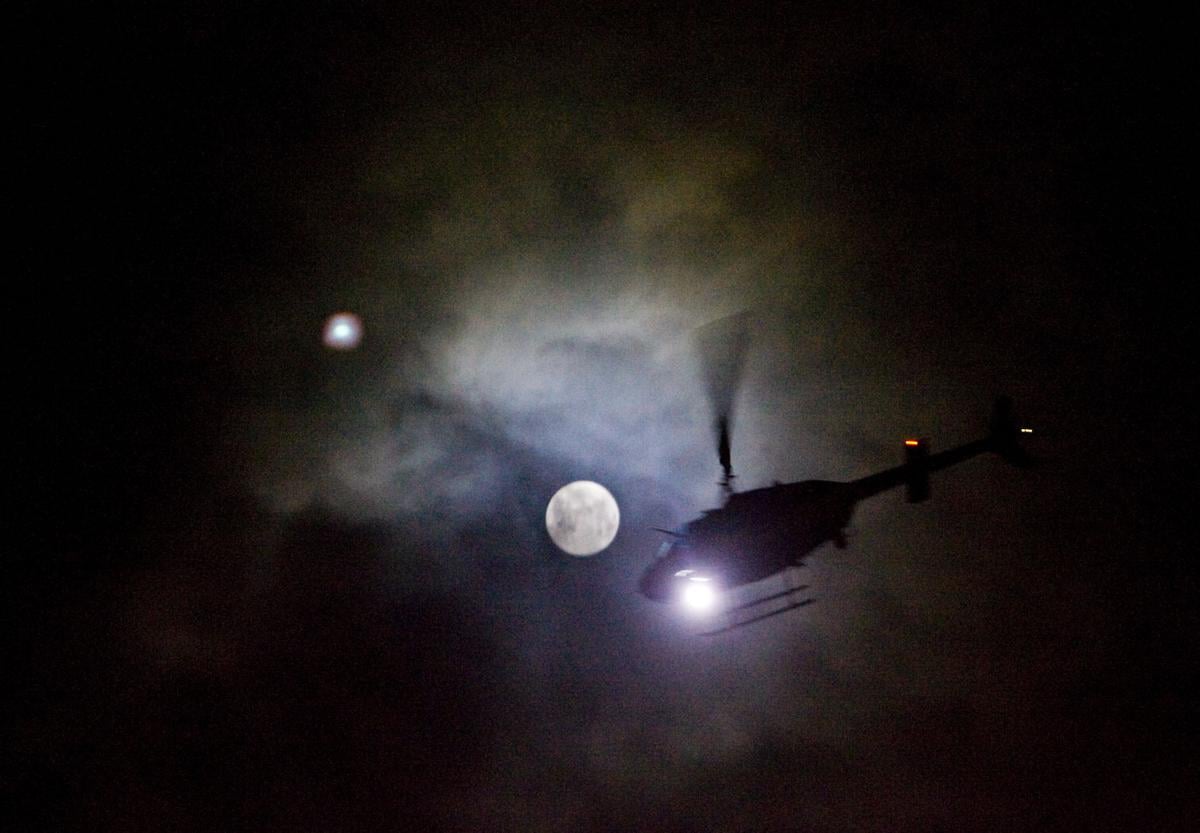
The Tucson Police Department wants its helicopters and aircraft back in flight by the end of the week, despite grounding them 12 days ago after an outside audit found their operation to be a high safety risk.
The auditors found in November that disagreements between the pilots and mechanics over “perceived maintenance safety issues” had escalated to a level of hostility and “toxic operational culture.”
As a result, in one of his final acts before retiring, Tucson Police Chief Roberto Villaseñor took the three helicopters and one fixed-wing aircraft temporarily out of service on Dec. 23. He emailed a memo on Christmas Eve to police, employees, a city attorney and City Manager Michael Ortega announcing the grounding.
Villaseñor did not, however, let Pima County Sheriff Chris Nanos know that his department would need to provide air support during any emergencies in the interim.
Assistant Police Chief Mark Timpf says the issues with the TPD air support unit are about policy language, not operational safety.
“Nothing was being operated in an unsafe manner. We have an impeccable safety record. But because of the risk that the audit found, we elected to pause things,” Timpf said Thursday.
“We have 30 days from the grounding to get the unit operational again, and we’re running ahead of schedule,” Timpf said. “I’m cautiously optimistic that it’ll all be done by the end of (this) week.”
City Councilman Steve Kozachik has serious concerns about the audit, as well as Villaseñor’s decision to ground all air support.
“This is an extremely important unit to the safety of the public and the officers on the ground,” Kozachik said. “If it’s just a deficiency in policy language, it shouldn’t take three weeks to update and it shouldn’t have resulted in the grounding of the unit.”
“I don’t buy that it’s just a matter of fixing policy language,” he added.
58 percent compliance
Earlier in 2015, complaints from air support employees about the unit’s operation and policies were brought to the police chief’s attention, leading the department to ask for an external audit by the Airborne Law Enforcement Association, Villaseñor wrote in the email.
“The result of this audit determined that there were numerous policy and practice issues that needed to be addressed,” Villaseñor wrote.
The audit, which was obtained Thursday by the Star after a public-records request, determined that TPD’s air support unit was at high risk, logging only 58 percent compliance with the Airborne Law Enforcement Association’s safety standards.
The audit addressed five areas: administration, operational, safety, training and maintenance.
Consistent with the complaints made to Villaseñor, the audit revealed serious problems with communication in the Tucson police unit.
“Sworn unit members are often at odds with each other and have formed what was described to me during interviews as a ‘clique’ among themselves,” the auditor wrote. “More recently, differences between some of the pilots and the maintenance staff over perceived maintenance safety issues have escalated to a level of hostility as reported by several unit members during interviews.”
The auditor concluded that the police department needed to take any necessary steps “to neutralize what is perceived by an outsider as a toxic operational culture within the unit that goes beyond simple personality conflicts between individuals.”
The report added that the current culture “seems to center around a few pilots within the unit who are attempting to draw a line in the sand based on ‘who’s right’ rather than ‘what’s right.’”
The auditor said that resolving the differences between the aircrews and mechanics could require police to use an independent mediator, to allow each group to air concerns and attempt to reach a middle ground.
“The situation that currently exists between parties constitutes what could be considered a hostile work environment for both sides,” the report said.
The audit also found that the six pilots assigned to the unit each flew an average of 23 hours a month, which is a relatively low number of flying hours compared to other units of similar size.
“Perhaps aircrews could find more productive use of their duty time during day shift,” the auditor wrote, suggesting that management consider staffing a proactive day patrol, as opposed to emergency response-only.
Most of the other areas where TPD’s air support unit was faulted dealt with language in the policy manual that wasn’t consistent with the language used in the Airborne Law Enforcement Association’s.
“The majority of our compliance issues weren’t with practical issues; in fact, we met or exceeded most of those,” said Timpf.
A total of 27 national and international law enforcement agencies have been assessed over the past four years, with an average compliance of 80 percent, putting TPD’s unit — with its score of 58 percent — in the lower quadrant, the audit said. Nine of the agencies scored between 90 and 100 percent.
“JOB ONE” FOR NEW CHIEF
In his email, Villaseñor said that while the unit was grounded, the Pima County Sheriff’s Department would provide air coverage during high-risk situations.
However, Sheriff Nanos wasn’t made aware of the grounding, or that his department would be providing coverage, prior to the memo’s release.
Nanos didn’t receive the memo; he learned about the decision when a member of his department asked him if they’d be covering TPD’s regular patrols, or only in emergencies.
A week after the memo went out, Villaseñor called Nanos to apologize for not talking to him.
“He thought I already knew when he sent it,” Nanos said. “He never intended for us to do their patrols, just respond to emergencies.”
Kozachik expressed serious concerns that the Sheriff’s Department wasn’t informed of the grounding or its responsibility to provide aerial coverage.
“If the policy issues don’t represent a safety risk, as the department says, grounding the unit certainly does,” Kozachik said. “This has to be job number one for Chief Magnus.”
Christopher Magnus, former police chief in Richmond, California, took over as Tucson’s new chief on Jan. 1, following Villaseñor’s retirement after 35 years on the force.

